

Stronger institutional framework needed to align SOEs with OECD standards
Stronger institutional framework needed to align SOEs with OECD standards
The Government's ambition to achieve double-digit economic growth requires SOEs to improve efficiency, governance and competitiveness while continuing to fulfil public policy obligations, according to experts.

The LNG pipeline system connecting the jetty to the Thị Vải LNG terminal, operated by PetroVietnam Gas Joint Stock Corporation (PV GAS), a key subsidiary of Vietnam National Industry-Energy Group (Petrovietnam). — VNA/VNS Photo Quốc Khánh |
Việt Nam needs to strengthen its institutional framework, clarify State ownership and improve corporate accountability to bring State-owned enterprises (SOEs) closer to Organisation for Economic Co-operation and Development (OECD) governance standards, as the country seeks to enhance their efficiency, competitiveness and contribution to economic growth.
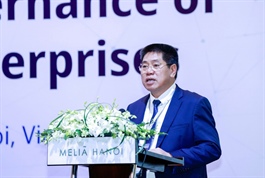
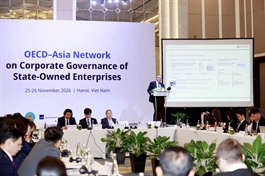
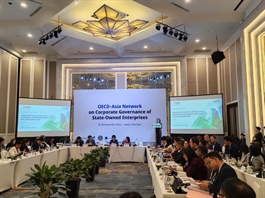
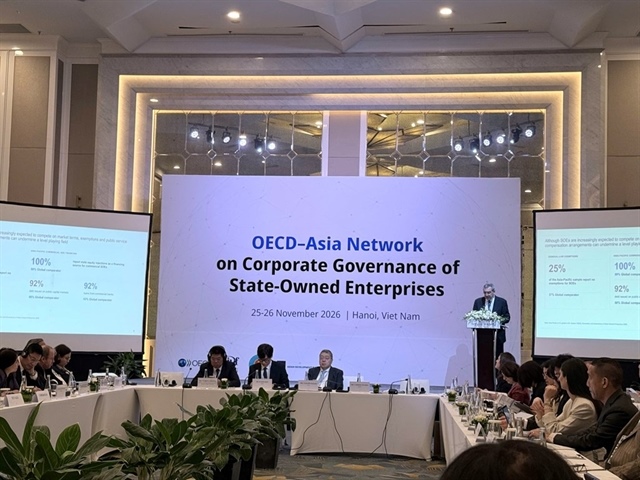
These priorities were highlighted at the OECD-Asia Network on Corporate Governance of State-Owned Enterprises, a two-day conference taking place in Hà Nội on November 25 and 26.
Vũ Hồng Phương, director general of the Ministry of Finance's Department of State-Owned Enterprise Development, said effective SOE governance is essential not only to improving individual corporate performance, but also to ensuring more efficient use of public resources, strengthening national competitiveness and supporting sustainable growth.
Amid global economic uncertainties and the growing demands of digital and green transitions and higher productivity, Việt Nam needs to further reform SOE governance, improve the framework for exercising State ownership rights, strengthen market discipline and accountability and balance commercial objectives with public policy responsibilities, Phương said.
“Việt Nam is continuing to accelerate the reform, restructuring and improvement of SOE performance, with the aim of building enterprises with modern governance, greater efficiency and the capacity to compete regionally and internationally,” he said.
The Government aims to have all State-owned economic groups and corporations apply OECD corporate governance principles by 2030.
Phương said Việt Nam will continue working with the OECD on policy advice, technical assistance and international experience-sharing to improve its legal framework, professionalise State ownership and strengthen SOE monitoring and performance evaluation.
OECD Deputy Secretary-General Yasushi Masaki said the OECD's 2026 report showed that many economies are professionalising State ownership functions and strengthening SOE oversight, although gaps remain in establishing consistent ownership policies and ensuring a level playing field between State-owned and private businesses.
Transparency in SOE operations and the use of public resources is particularly important for enterprises providing public services, he said, adding that disclosure enables governments to assess resource use and develop policies to ensure fair competition across economic sectors.
Changoh Moon, executive director of the Centre for SOE Research Centre at the Korea Institute of Public Finance, said SOEs need not only to fulfil public mandates, but also to maintain sustainable competitiveness and resilience amid rapid economic and technological changes.
Good governance is not a fixed destination, according to Moon. Instead, it's an ongoing process requiring enterprises and regulatory authorities to adapt continuously, he said, stressing the importance of regional cooperation in translating international standards into practical reforms.
The LNG pipeline system connecting the jetty to the Thị Vải LNG terminal, operated by PetroVietnam Gas Joint Stock Corporation (PV GAS), a key subsidiary of Vietnam National Industry-Energy Group (Petrovietnam). — VNA/VNS Photo Quốc Khánh |
Ownership and accountability
Việt Nam's SOE reform challenge is reflected in its fragmented ownership structure and the need to focus State resources on strategically important businesses.
Nguyễn Thu Thuỷ, deputy director general of the Ministry of Finance's Department of SOE Development, said Việt Nam has made progress in restructuring SOEs, but still faces significant governance challenges.
She said the country currently has around 691 enterprises in which the State holds more than 50 per cent of charter capital or voting rights.
State ownership responsibilities remain relatively fragmented, involving 11 ministries and 34 provincial and municipal authorities. Meanwhile, around 70 per cent of State capital and assets in SOEs are concentrated in 20 large enterprises under the Ministry of Finance's ownership oversight.
Thuỷ said Việt Nam needs to review its State-owned enterprise portfolio, determine more clearly which sectors require continued State ownership and consider reducing State holdings or withdrawing from areas where private businesses could operate effectively.
The aim is to concentrate public resources on strategically important enterprises, professionalise ownership functions and give businesses greater operational autonomy, she said.
The Government's ambition to achieve double-digit economic growth requires SOEs to improve efficiency, governance and competitiveness while continuing to fulfil public policy obligations.
Thuỷ identified four major priorities for reform: improving transparency to support higher growth and capital mobilisation, strengthening corporate governance as SOEs seek to go global, granting enterprises greater operational autonomy while enhancing accountability and narrowing the governance gap with international and regional standards.
Experts also pointed out that important institutional weaknesses continue to constrain SOE governance.
National Assembly Standing Committee member Nguyễn Mạnh Hùng said one major challenge is the lack of clear separation between the costs of public service obligations and commercial activities. This makes it difficult to assess enterprises' actual business performance and ensure appropriate compensation for State-assigned tasks.
Hùng also highlighted difficulties in equitisation, particularly those relating to land use, asset valuation and implementation procedures, as well as the need to strengthen the independence and professional capacity of corporate board members.
“The effectiveness of SOE restructuring should not be measured simply by the number of enterprises equitised or transferred into joint stock companies, but by whether they subsequently operated more efficiently,” he said.
According to Hùng, the National Assembly will continue reviewing legislation on State capital management, corporate governance, transparency and accountability, with further legal amendments planned for the next few years.
The LNG pipeline system connecting the jetty to the Thị Vải LNG terminal, operated by PetroVietnam Gas Joint Stock Corporation (PV GAS), a key subsidiary of Vietnam National Industry-Energy Group (Petrovietnam). — VNA/VNS Photo Quốc Khánh |
Hà Thu Thanh, chairwoman of the Vietnam Institute of Directors, said Vietnamese SOEs still face significant challenges in applying OECD governance principles.
She said improving the role, capacity and effectiveness of boards should be a priority in bringing SOE governance closer to international practices.
Nguyễn Văn Mậu from the Vietnam National Industry-Energy Group's Board of Members said SOE governance remains largely compliance driven, with gaps in board independence, the management of public service obligations and related-party transactions, minority shareholder protection, ESG integration and information disclosure, some of which are constrained by the existing legal framework.
The conference also saw the regional launch of the OECD's 2026 report on Ownership and Governance of State-Owned Enterprises, which examines practices across 58 economies.
By 2024, around 33,800 large SOEs operated globally, holding combined assets of US$141 trillion, equivalent to 126 per cent of global gross domestic product (GDP).
However, only 43 per cent of the 58 surveyed economies had a government-wide ownership policy setting out the objectives and rationale for state ownership.
Only 57 per cent applied the same legal rules to SOEs and private businesses, while just 48 per cent directly linked compensation for public service obligations to the costs incurred and required separate accounting.
The report also found that only 54 per cent of surveyed economies required SOE boards to include a minimum number of independent directors. Boards had full authority to determine corporate strategy in only 43 per cent of economies.
The OECD recommended that governments clarify their ownership objectives, separate ownership functions from policymaking and regulatory responsibilities, strengthen financial and non-financial disclosure, and improve board independence and effectiveness.
Hosted by Ministry of Finance and supported by the Korea Institute of Public Finance and the Asian Development Bank, the two-day forum is also discussing state ownership and sustainability, building effective SOE boards, transparency, performance and public policy objectives and managing risk across SOEs.
- 07:14 26/11/2026