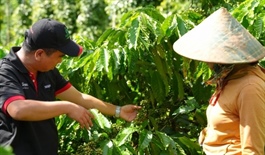


Healthy soils, sustainable livelihoods key to higher coffee value
Healthy soils, sustainable livelihoods key to higher coffee value
Soil degradation is not merely an environmental concern. It also directly affects yield stability, coffee quality, production costs and the resilience of supply chains.

Lê Thị Hoài Thương, External Affairs Director at Nestlé Vietnam, speaks at a panel discussion on 'Quality, Sustainability and Value Addition in the Coffee Industry' at VICO 2026. — Photo courtesy of Nestlé Vietnam |
Improving the value of Vietnamese coffee requires more than increasing output or investing in processing, experts have told a conference.
It starts with healthier soils, more resilient farming households and closer cooperation across the value chain, according to Nestlé Vietnam.
The company shared this view at the Vietnam International Coffee Conference (VICO) 2026, organised by the Vietnam Coffee and Cocoa Association (VICOFA) under the theme 'Current Trends in the Coffee Industry and Future Development Directions'.
The conference brought together representatives from regulatory agencies, international coffee organisations and businesses across the value chain to discuss major trends shaping the future of Việt Nam’s and the global coffee industries, including market volatility, new regulations, quality, value addition, climate change, green finance, technology and cooperation among producing countries.
Speaking at a panel discussion on 'Quality, Sustainability and Value Addition in the Coffee Industry', Lê Thị Hoài Thương, External Affairs Director at Nestlé Vietnam, said the long-term competitiveness of Vietnamese coffee must be built from the foundations of the value chain.
“To increase the value of Vietnamese coffee, we should look beyond output and final-stage processing," she said.
"Value must be created at the farm level by maintaining and improving soil health, preserving biodiversity, using resources more efficiently, ensuring more consistent quality and improving farmers’ livelihoods."
According to Nestlé Vietnam, soil degradation is not merely an environmental concern. It also directly affects yield stability, coffee quality, production costs and the resilience of supply chains.
Regenerative agriculture is therefore an important approach to restoring soil health, improving water efficiency and promoting biodiversity, the company said.
Through its NESCAFÉ Plan, Nestlé supports farmers in adopting regenerative agricultural practices that have helped reduce the use of chemical fertilisers and pesticides by around 20 per cent, while saving 40–60 per cent of irrigation water.
After more than 15 years of implementation in Việt Nam, the programme has worked with more than 23,000 farming households. Their incomes have increased by between 30 and 150 per cent, supported by lower input costs and diversified revenue from appropriate intercropping models, according to the company.
The programme has also contributed to the replanting of more than 100,000 hectares of ageing coffee plantations with new varieties offering higher yields, greater resistance to pests and diseases, and better adaptability to climate change.
From the perspective of an international coffee buyer with a long-term presence in Việt Nam, Nestlé Vietnam said companies should not limit their responsibilities to setting standards for suppliers. They should work alongside producers over the long term through training, technical support, farm management tools, traceability systems and initiatives to improve farming efficiency.
“Sustainability should not be seen simply as the cost of meeting increasingly demanding market requirements. The transition can only be sustained in the long run if it delivers tangible benefits to farmers, while costs, responsibilities and the value created are shared fairly across the supply chain,” Thương said.
She also stressed that transforming the coffee sector would require coordinated efforts by regulatory agencies, industry associations, research institutes, businesses, development organisations and farming communities.
Connecting scientific research with local knowledge, data and market commitments would help Việt Nam strengthen its position not only as a major coffee producer but also as a reliable supplier of high-quality, traceable and climate-resilient coffee that generates greater value across the supply chain, she added.
Nestlé Vietnam said it would continue working with farmers and partners to promote healthier farms, more sustainable livelihoods and a more resilient coffee supply chain, contributing to the sector’s long-term value creation and competitiveness.
- 19:59 17/11/2026