

Durian industry urged to go green to safeguard export markets
Durian industry urged to go green to safeguard export markets
Rapid expansion has exposed the industry to mounting challenges, including climate change, pests, fragmented production and risks involving pesticide residues, cadmium and the banned substance Auramine O.
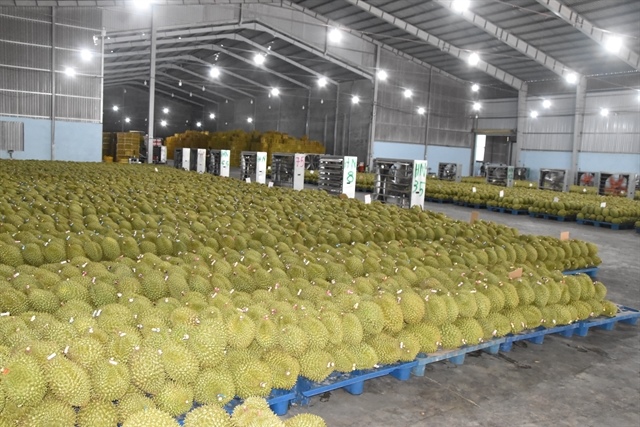
Durian at a storehouse in Đồng Tháp Province. — VNA/VNS Photo Công Trí |
The durian industry needs to accelerate its green transition, tighten quality controls and strengthen traceability to maintain export growth as importing markets impose increasingly stringent requirements on food safety and product quality.
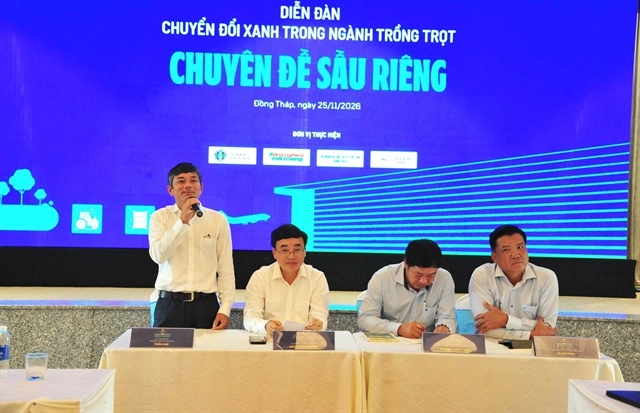
At a forum on the green transformation in durian crop production held on Wednesday in Đồng Tháp Province, experts said rapid expansion has exposed the industry to mounting challenges, including climate change, pests, fragmented production and risks involving pesticide residues, cadmium and the banned substance Auramine O.
The durian cultivation area in Việt Nam expanded from 33,400ha in 2016 to 200,000ha in 2026, with production forecast at around 2.08 million tonnes.
Exports totalled more than US$3.3 billion in the first 10 months, up 13 per cent year-on-year, with China accounting for more than 95 per cent of fresh durian export volume.
As of November 2, Việt Nam had 1,577 active durian growing area codes and 274 packing facility codes.
However, production remains fragmented, with some orchards outside planned growing areas. Premature harvesting, inadequate cold storage capacity and long-distance transportation also affect fruit quality, according Tô Văn Huấn, a representative of the Plant Production and Protection Department.
The agricultural sector is therefore shifting its focus from expanding cultivation areas to improving quality, reviewing growing areas against planning requirements and tightening the management of growing area and packing facility codes, he said.
Priority measures include greater use of organic fertilisers, integrated pest management, improved water storage, emissions reduction and investment in preservation, processing and transportation technologies.
Tightening traceability
|
Durian at a storehouse in Đồng Tháp Province. — VNA/VNS Photo Công Trí |
Nguyễn Quốc Mạnh, the department’s deputy director, said responsibility for issuing growing area codes has been assigned to commune-level People's Committees, which have three months to conduct post-approval inspections. This creates an opportunity to strengthen technical guidance and training for local officials and improve supervision of cultivation practices, he said.
The department has also advised on standards for durian mother plants, mother orchards and seedlings, while calling for research institutions to consolidate existing scientific findings to help develop standards for rootstock plants.
A representative of Phú Hộ Cooperative in Đồng Tháp said many farmers lacked knowledge about the causes of cadmium contamination, testing methods and control measures, calling for more practical technical guidance.
Lê Chí Thiện, deputy director of the Đồng Tháp Province Department of Agriculture and Environment, said the province is collecting samples to develop a cadmium risk map, classifying growing areas into three categories: uncontaminated, potentially at risk and high risk.
The province also plans to invest in sensor equipment to analyse soil, water and air quality, alongside rapid cadmium testing in fruit, leaves and soil to screen for contamination before harvesting.
Ngô Tường Vy, chairwoman of Chánh Thu Fruit Import-Export Group, said deep processing offers considerable potential, but Vietnamese companies are still largely supplying raw materials rather than capturing greater value from finished consumer products.
Around 90-95 per cent of frozen durian exported to China is currently supplied as raw material, she said.
Vy called for Government support through preferential interest rates and better access to capital to help businesses invest in technology and diversify products.
Nguyễn Minh Châu, former director of the Southern Horticultural Research Institute, highlighted the role of science and technology in improving durian quality.
He called for wider use of unmanned aerial vehicles to spray crop protection products, saying the technology could reduce pesticide use, save labour and improve production efficiency.
Correctly determining fruit maturity at harvest was also crucial to flesh quality and commercial value, he said, urging farmers to move away from prioritising output at the expense of quality.
The fruit generated a record $3.86 billion in export revenue in 2025, accounting for about 45 per cent of the country's total fruit and vegetable exports.
- 09:51 26/11/2026