Germany seeks stronger Asia-Pacific partnerships to diversify supply chains, drive growth
Germany seeks stronger Asia-Pacific partnerships to diversify supply chains, drive growth
Investors from the Asia-Pacific had also become essential players for Germany and Europe, while economic exchanges had generated innovation and strengthened supply-chain connections, said German Federal Chancellor Friedrich Merz.
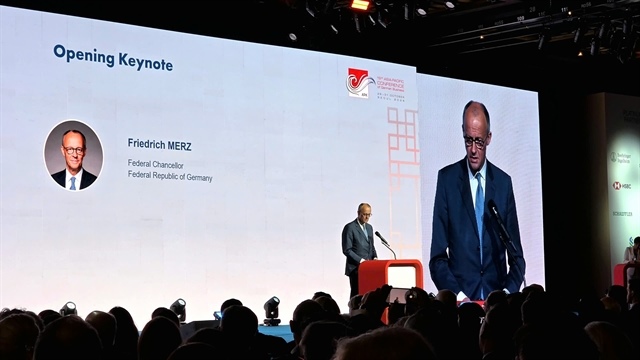
German Federal Chancellor Friedrich Merz delivers a speech at the APK 2026 in Seoul. — VNS Photo Ly Ly Cao |
Germany is seeking to deepen economic partnerships with countries across the Indo-Pacific region to diversify supply chains, secure access to critical resources and strengthen its competitiveness amid rising geopolitical and trade tensions, German Federal Chancellor Friedrich Merz said at the 19th Asia-Pacific Conference of German Business (APK) in Seoul on the morning of October 30.
Addressing the conference, he said German companies had established extensive cooperation with partners across the region through investment, production facilities, research centres and technology transfer, creating skilled jobs and developing close business relationships.
Investors from the Asia-Pacific had also become essential players for Germany and Europe, while economic exchanges had generated innovation and strengthened supply-chain connections, he said.
"Our businesses and economies are not only committed to further deepening our relations. They also want to secure supply chains and diversify our economic relations," Merz said.
However, he noted that economic imbalances, market-distorting practices and the targeted use of economic ties to exert political pressure were increasingly shaping international trade relations.
The war in Ukraine and escalating tensions in the Middle East were also placing pressure on global supply chains, energy supplies and corporate investment, while threats to maritime transport routes were creating additional risks for international commerce.
Merz highlighted the importance of maintaining open international shipping routes, particularly in the South China Sea, the Strait of Hormuz and the Bab-el-Mandeb Strait, describing them as the arteries of global trade.
He also pointed to intensifying competition between the US and China, including tariffs, technological decoupling strategies and the race to secure critical raw materials and emerging technologies.
Against this backdrop, Germany was pursuing a strategy of de-risking and diversification rather than economic decoupling or protectionism.
"Diversification is the name of the game. Our goal is to preserve economic strength, stability and freedom of action," he said, adding that Germany wanted to build a network of resilient and reliable partnerships.
Merz called for stronger cooperation among like-minded economies to defend an open, rules-based international trading system. He also proposed establishing a global political alliance for rules-based trade to strengthen and further develop the World Trade Organisation (WTO) framework.
He urged partners to better align their bilateral trade agreements so businesses could make fuller use of their benefits, while working towards a comprehensive interregional agreement that reflects increasingly interconnected supply and production chains. He also expressed support for an agreement between the European Union and ASEAN.
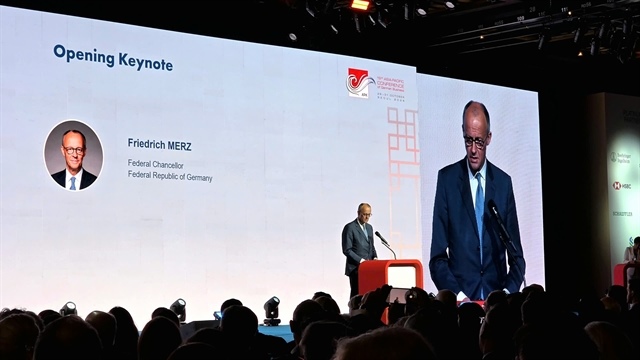
German Federal Chancellor Friedrich Merz delivers a speech at the APK 2026 in Seoul. — VNS Photo Ly Ly Cao |
In her opening remark, Prime Minister of the Republic of Korea Seongsook Han highlighted the longstanding partnership between the two countries.
"Korea and Germany are trusted partners that build on each other's strengths to enhance their competitiveness together," the PM said.
"I hope APK 2026 will go beyond serving as a forum for discussion and become a platform for action, one that builds new supply chains, drives technology and investment, and enables companies from Korea and Germany, as well as across Asia-Pacific and Europe, to achieve tangible results."
Việt Nam as a potential cooperation partner
Germany also sees opportunities to expand economic cooperation with Việt Nam, particularly in securing critical minerals and strengthening supply chains, Stefan Rouenhoff, State Secretary at the German Federal Ministry for Economic Affairs and Energy, told Việt Nam News at the press conference.
Rouenhoff said he had visited Việt Nam a few months earlier and held discussions on potential areas for closer cooperation.
"In Việt Nam, there are plenty of opportunities. You have a quite high growth rate in your country," he said.
He said discussions during his visit had included ways to secure critical minerals and supply chains, as well as the potential for German companies to increase their presence in Việt Nam.
"So we have to elaborate on what is possible, how we can bring companies to Việt Nam, how we can collaborate in certain fields, and also politically," Rouenhoff added.
Technology cooperation on the agenda
Roland Busch, chairman of the Asia-Pacific Committee of German Business (APA) and chief executive officer of Siemens AG, also highlighted the role of cooperation in developing future-orientated technologies and supporting economic growth.
"The Asia-Pacific Conference is a vital forum for exchange and for deepening cooperation between our regions," he said.
"We have much to learn from one another and can collectively unlock enormous potential for our economies."
Busch identified industrial artificial intelligence as one area in which Germany and Asia-Pacific economies could combine their strengths.
"Particularly in future-orientated technologies, such as industrial AI, we combine everything necessary for success: technological leadership, manufacturing excellence, industrial expertise, and robust ecosystems," he said.
He added that the two regions were working closely together and maintaining continuous dialogue to translate these strengths into growth, competitiveness and prosperity.
The three-day APK 2026 is taking place in Seoul from October 29 to 31, bringing together more than 800 political and business decision-makers, primarily from Germany and the Asia-Pacific region, alongside German Federal Chancellor Friedrich Merz, South Korean Prime Minister Seongsook Han and ministers from various Asian countries.
The conference is organised jointly by the Asia-Pacific Committee of German Business (APA), Germany's Federal Ministry for Economic Affairs and Energy and German Chambers of Commerce Abroad in the Asia-Pacific region.
- 14:50 30/10/2026