Việt Nam seeks shift in focus from localisation to industrial capabilities
Việt Nam seeks shift in focus from localisation to industrial capabilities
A strong industrial base should be measured not only by production and exports of finished products, but also by the ability to master materials, components, equipment, technology, design, standards and technical services that generate higher added value.
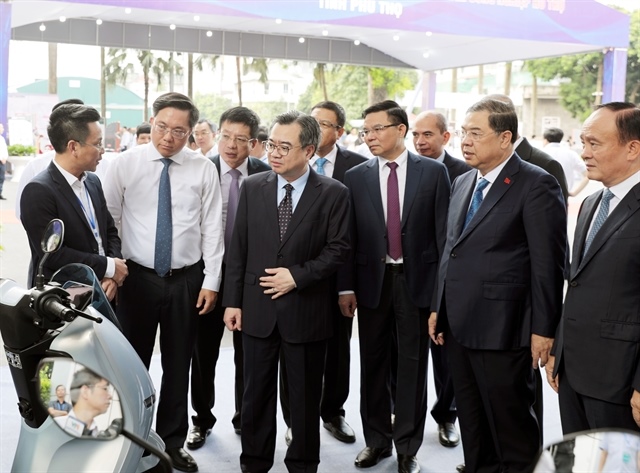
Delegates visit an exhibition showcasing Phú Thọ Province’s key supporting industries on the sidelines of the conference. — VNA/VNS Photo Tạ Toàn |
Việt Nam needs to overhaul its approach to develop supporting industries by shifting from simply increasing the local procurement rate to building domestic capabilities in technology, materials, components, design and high-value manufacturing, senior officials said at a conference in Phú Thọ Province on September 30.
Jointly organised by the Party Central Commitee's Policy and Strategy Commission, the Phú Thọ Party Committee and the Ministry of Industry and Trade, the conference discussed bottlenecks and proposed measures to make supporting industries a key foundation for a modern, self-reliant and competitive national industrial base.
Head of the Party Central Committee's Policy and Strategy Commission Nguyễn Thanh Nghị said supporting industries should no longer be viewed as a secondary part of manufacturing, but as a foundation of national industrial capacity.
A strong industrial base should be measured not only by production and exports of finished products, but also by the ability to master materials, components, equipment, technology, design, standards and technical services that generate higher added value, Nghị said.
The commission leader called for a new approach that puts companies, markets and supply chain demand at the centre of supporting industry development.
“Việt Nam must identify which technologies and capabilities need to be mastered domestically, where Vietnamese companies stand in global value chains and which higher-value stages they can move into,” he said.
Nghị said development policy should start from markets, orders and the requirements of value chains, rather than from the supply side.
The focus should be on strengthening existing supply chains and preparing domestic capabilities for emerging industries, such as semiconductors, artificial intelligence (AI), robotics, new materials, batteries, unmanned aerial vehicles, aerospace and smart manufacturing, he added.
Rethinking the policy approach
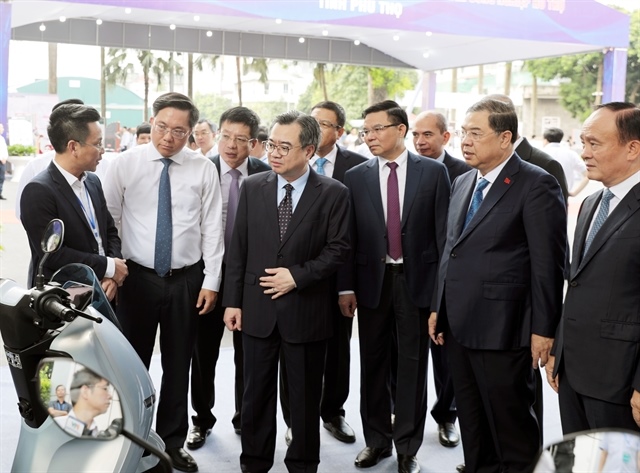
Delegates visit an exhibition showcasing Phú Thọ Province’s key supporting industries on the sidelines of the conference. — VNA/VNS Photo Tạ Toàn |
Permanent Deputy Prime Minister Phạm Gia Túc called for five fundamental shifts in policy: from localisation to mastery of capabilities, from broad-based support to targeted support along supply chains, from input incentives to results-based support, from attracting foreign investment to making more effective use of it, and from process-based management to outcome-based management.
Việt Nam currently has more than 7,000 supporting-industry companies, with about 30 per cent participating in global supply chains, according to figures presented at the conference.
But Vietnamese firms' participation in global value chains remains limited at around 18 per cent, mainly among larger enterprises, while domestic supply to high-tech industries is estimated at only 5-10 per cent.
The figures underline the need to rethink Việt Nam's approach to supporting industries rather than simply introducing more institutional reforms or policies, Túc said.
He pointed out problems including a lack of stable orders, inadequate incentives for small and medium-sized enterprises, weak standards, measurement and testing infrastructure, shortages of skilled technical workers and limited coordination among businesses, research institutions and Government agencies.
The deputy PM said the supporting industries need to complete the remaining tasks of traditional industrialisation, while ensuring that emerging sectors such as semiconductors, AI, robotics, batteries, new energy and aerospace do not have to rely heavily on imported components and materials.
By 2045, the goal is for Việt Nam's supporting industries to master core technologies in foundational industries and participate in higher-value stages of regional and global supply chains.
Túc called for greater efforts to improve the legal framework, especially the Law on Key Industries, while developing the materials industry, financial and credit tools, and strengthening personnel for supporting industries.
Major projects should serve as a source of initial orders for Vietnamese companies, he said.
The deputy PM asked the Ministry of Industry and Trade to issue an action plan for the 2026-2028 supporting industry development programme by the end of October, while urging major State agencies and State-owned groups to increase domestic procurement.
He urged Vietnamese companies to strengthen their own capabilities to meet leading firms' technical and quality requirements, particularly as products and designs change rapidly.
Phan Đăng Tuất, chairman of the Vietnam Association for Supporting Industries, called for the early enactment of a dedicated law on supporting industries, adding that the sector needs a stronger legal framework to address persistent problems with capital, technology, supply chain links and industrial materials.
He also stressed the need for a national strategy on industrial materials, along with measures to support the technological and green transition among supporting-industry companies.
Establishing a national supporting industry development fund and creating a nationwide master plan identifying priority products, regions and industrial clusters will also be necessary, Tuất said.
Tuất called for stronger links between major domestic companies and small and medium-sized suppliers, adding that major companies such as VinFast, Thaco, Viettel and Hòa Phát, which occupy leading positions in domestic supply chains, could create markets for supporting-industry suppliers.
- 08:39 01/10/2026