




SCG and Prime Group add value to the ecosystem
SCG and Prime Group add value to the ecosystem
As global buyers look beyond product quality to carbon, traceability, and governance, foreign investors are being asked to contribute more than capital. SCG, through its member company Prime Group, is testing a model in which raising standards goes hand in hand with helping Vietnamese partners, especially SMEs, meet them.
Building materials is an industry of many hands, from raw materials and energy to logistics, contractors, and developers.
“Product quality and competitiveness are closely linked to the capabilities of the broader ecosystem surrounding the business," said Nguyen Thi Thanh Tam, head of Sustainable Development at Prime Group, a member of SCG, at the “Reaching out to innovative global supply chains” discussion on October 8.
Nguyen Thi Thanh Tam has over 23 years of experience working in the field of safety, environment, and quality promotion at Prime Group. Photo: SCG |
That ecosystem is now judged on new criteria. International customers increasingly look beyond product quality to carbon emissions, raw material traceability, energy efficiency, and suppliers’ ESG standards, and Vietnam’s commitment to net-zero by 2050 will only reinforce them. Prime Group, whose products are sold in 24 countries, has seen each new market add environmental, energy, safety, and governance requirements.
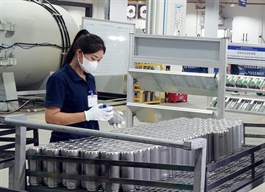
For SCG, which has operated in Vietnam since 1992 with 28 companies and about 15,000 employees, meeting these demands starts inside its own plants. Prime Group advances its agenda under the group’s Inclusive Green Growth strategy and the ESG 4 Plus framework. Its 14 subsidiaries and more than 3,600 employees work under ISO 9001, 14001, 45001, and 50001 systems, and its products meet standards in the EU, Thailand, and Malaysia and carry green labels including the Singapore Green Label and SCG Green Choice.
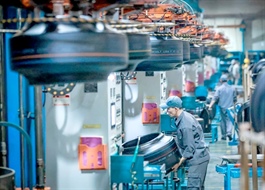
Targets are tied directly to production: by 2030, Prime Group aims to cut emission intensity by more than 30 per cent from 2020, draw 30 per cent of its energy from clean sources, lift waste recycling to around 8.9 per cent, and recycle and reuse all production wastewater. Waste heat recovery, reuse of broken tiles and coal ash as raw material, the Internet of Things monitoring, biomass, solar power, and electric vehicles are among the measures. Prime Group treats them as a way to cut resource use, sharpen quality control, and respond faster to the market, not simply to satisfy auditors.
|
Tam shares how the group’s own operational improvements underpin its approach to supply chain partners. Photo: SCG |
From buyer – seller to joint improvement
Prime Group’s experience feeds directly into Go Together, SCG’s approach to working with businesses across the value chain. “For SCG, Go Together means raising standards while helping partners build the capabilities needed to meet them,” Tam said.
The reasoning is practical: improvements by a lead company reach deep into its supplier base, from the consistency of raw materials to the reliability of logistics and data. Go Together therefore works on three fronts: sharing standards, so suppliers understand quality, safety, environmental, and market requirements; sharing the implementation experience SCG and Prime Group have gained in energy, materials, waste, and data; and improving together on issues that directly affect a supplier’s quality, cost, and responsiveness.
The benefits run both ways. “Raising standards can create clear business value for both sides, from higher productivity and operational efficiency to greater resilience and long-term competitiveness," she said.
For SMEs, the starting point does not have to be ambitious. Prime Group itself has faced investment costs, technology, and talent gaps, as well as competitive pressure, which is why it urges partners to begin with concrete problems: stabilising raw material quality, cutting energy and fuel use, reducing production losses, standardising safety and environmental practices, and building data for traceability. The lead company’s role is to guide rather than dictate. “It is to help partners identify which requirements matter most, where the current gaps are, and which areas should be prioritised first,” Tam said.
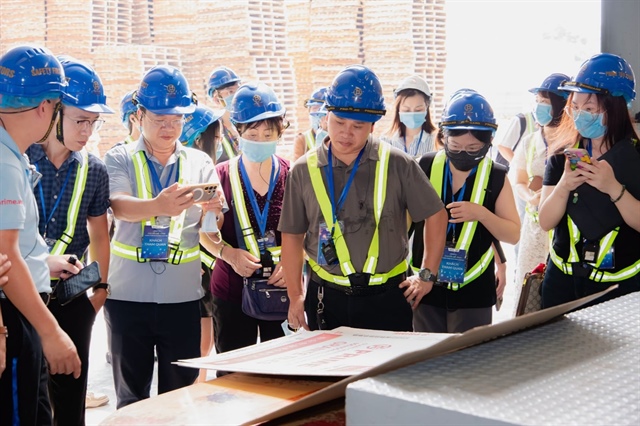
That step-by-step logic was also on show at SCG’s ESG Company Tour 2026 on August 12, where SME representatives visited Prime Group’s Tien Phong plant. Prime Group’s energy management specialists advised smaller firms to measure a baseline of energy use, emissions, materials, and waste, shortlist five to ten feasible improvements, and start with two or three quick wins whose results build confidence for larger investments.
Over time, SCG sees the relationship between foreign direct investment companies and Vietnamese businesses moving from supplier assessment to supplier capability development, from buyer–seller transactions to joint improvement, and from the competitiveness of an individual company to the competitiveness of the entire supply chain.
A long-term commitment
SCG regards Vietnam as a strategic, long-term market, and one whose ecosystem it wants to grow with local companies. As global supply chains restructure, the group sees an opportunity to strengthen ties between foreign-invested enterprises and Vietnamese suppliers and SMEs, and so lift the capability of the domestic supply chain as a whole.
“We see our long-term role as growing together with the local business ecosystem and enabling more Vietnamese enterprises to participate more deeply in higher value, higher standard supply chains,” Tam said.
SCG says it will keep investing in solutions, technologies, and products that support green transformation, and keep sharing its experience with the surrounding businesses. For a market seeking quality over quantity in foreign investment, that is a commitment worth watching.
- 15:55 15/10/2026