




Smart factories need skills, finance and trust to scale
Smart factories need skills, finance and trust to scale
Robots are getting cheaper, but Vietnamese manufacturers will need skilled workers, secure systems, and flexible financing, to turn automation into growth, according to German and Vietnam-based industry leaders.
Robots are getting cheaper, but Vietnamese manufacturers will need skilled workers, secure systems, and flexible financing, to turn automation into growth, according to German and Vietnam-based industry leaders.
The message came from a panel on smart manufacturing and green growth at the German Business and Investment Forum 2026 in Ho Chi Minh City on October 13. It followed opening remarks that put the economic stakes in numbers: bilateral trade exceeded $13.6 billion in 2025, and Germany has 538 valid projects in Vietnam with registered capital of more than $3 billion.
Phu Huynh, CEO of Kuka Vietnam, said falling prices are changing how manufacturers weigh automation. The company has spent more than 15 years persuading factories that robots are not only for top-tier players, he said, and the sums now add up for smaller firms.
“The initial capital expenditure for a robotics system has gone down significantly compared with five years ago,” Huynh said. “These days, the typical return on investment for a common manufacturing small- and medium-sized enterprise is around two to three years.”
Demand reflects that shift. Huynh said robot imports into Vietnam were growing by more than 20 per cent this year.
Cost is not the only barrier, however. Access to funding remains the main obstacle for small- and medium-sized enterprises, which often struggle to secure bank loans for automation. Kuka is pushing a subscription-style model to lower the entry threshold.
“We call it Robot-as-a-Service,” Huynh said. “We offer customers pay-per-outcome or pay-per-output. Instead of putting in the initial capex, the customer just pays as an operating expense.”
Huynh also pointed to Vietnam’s own technology ambitions, noting that homegrown drone makers are targeting agriculture at home and exporting widely.
While machines can be financed, skilled people take longer to build. Christoph Janensch, business lead for economic development at AWE and the German Chamber of Commerce in Vietnam, said German development cooperation is best placed to help with this.
“The German Agency for International Cooperation (GIZ) is not really providing capital. There are some agreements, but they are rather small in scale,” Janensch said, adding that larger funding is more likely to come from Germany’s state development bank. “What GIZ can do for companies is upskill the workforce. Workforce upgrading is a core competency.”
He cited a three-year metal-cutting training course for graduates, combining classroom study, external assessment, and in-company training. A separate three-year curriculum project with Schneider Electric and vocational schools involves more than 300 trainers and teachers, who pass on knowledge to other graduates.
For large manufacturers, the debate is as much about resilience as about productivity. Tuan Vi, vice president of supply chain management and logistics for Asia-Pacific at Schaeffler Vietnam, said access to AI and automation is levelling the field and reshaping the workforce by moving beyond blue-collar tasks to white-collar work.
“Competition is intensifying, with newcomers in Vietnam and elsewhere in the region taking business from established players. We all have to be highly involved when we assess the challenges right now,” Tuan Vi said.
Marcus Pratsch, global head of sustainable bonds and finance and managing director at DZ Bank, focused on the risks that come with digital factories. He said German companies must account for export controls and security, and cannot rely on a single supplier or solution. Interconnected systems and AI also expose factories to outside threats, he noted.
“We cannot just implement single-source solutions. Technology is available everywhere. You set something up, connect it to a network, and AI already affects certain systems and the data they generate,” Pratsch said.
Even so, he said, workers’ fears should ease once the benefits become visible.
In his keynote, Pratsch also highlighted the World Bank’s estimate of $368 billion in additional investment needed for Vietnam over 2022-2040, with around two-thirds for resilience and adaptation. To attract capital, he called for clear policies, predictable project revenues, reliable data, and risks allocated to those best able to manage them.
“Standardising contracts and pooling smaller rooftop solar and energy efficiency projects could help entice institutional investors, while refinancing could release capital for further ventures,” he said.
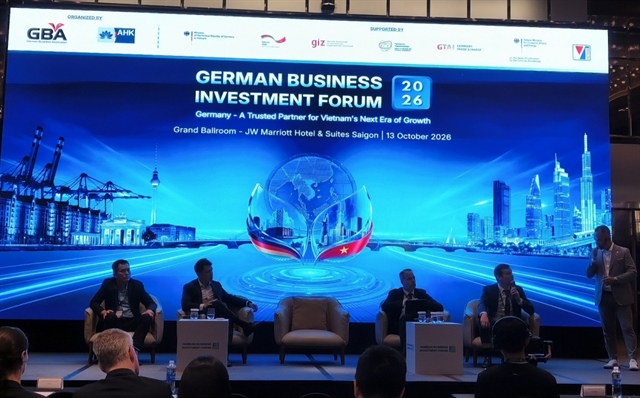
German and Vietnamese representatives at the panel on smart manufacturing and green growth at the German Business and Investment Forum 2026 in Ho Chi Minh City on October 13. Photo: Bich Ngoc |
- 17:33 14/10/2026