




Project helps 100 shrimp and rice firms improve workplace standards
Project helps 100 shrimp and rice firms improve workplace standards
After four years in Ca Mau, An Giang, Can Tho, and Ho Chi Minh City, a social welfare project has helped more than 100 shrimp and rice businesses improve working conditions, occupational safety and health, and responsible business practices.
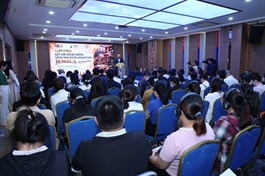
On October 15, in Can Tho City, Oxfam in Vietnam, in collaboration with the Vietnam Chamber of Commerce and Industry (VCCI) in Ho Chi Minh City, held a workshop to review the project on improving international market access for shrimp and rice businesses through enhanced workplace skills and occupational safety and health.
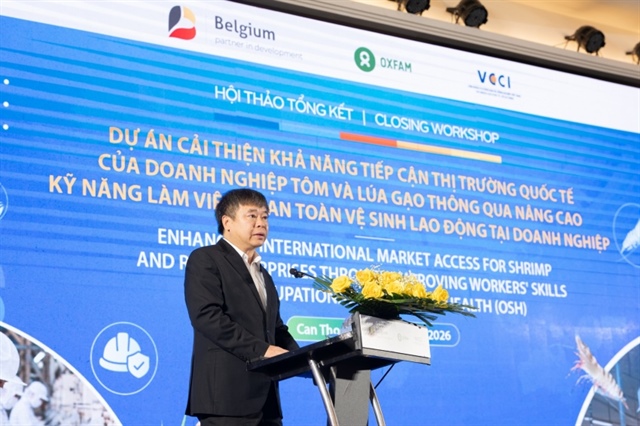
More than 100 shrimp and rice businesses improve working conditions and ESG practices. Photo: Thanh Tra |
Implemented from 2022 to 2026, the project benefited more than 23,000 workers, over 55 per cent of whom were women. Nearly 4,000 workers directly participated in training courses covering workplace skills, occupational safety and health, and related topics.
The project established 10 pioneering business models and supported four businesses in piloting sustainable management practices under the environmental, social, and governance (ESG) framework. All four completed independent ESG assessments with positive results.
In addition, more than 30 shrimp and rice cooperatives were connected with commercial partners, helping improve market access and supporting more stable livelihoods for producers. Through training and consultancy, cooperatives and farmers also strengthened their capacity to adopt safe production practices, develop brands, and improve product packaging and labelling.
|
Tran Ngoc Liem, deputy secretary-general of the VCCI and director of VCCI’s Ho Chi Minh City branch. Photo: Oxfam in Vietnam |
Tran Ngoc Liem, deputy secretary-general of the VCCI and director of VCCI’s Ho Chi Minh City Branch, explained that shrimp and rice are two vital agricultural sectors, making significant contributions to food security, exports, and socioeconomic development, particularly in the Mekong Delta.
However, most processing businesses in the two sectors are small or medium-sized, with limited investment resources and management capacity. Some struggle to fully comply with labour and occupational safety and health regulations, including requirements relating specifically to women workers.
Working conditions also present occupational risks. Shrimp processing workers often operate in cold, humid environments and stand for extended periods along production lines. Meanwhile, workers at rice processing facilities may be exposed to dust and noise for extended periods. Production pressures, overtime, and insufficient rest can also affect workers' health and the sustainability of their employment.
"Major markets, such as EU, the United States, and Japan, are no longer focused solely on quality and price; they now impose rigorous standards regarding social responsibility, occupational health and safety, environmental protection, and transparent governance, in line with ESG criteria," he said.
"Domestically, consumers are also placing greater emphasis on food safety, quality, and product origin. Furthermore, labour shortages are exerting additional pressure on both sectors."
According to the 2025 Census on Agriculture and Rural Areas, the workforce in the agriculture, forestry, and fisheries sector declined by 2.84 million people, a reduction of almost 15 per cent, between 2016 and 2025. Consequently, recruiting and retaining workers has become a major challenge for many businesses and cooperatives operating within the shrimp and rice value chains.
Vu Thi Quynh Hoa, national director of Oxfam in Vietnam. Photo: Oxfam in Vietnam |
According to the project’s implementing partners, one of its key achievements has been helping businesses recognise that working conditions, occupational safety and health, and social protection are not merely compliance requirements. They can also directly influence business performance and the ability to participate in international supply chains.
Vu Thi Quynh Hoa, national director of Oxfam in Vietnam, said business competitiveness was determined by more than productivity, costs, and product quality. As sustainability, traceability, social responsibility, and ESG requirements increasingly become part of global trade, workplace quality and investment in workers are also competitive advantages.
“Competitiveness and responsibility towards workers are not separate objectives,” Hoa said, noting that the two reinforced each other. "Businesses that prioritise workers are better positioned to meet increasingly stringent market and global supply chain requirements."
The project’s implementation has demonstrated that improving occupational safety and health can help businesses reduce risks, maintain a stable workforce, and enhance product quality. Policies that respond to workers’ needs, particularly those of women, can also help businesses build more equitable and sustainable working environments.
Under the project, workers at shrimp and rice processing facilities received training to strengthen their knowledge and skills in occupational safety and health, including the safe operation of equipment and first aid. State officials responsible for occupational safety were also provided with additional training through activities coordinated with relevant authorities.
Initiatives specifically targeting women workers were expanded to strengthen their participation and voice within businesses, cooperatives, and trade unions. One example was the weekend programme Chuyện nhà, chuyện xưởng (Stories from Home and the Workplace), which provided women workers with a space to share knowledge and skills related to healthcare, as well as managing workplace pressure and stress.
In parallel, the project promoted responsible business practices through multi-stakeholder initiatives, connections among businesses across the shrimp and rice value chains, and support for improving internal policies and procedures.
At the four businesses piloting ESG practices, consultancy helped progressively strengthen management systems and environmental and social policies, while establishing short-, medium-, and long-term sustainability goals. The businesses also received support to improve their capacity to meet standards relating to food safety, occupational safety, and social responsibility, including ISO 22000, ISO 45001, and Sedex-SMETA.
"The pioneering models demonstrated that the gap between compliance requirements and actual business practices could be narrowed when businesses made a commitment, invested resources, and received appropriate support. Sharing lessons from these models could help spread good practices throughout the value chain," Hoa said.
|
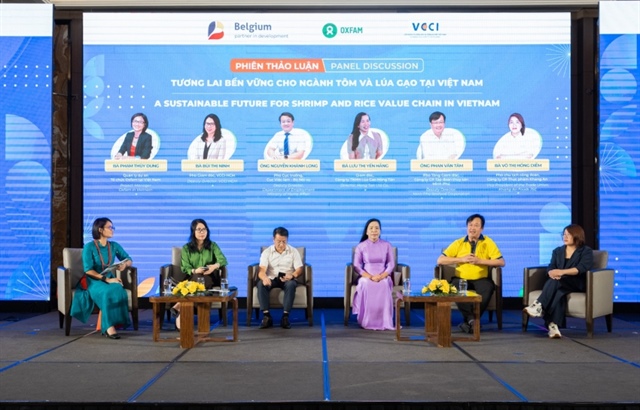
Photo: Oxfam in Vietnam |
Beyond direct support for businesses, the project focused on strengthening connections between processors, cooperatives, and farmers to improve market access and sales opportunities.
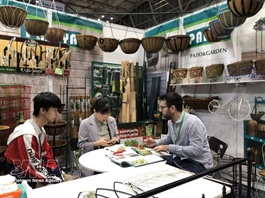
Cooperatives and farmers received consultancy on safe food production practices, brand development, and product packaging and labelling. Study visits and networking activities at the Vietshrimp exhibition also created opportunities for participants to access market information and expand commercial relationships.
At the policy level, VCCI worked with the Department of Home Affairs of Can Tho City to organise an interprovincial workshop on occupational safety and health in the shrimp and rice value chains. Held in response to the Action Month for Occupational Safety and Health and Workers’ Month, the event brought together experts from the Ministry of Home Affairs.
Dialogue on rice value chain linkages, organised by VCCI in coordination with the An Giang Farmers’ Union and the Institute of Agricultural and Environmental Policy and Strategy, also helped strengthen exchanges among stakeholders, with a view to improving production conditions and developing value chains.
These achievements provide a foundation for continued support to shrimp and rice businesses as they strengthen management capacity, improve sustainability policies, and meet export market standards. However, scaling up these models will require businesses to invest proactively, alongside closer cooperation among regulatory authorities, industry associations, support organisations, and supply chain partners.
- 17:20 16/10/2026