




Listed firms face mixed outlook as commodity prices fluctuate
Listed firms face mixed outlook as commodity prices fluctuate
The impact of commodity prices depends on whether companies are buyers or sellers, the spread between selling prices and input costs, the timing of cost recognition and their ability to pass higher costs onto customers.
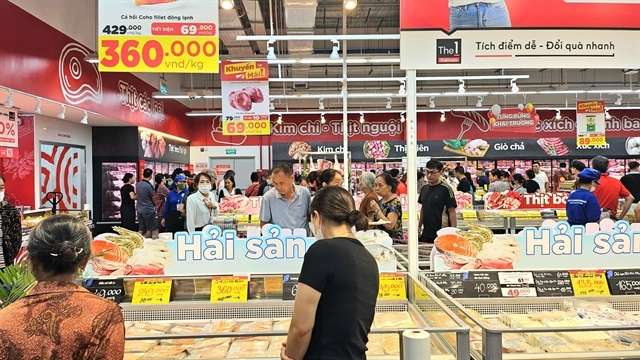
Customers shopping at a supermarket in Lào Cai Province. — VNS Photo Ly Ly Cao |
Rising oil, copper and rubber prices are creating divergent earnings prospects for listed Vietnamese companies, with refiners, fertiliser producers, airlines and steelmakers experiencing different effects from changing input costs, according to a latest report by TCBS Research.
The report said commodity prices this year had been driven primarily by supply shocks and geopolitical developments rather than demand cycles.
By September, Brent oil had increased 86.3 per cent from the end of 2025, while Australian coal rose by 36.6 per cent, rubber 33.5 per cent, diammonium phosphate 27.6 per cent and copper 22.8 per cent.
In contrast, iron ore fell by 6.6 per cent, while robusta coffee declined by 12.1 per cent.
According to TCBS Research, the impact of commodity prices depends on whether companies are buyers or sellers, the spread between selling prices and input costs, the timing of cost recognition and their ability to pass higher costs onto customers.
PetroVietnam Refining and Petrochemical Corporation (BSR) and airlines illustrate how oil price movements can have opposite effects.
BSR benefits when the spread between refined product prices and crude oil costs widens. Its gross profit margin reached 15 per cent in the second quarter of 2026, up 12.2 percentage points year on year.
First-half profit after tax attributable to the parent company's shareholders totalled VNĐ15.931 trillion, around 12.8 times the figure a year earlier.
By contrast, higher fuel costs squeezed airline margins. Vietnam Airlines (HVN) saw its gross margin fall from 17.6 per cent to 4.2 per cent in the second quarter, while Vietjet Air (VJC) recorded a decline from 13.5 per cent to 5.6 per cent.
Vietnam Airlines estimated that each US$1-per-barrel increase in fuel prices could raise its costs by around VNĐ300 billion.
Petrolimex (PLX) also faced pressure because retail prices are adjusted periodically and may lag behind inventory costs. Its second-quarter gross margin fell to 5.6 per cent, from 6.7 per cent a year earlier.
Fertiliser producers benefited from higher urea prices in the first half.
Ca Mau Fertiliser (DCM) recorded a second-quarter gross margin of 31.3 per cent, up 10.8 percentage points year on year, while PetroVietnam Fertiliser and Chemicals (DPM) reached 23.8 per cent, up 6.9 percentage points.
First-half profit after tax attributable to the parent company's shareholders rose by 55 per cent at DCM and 115 per cent at DPM.
However, TCBS Research said the second quarter was likely to have marked the sector's peak in margins.
Average urea prices fell by 42.4 per cent quarter on quarter to $399 per tonne in the third quarter. September prices rose by 4.5 per cent from August to $407.5 per tonne, but remained at less than half the April peak.
Rubber producers continued to benefit from elevated prices.
Average RSS3 prices reached $2.75 per kg in the third quarter, up 2.5 per cent from the previous quarter.
Phuoc Hoa Rubber (PHR) and Dong Phu Rubber (DPR) recorded second-quarter gross margins of 34.2 per cent and 39.9 per cent, respectively, both around seven percentage points higher year on year.
Vietnam Rubber Group (GVR) posted a margin of 30.6 per cent, broadly unchanged, partly reflecting its diversified revenue from industrial parks and wood processing.
TCBS Research noted that the second half is the main rubber harvesting season, although earnings also depend on plantation liquidation and compensation for land converted to industrial parks.
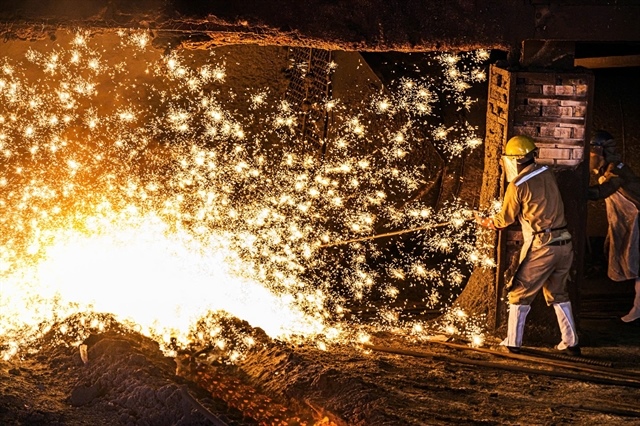
Customers shopping at a supermarket in Lào Cai Province. — VNS Photo Ly Ly Cao |
Meanwhile, steelmakers benefited from lower iron ore costs. Average iron ore prices fell by 7.4 per cent quarter on quarter to $97.4 per tonne in the third quarter.
Hoa Phat Group (HPG) achieved a second-quarter gross margin of 19 per cent, its highest in eight quarters, while Hoa Sen Group (HSG) and Nam Kim Steel (NKG) recorded margins of 15.3 per cent and 10.5 per cent, respectively.
TCBS Research said steelmakers' results would continue to depend on the spread between steel selling prices and the costs of iron ore and coking coal, alongside inventory movements.
For GELEX Electric (GEE), raw materials account for 93 per cent of production costs, yet its gross margin has remained at around 15 per cent, indicating that much of the fluctuation in copper prices is passed through to selling prices.
The main risks are delays in price adjustments and working capital requirements.
The report cautioned that rising commodity prices do not necessarily translate into corresponding share price gains.
During the 2021–2022 commodity cycle, 13 of the 14 commodity-related stocks in its sample peaked between October 2021 and June 2022, then fell by 37–75 per cent over the following four to 18 months.
"Investors therefore need to monitor not only commodity price movements, but also how these prices translate into profit margins and business results at individual companies," the report said.
- 08:26 12/10/2026