JBIC considers new financing options for Vietnam’s energy projects
JBIC considers new financing options for Vietnam’s energy projects
Vietnam’s substantial capital requirements for achieving high economic growth are driving efforts to diversify domestic and international funding channels. The Japan Bank for International Cooperation has expressed its readiness to support Vietnam in energy and infrastructure projects, as well as efforts to raise capital in international markets.
On October 2, Minister of Finance Ngo Van Tuan received Maeda Tadashi, chairman of JBIC, at the Ministry of Finance’s (MoF) headquarters in Hanoi.
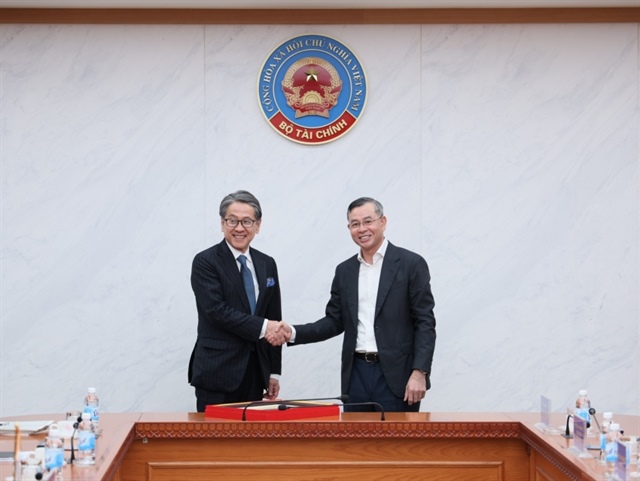
Photo: Manh Tuan |
At the meeting, Minister Tuan acknowledged the contributions of the Japan Bank for International Cooperation (JBIC) to Vietnam’s economic development, including financing for 16 projects through loans totalling more than $3 billion, particularly in energy, infrastructure, and construction materials. He also recognised the bank’s role in providing policy advice.
For his part, Tadashi praised Vietnam’s strong economic performance, noting that the country was among the fastest-growing economies in the region. He also highlighted Politburo resolutions supporting Vietnam’s future growth, including Resolution No.68-NQ/TW on private-sector development and Resolution No.10-NQ/TW on the development of the foreign-invested economy.
Maeda said that mobilising and harnessing private-sector resources would be essential for Vietnam to sustain high growth over the next 10–20 years and beyond.
“JBIC stands ready to cooperate with and support Vietnam in line with the Vietnamese government’s development policy orientations. We will also ensure that such cooperation is innovative and sustainable,” he said.
He also noted that the rapid development of AI was driving significant changes, including rising electricity demand from data centres. Meanwhile, disruptions to fuel supply chains underscored the need to strengthen the resilience of energy systems, an issue he said Vietnam also needed to address.
Regarding support for Vietnam’s energy projects, Maeda said JBIC was considering financing arrangements that would not require government guarantees for gas-fired power and liquefied natural gas (LNG) power projects in Vietnam.
However, these projects would require funding in US dollars while generating electricity sales revenue in VND, exposing investors to foreign exchange risks. He called on the Vietnamese side to consider appropriate solutions to address this issue.
Minister Tuan welcomed the proactive efforts of the Japanese government and JBIC to advance the Powering and Optimising Worldwide Energy Resources through Resilient and Renewable Energy (POWERR ASIA) initiative and the Asia Zero Emission Community (AZEC), which aim to promote decarbonisation and strengthen the resilience of energy and mineral supply chains.
Minister Tuan called on Maeda and JBIC to continue identifying projects that could receive support, including liquefied natural gas power projects. "The MoF would study appropriate mechanisms to address foreign exchange risks," he said.
Vietnam also plans to establish a strategic energy and oil and gas reserve centre in Quang Ngai province and is developing the relevant mechanisms. The minister expressed the hope that JBIC would actively participate in mobilising capital and establishing an appropriate cooperation framework for the centre.
Minister Tuan said, "Meeting the capital requirements for double-digit economic growth would require total social investment equivalent to at least 40 per cent of GDP annually, alongside improvements in capital efficiency. Vietnam aims to reduce its incremental capital-output ratio from 6.4 to 4.5–4.8."
“The target is to double the scale of capital mobilisation and double the efficiency of capital utilisation compared with the previous period. International financing through international financial institutions and foreign investors therefore plays a particularly important role. JBIC’s support through AZEC and POWERR ASIA is highly significant for Vietnam,” the minister added.
According to the MoF’s estimates, every 1 per cent increase in Vietnam’s GDP requires electricity output to grow by a factor of 1.2-1.5. This translates into substantial capital requirements for power generation and transmission networks.
To meet its development needs, Vietnam is seeking a broad range of funding sources, including international capital markets through the issuance of government bonds overseas.
The MoF has been working closely with international credit rating agencies and recently conducted roadshows in the United Kingdom, Europe, and the United States. During Party General Secretary and State President To Lam’s planned visit to Japan in November, the ministry also expects to meet Japanese investors.
|
Photo: Manh Tuan |
Maeda said JBIC had expanded and adjusted its operations to reflect changing market conditions and the rapidly evolving global financial environment. The bank has also expanded into venture capital, supporting early-stage startups through its own funds and partnerships with other organisations.
In response, the MoF minister said Vietnam was actively implementing Politburo Resolution No. 57-NQ/TW, which promotes science and technology, innovation, and digital transformation as key drivers of future economic growth.
The minister expressed his hope that JBIC would finance Vietnamese companies that eventually achieve unicorn status. He also called on the bank to use its extensive experience and international network to introduce more Japanese investors to Vietnam.
He added that the MoF was accelerating efforts to translate Resolution No. 10-NQ/TW on the development of the foreign-invested economy into legislation through amendments to the Investment Law, which were scheduled to be submitted to the National Assembly for approval at its mid-October session.
The amendments are intended to facilitate investment in Vietnam, particularly in green and digital transformation, labour productivity improvements, and stronger links between Vietnamese enterprises and foreign-invested companies.
- 08:00 03/10/2026