Việt Nam seeks deeper capital markets to finance next growth phase
Việt Nam seeks deeper capital markets to finance next growth phase
The SSC would continue to improve the regulatory framework, strengthen disclosure and corporate governance, enhance product quality and diversity, broaden the investor base and make the market more accessible to foreign investors.

Vũ Thị Chân Phương, chairwoman of the SSC, delivers an opening remark at the event on Friday afternoon. — VNS Photo Ly Ly Cao |
Việt Nam aims to expand the scale, depth and transparency of its capital markets to mobilise more medium- and long-term funding for economic development, officials and experts said at the 31st Annual General Meeting of the Asia Securities Forum (ASF) in Hà Nội on October 2.
At the special session titled "Investing in Vietnam: Rising in a New Era", speakers discussed the development priorities of Việt Nam's capital markets for 2026–2030, including improving market infrastructure, broadening the investor base and strengthening the ability to channel domestic and international capital into the economy.
Vũ Thị Chân Phương, chairwoman of the State Securities Commission of Vietnam (SSC), said the country was entering a new stage of development, with substantial capital requirements to support economic growth, infrastructure, the energy transition, high technology and industry.
"The capital market must play a critical role," she said.
"Our goal is for the securities market not only to help businesses raise capital but also to become an effective source of medium- and long-term funding for the economy and a stronger bridge between domestic and international capital."
She said Việt Nam's upgrade to secondary emerging market status by FTSE Russell marked an important milestone after years of reform, including improvements to the regulatory framework and modernisation of market infrastructure to improve accessibility for international investors.
According to Phương, equity market capitalisation on the country's two main exchanges had reached approximately US$404 billion, equivalent to 81.7 per cent of gross domestic product.
Average daily equity trading value since the beginning of 2026 had been around $1 billion, while the number of securities trading accounts stood at nearly 13.9 million at the end of September.
However, she stressed that the upgrade was not the destination but the beginning of a new journey.
"An emerging market should not simply be bigger," Phương said. "It should be more transparent, more efficient, safer, and more closely aligned with international standards."
The SSC would continue to improve the regulatory framework, strengthen disclosure and corporate governance, enhance product quality and diversity, broaden the investor base and make the market more accessible to foreign investors.
She also highlighted plans to modernise market infrastructure, implement new exchanges, develop central counterparty models and promote the use of digital technology in market management and supervision.
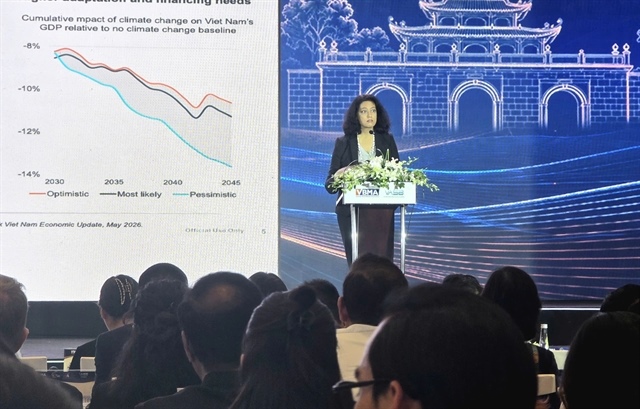
Vũ Thị Chân Phương, chairwoman of the SSC, delivers an opening remark at the event on Friday afternoon. — VNS Photo Ly Ly Cao |
Presenting at the event, Tehmina Khan, the World Bank's lead economist for Việt Nam, Cambodia and Lao PDR, highlighted the need to shift towards productivity-led growth as the country moves beyond the drivers that supported its transition to middle-income status.
Việt Nam's gross national income per capita rose from about $220 to nearly $5,000 in less than two generations. However, she noted that reaching high-income status would be considerably more challenging, with productivity improvements becoming increasingly important.
The country faces several headwinds, including trade uncertainty, an ageing population and climate change. These pressures add to the need for investment in productive infrastructure, skilled workers, competitive businesses, efficient capital allocation and stronger institutions.
The World Bank's expert stressed substantial financing requirements for 2026–2030.
The public investment plan for priority energy and transport projects was shown at 10.3 per cent of GDP, compared with public investment levels of 5.9 per cent in 2011–2015, 6.6 per cent in 2016–2020 and 5.9 per cent in 2021–2025.
She identified shallow capital markets and limited domestic capacity to absorb additional borrowing as constraints on financing.
Khan said Vietnam Social Security held roughly 60 per cent of outstanding government bonds, with domestic banks holding most of the remainder. While this ownership structure had kept yields low, it had also limited price discovery.
Financing budget deficits through banks and the pension fund could crowd out private credit and constrain capital market development.
As a result, Khan identified three priorities for deeper capital markets: broadening the institutional investor base, strengthening price discovery and market liquidity, and improving market infrastructure and supervision.
She also highlighted the potential benefits of stronger sovereign creditworthiness, including broader access to institutional investors, lower sovereign risk premiums and improved financing conditions for domestic issuers. These benefits would still depend on global interest rates and individual issuer risks.
- 19:37 02/10/2026