Inter-sectoral cooperation on Montreal protocol
Inter-sectoral cooperation on Montreal protocol
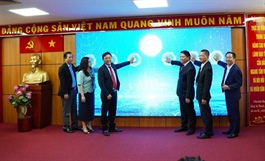
On September 29, the Department of Climate Change under the Ministry of Agriculture and Environment held a signing ceremony for cooperation agreements for the "Sustainable Management of Controlled Substances under the Montreal Protocol."
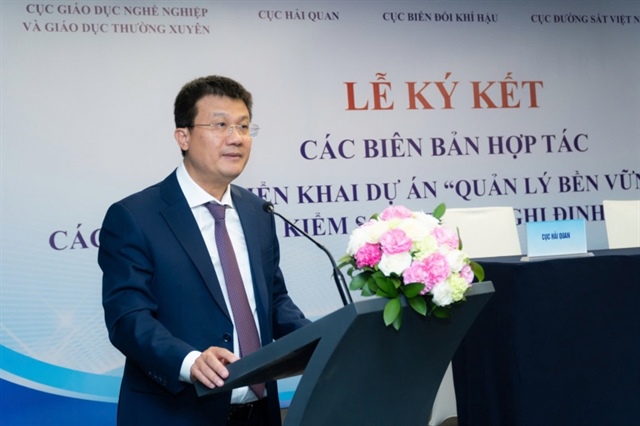
Inter-sectoral cooperation in the Montreal Protocol. Photo: SMS-MP Project |
At the event, the department signed three cooperation agreements with the agencies, including the Customs Department (under the Ministry of Finance); the Department of Vocational Education and Continuing Education (under the Ministry of Education and Training); the Department of Vietnam Railway (under the Ministry of Transport), and the Vietnam Railway Transport JSC (Vietnam Railways Corporation).
Inter-sectoral units will coordinate to implement the Montreal Protocol (SMS-MP Project), aiming to manage controlled substances, namely hydrochlorofluorocarbons (HCFCs), and hydrofluorocarbons (HFCs), and support Vietnam in fulfilling its obligations under the protocol
Nguyen Tuan Quang, director of the Department of Climate Change, said, “Vietnam will simultaneously implement the roadmap for eliminating HCFCs and gradually reducing HFCs. This is not just a matter of refrigerant management, but directly related to import and export control, the capacity of technicians, training systems, technology transfer, and the participation of businesses and facilities using the equipment.”
In cooperation with the Customs Department, the two departments will exchange information, support risk management, enhance the capacity and equipment of customs forces, contributing to the prevention and handling of violations in the import and export of controlled substances.
For the Department of Vocational Education and Continuing Education, the cooperation aims to strengthen the capacity of vocational education institutions and workers in the refrigeration and air conditioning sector. The focus is on building and integrating content on refrigerant management and good technical practices into training activities; enhancing practical equipment and developing a team of lecturers and technicians to meet the requirements of technology transfer.
For the Vietnam Railway Authority and the Vietnam Railway Transport JSC, the units will cooperate in testing, evaluating, and gradually transitioning to the use of refrigerants with low global warming potential in railway carriage air conditioning systems.
The coordination between specialised management agencies and transport operators will facilitate testing and evaluating the technology under real operating conditions, providing a basis for considering its applicability, gradual transition, and appropriate scaling up in the railway sector.
|
Nguyen Tuan Quang, director of the Department of Climate Change. Photo: SMS-MP Project |
“The three cooperation agreements, while focusing on different areas, are closely related, from managing and controlling these substances at the import and export stage; building capacity and skills for technical personnel; to testing and evaluating technology transition solutions in practice. The participation of management agencies, specialised agencies, and businesses helps connect the project's resources with the capabilities and actual conditions of each industry and sector,” Quang said.
Previously, in late July, the Ministry of Agriculture and Environment (MAE) launched the SMS-MP project.
The SMS-MP project is funded by non-refundable grant aid from the Multilateral Fund for the Implementation of the Montreal Protocol through the World Bank and the United Nations Environment Programme. The MAE is the project executing agency; the Department of Climate Change is the lead agency for implementation.
The project consists of four components, including reducing HFC consumption in the repair and maintenance of refrigeration equipment and the mobile air conditioning sector, and reducing HFC consumption in the manufacturing and repair/maintenance servicing sector of refrigeration and air conditioning equipment through technology conversion and technical capacity building.
The third component is to phase out HCFC substances in the refrigeration and air conditioning repair and maintenance servicing sector. The final component is project management, coordination, monitoring, and evaluation.
The project aims to support the phase-out of 97,5 per cent of baseline HCFC-22 consumption in the refrigeration and air conditioning servicing and maintenance sector from January 1, 2030. It seeks to maintain HFC consumption levels not exceeding the baseline consumption level during 2024-2028 and reduce baseline consumption by 10 per cent from January 1, 2029.
Simultaneously, it aims to reduce greenhouse gas emissions by encouraging the use of non-ozone-depleting, climate-friendly alternative technologies, and enhancing energy efficiency in the refrigeration and air conditioning sector.
- 17:20 30/09/2026