HCM City seeks stronger port connectivity, green transition
HCM City seeks stronger port connectivity, green transition
The expansion of HCM City’s administrative boundaries has reshaped its seaport and logistics landscape, bringing under one network port clusters in the city and in the former provinces of Bình Dương and Bà Rịa–Vũng Tàu.
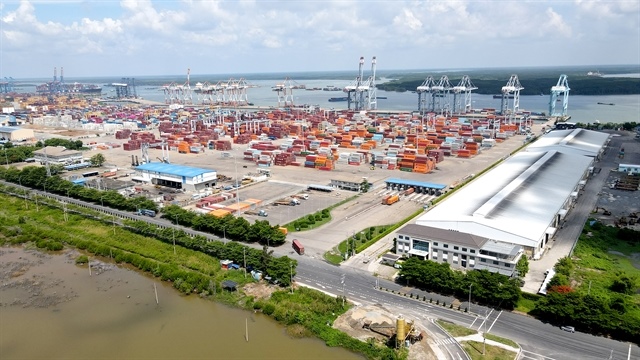
The Tân Cảng–Cái Mép International Terminal is ranked 11th among the world’s most efficient ports and is capable of handling ultra-large vessels. — VNA/VNS Photo |
The expansion of HCM City’s administrative boundaries has reshaped its seaport and logistics landscape, bringing under one network port clusters in the city and in the former provinces of Bình Dương and Bà Rịa–Vũng Tàu, including the deep-water Cái Mép–Thị Vải complex.
The expanded system offers advantages in scale, cargo sources and access to international shipping routes.
However, experts say stronger infrastructure links, cooperation among ports and investment in green and smart technologies are essential to turn these advantages into sustainable competitiveness.
The expanded port system extends beyond the existing Cát Lái, Hiệp Phước and Nhà Bè clusters to include ports in the former provinces of Bình Dương and Bà Rịa–Vũng Tàu. The Cái Mép–Thị Vải complex plays an important role in international maritime networks and serves as a key deep-water gateway.
Bùi Hòa An, deputy director of the municipal Department of Construction, said the expanded network strengthened the city’s position as an inter-regional port and logistics coordination centre, linking production areas, logistics hubs and international maritime gateways.
Under a recently issued plan by the Ministry of Construction, the city's seaport system is expected to handle between 463.4 million and 512.5 million tonnes of cargo by 2030, including approximately 29.63 million to 33.16 million TEUs of containers, excluding international transhipment cargo.
“With this scale, HCM City will become a major port and logistics centre in Southeast Asia, competing directly with major ports in Asia and around the world. At the same time, the transition towards green and smart ports is an unavoidable requirement,” An said.
According to Trương Tấn Lộc, chairman of the Members’ Council of Tân Cảng–Cái Mép International Port Co Ltd and vice chairman of the HCM City Logistics and Seaport Association, the city possesses a rare advantage in having port systems that can connect with and complement one another.
The Tân Cảng–Cái Mép International Terminal is ranked 11th among the world’s most efficient ports and is capable of handling ultra-large vessels, according to the World Bank and S&P Global Market Intelligence.
The Tân Cảng–Cái Mép International Terminal is ranked 11th among the world’s most efficient ports and is capable of handling ultra-large vessels.
The Cái Mép–Thị Vải complex is also strengthening its role as an international maritime gateway and regional transhipment hub.
Ports in different locations have complementary functions, according to Lộc.
While Bà Rịa–Vũng Tàu serves as a major deep-water port and logistics centre, inland ports such as Cát Lái remain important because of their proximity to production areas in the southern region.
He also proposed linking the existing ports in the Cái Mép–Thị Vải area with a planned free trade zone to make better use of roads, railways, berths and logistics infrastructure.
Combined with appropriate customs mechanisms, this could improve the port system’s competitiveness and integration into global supply chains.
Connectivity under pressure
Despite its growth potential, the port system faces mounting pressure from fragmented infrastructure and uneven development across the logistics chain.
Experts say some ports remain physically separated, berth facilities are not sufficiently integrated and cargo movement between terminals is not yet seamless.
Multimodal transport connections and the wider logistics ecosystem have also not developed in line with the system’s growing scale.
Infrastructure at several port clusters must keep pace with the increasing size of international vessels, particularly in terms of berth standards, channel depth, handling equipment and operational capacity.
Lê Thị Ngọc Dung, deputy general director of Cái Mép International Terminal Co Ltd (CMIT), said ports built during the sector’s early development faced challenges because their berths had been designed for vessel sizes at the time of investment.
Recently, CMIT and Tân Cảng–Cái Mép Thị Vải Terminal (TCTT) successfully cooperated to receive and handle the SHENZHEN, operated by ZIM, at a shared berth area connecting the two terminals.
The operation marked an important step towards a more interconnected port infrastructure model in Cái Mép.
“Cooperation between CMIT and TCTT helps increase handling capacity, improve service quality and expand the capacity to receive new shipping services,” Dung said.
“It also contributes to strengthening the competitiveness of the Cái Mép–Thị Vải deep-water port complex as Việt Nam’s international maritime gateway.”
Ngô Thị Thanh Vy, general director of QTM International Port JSC, said connectivity should extend beyond data sharing and cooperation between ports to encompass all participants in the logistics chain.
“When ports connect effectively with cargo owners, shipping lines, logistics businesses and transport operators, the entire chain can optimise costs, improve efficiency and create greater value for customers,” she said.
The pressure on capacity is also becoming more evident. Cái Mép International Port handled more than 2.2 million TEUs in 2025, equivalent to 1.5 times its initial design capacity.
Across the Cái Mép area, current throughput capacity is approximately 15 million TEUs per year, while demand could reach 45 million TEUs by 2035.
The channel depth in the Cái Mép–Thị Vải area currently ranges from 16.5m to 18m.
Although the complex is among the world’s major deep-water ports, it still faces challenges in meeting the berthing requirements of the largest vessels currently in operation.
Lê Quang Trung, deputy general director of Vietnam Maritime Corporation and chairman of the Board of Directors of Cái Mép International Port, said the Government’s approval in principle of the Cần Giờ international transhipment port project could help address future capacity demands.
The project, together with the Cái Mép–Thị Vải complex and other port developments, would add capacity and create new transport links to support import-export activities and improve international connectivity, he said.
|
The Tân Cảng–Cái Mép International Terminal is ranked 11th among the world’s most efficient ports and is capable of handling ultra-large vessels. — VNA/VNS Photo |
Green, smart development
Expanding port capacity also brings greater demands for green and digital investment.
Lộc said port operators needed to adapt to the development of green and smart ports, reduce waste and operating costs and meet environmental, social and governance (ESG) requirements.
“Ports must become smarter by applying technology to production and operations. Alongside digital transformation, the green transition is an unavoidable trend,” he said.
This requires investment in the electrification of equipment, solar energy, waste reduction and the continuous optimisation of operational processes.
Ports must also strengthen links with shipping lines, partners and customers, particularly logistics service providers, to reduce costs and waiting times and improve the competitiveness of Vietnamese goods.
An said HCM City should prioritise coordinated investment in port infrastructure and connections to logistics centres and production areas.
It should also improve policies on seaports, inland waterways, green ports, digital transformation and automation.
Trade facilitation mechanisms such as free trade zones and open ports could further reduce administrative costs and improve the efficiency of cargo flows.
The city is moving towards a modern, green and smart port system with stronger links among its different areas.
Achieving this goal will require not only the development of individual ports but also closer integration of infrastructure, logistics and transport modes.
With stronger coordination between authorities and businesses, the expanded port network could become a major driver of economic growth and international integration for HCM City and the southern region as a whole.
- 09:48 10/10/2026