Government proposes a 0.2 per cent tax on unused and abandoned land to NA
Government proposes a 0.2 per cent tax on unused and abandoned land to NA
Under the proposal, the 0.2 per cent rate would apply to the entire area of land classified as abandoned, unused or put into use late, with no preferential threshold for land within prescribed limits.
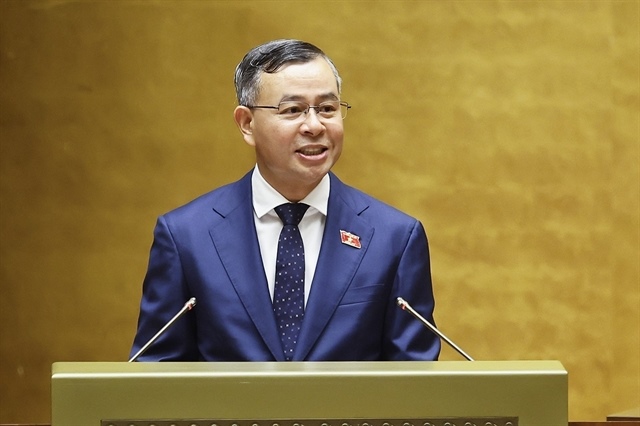
Minister of Finance Ngô Văn Tuấn presented the draft amendments to three tax laws – corporate income tax (CIT), non-agricultural land use tax and personal income tax (PIT) – at the NA meeting on Friday. — VNA/VNS Photo Doãn Tấn |
The Government has proposed imposing a 0.2 per cent tax on abandoned land and land that is unused or put into use late, without applying tax-free thresholds, as part of amendments to three tax laws: corporate income tax (CIT), non-agricultural land use tax and personal income tax (PIT).
The draft amendments were presented to the National Assembly (NA) at the meeting on Friday.
Under the proposal, the 0.2 per cent rate would apply to the entire area of land classified as abandoned, unused or put into use late, with no preferential threshold for land within prescribed limits.
The government said the measure aims to implement the Communist Party's Resolution 21 on land policy and related financial and tax reforms, while discouraging land speculation and improving land-use efficiency.
Phan Văn Mãi, chairman of the NA’s Committee on Economic and Financial Affairs, said the draft legislation had not adequately assessed the potential impact of the proposed tax on state budget revenue.
The committee also warned that the draft did not exclude delays caused by force majeure or phased investment projects approved by authorities, potentially subjecting landowners to tax for circumstances beyond their control.
It said the draft needed to clarify the definitions and criteria for abandoned land, land not put into use and land put into use late, noting that the draft revised Law on Land only defined abandoned land and specified circumstances in which it could be reclaimed for violations of land regulations.
The committee also highlighted a potential overlap with existing legislation, urging the government to clarify the relationship between the proposed 0.2 per cent rate and additional financial obligations under land laws to avoid duplicate charges.
Under the draft revised Law on Land, agricultural land left unused continuously for more than 24 months could be reclaimed if it remained unused after administrative penalties.
For delayed investment projects, developers could face additional annual payments on top of land-use or rental fees, with land subject to reclamation if it remained undeveloped for more than 60 months.
Tax incentives for education and healthcare
The draft amendments propose CIT exemptions for non-profit educational institutions, regardless of whether they are publicly or privately operated, as well as CIT and PIT exemptions for businesses providing meals to educational institutions and medical examination and treatment facilities.
The Government said the changes were intended to implement Party resolutions on breakthroughs in education and training, public health protection and improvements to land policy.
Presenting the verification report, Mãi said the Committee on Economic and Financial Affairs supported CIP exemptions for non-profit private educational institutions but said the policy's eligibility criteria, oversight mechanisms and potential impact on public revenue needed careful consideration.
The incentives should primarily benefit disadvantaged groups and deliver direct benefits to learners, rather than potentially benefiting higher-income groups, the committee said.
The committee also questioned the proposed tax exemptions for meal providers serving schools and healthcare facilities, saying exemptions from direct taxes would not necessarily lower meal prices without mechanisms to ensure the savings reached students and patients.
The committee therefore did not support the proposed meal-service tax exemptions, recommending that the government consider direct assistance to students and patients if that was the intended policy objective.
Regarding land-use tax exemptions for educational institutions, the committee asked the government to clarify the legal basis and scope of the proposal.
The National Assembly was scheduled to discuss the proposed amendments in group sessions on Friday afternoon and in a plenary session on November 6.
If approved on November 20, the legislation would take effect in 2027.
- 15:53 23/10/2026