Agricultural firms struggle to secure long-term financing despite preferential credit
Agricultural firms struggle to secure long-term financing despite preferential credit
Experts cite a lack of collateral among farmers and agricultural enterprises as a major obstacle to accessing bank loans.
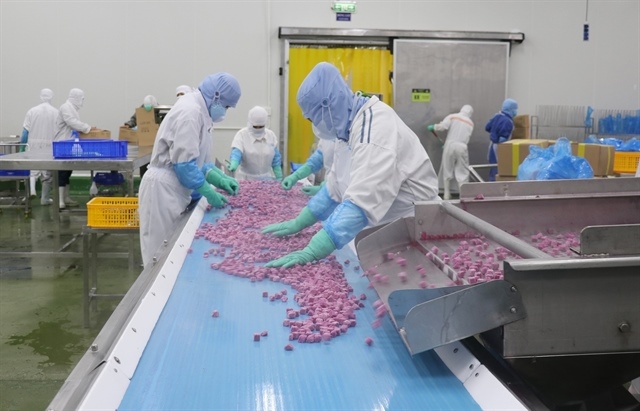
A dried dragon fruit production plant in Đồng Tháp Province. — VNA/VNS Photo |
Despite banks expanding preferential lending programmes to support production, agricultural businesses continue to face difficulties in securing medium- and long-term financing for raw material development and deeper processing.
Agriculture accounts for only around 11 per cent of total outstanding bank credit, according to experts, highlighting funding constraints in a sector considered a pillar of the economy.
At a press conference on third-quarter performance, Nguyễn Xuân Bắc, deputy director of the State Bank of Vietnam (SBV)'s Credit Department, said total outstanding credit across the economy reached approximately VNĐ20.75 quadrillion (US$802 billion) as of September 30, up 11.59 per cent from the end of 2025 and 16.7 per cent year-on-year.
Around 77.4 per cent of outstanding credit was allocated to production and business activities. Agriculture and rural development accounted for approximately 22 per cent of total credit, while small and medium-sized enterprises received around 20 per cent. Outstanding loans for export activities rose 33.32 per cent, while credit for businesses applying high technology increased 39.62 per cent from the end of 2025.
Credit support for agriculture, forestry and fisheries has also expanded significantly. Initially launched with VNĐ15 trillion, the programme has been expanded four times to reach VNĐ185 trillion. By the end of August, cumulative disbursements had reached nearly VNĐ238.12 trillion, equivalent to 128.7 per cent of the programme's stated scale, benefiting 88,434 customer transactions.
The SBV has asked 18 participating commercial banks to report on and assess the programme's effectiveness to support recommendations to the relevant authorities.
Commercial banks have also announced large preferential lending packages. Agribank has earmarked at least VNĐ50 trillion for clean and high-tech agriculture.
Nguyễn Thị Thu Hà, director of Agribank's Staff Training School and deputy head of its ESG steering committee, said the package offers interest rates 0.5 to 1.5 percentage points per year below normal rates to encourage technological innovation, smart agriculture and sustainable production.
BIDV has introduced a VNĐ200 trillion credit package with interest rates starting at 6.8 per cent per year, including VNĐ10 trillion reserved for green agriculture, organic production and safe food.
VietinBank and Vietcombank have also launched a VNĐ50 trillion package for SMEs, high-tech projects, the digital economy, semiconductors and green projects, offering interest rates up to one percentage point below normal levels for up to 12 months on medium- and long-term loans.
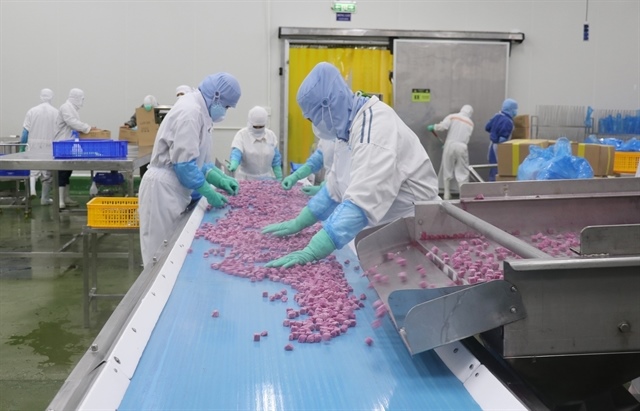
A dried dragon fruit production plant in Đồng Tháp Province. — VNA/VNS Photo |
Short-term loans fall short of investment needs
Despite the expansion of preferential credit, agricultural businesses continue to struggle to obtain funding, particularly for long-term investment. Experts cite a lack of collateral among farmers and agricultural enterprises as a major obstacle to accessing bank loans.
At the October 13 seminar, Nguyễn Văn Mười, chairman of the Tropical Agriculture Business Club, said conflicts in the Middle East since late February had driven up energy prices and transport costs for the fruit and vegetable sector, increasing businesses’ need for financing to maintain supply chains and expand production.
However, loan maturities and lenders' risk appetite remain major barriers. Credit institutions tend to favour lower-risk businesses or companies with advanced processing capabilities, while much of Việt Nam's agricultural produce is still exported fresh.
Durian illustrates the challenge. Although it has accounted for 35–45 per cent of Việt Nam's total fruit and vegetable export value since official exports to China began in July 2022, many businesses in the sector continue to struggle to secure financing.
Businesses typically rely on short-term loans tied to individual export orders. While this meets immediate working-capital needs, it does not provide the financial stability required to develop large raw material areas or maintain long-term partnerships with thousands of farming households.
Fluctuating market interest rates also raise financing costs and make business planning less predictable.
Alternative funding from investment funds is difficult to obtain because many agricultural businesses operate on a small scale, have limited cash-flow management capabilities and struggle to meet requirements for transparent financial records.
Mười said financing mechanisms needed to reflect crop growth cycles and the development of agricultural value chains. Investments in raw material areas and deep processing require several years to generate returns, meaning funding must be available over the long term and throughout project implementation rather than being tied to individual short-term transactions.
He also called for policies supporting a circular economy in agriculture, saying suitable financing could help businesses reduce costs, improve product quality and establish sustainable production linkages across the sector.
- 10:11 20/10/2026