




100 entrepreneurs honoured with Thanh Giong Cup 2026
100 entrepreneurs honoured with Thanh Giong Cup 2026
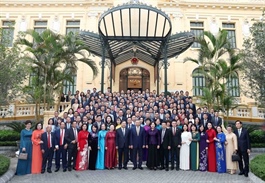
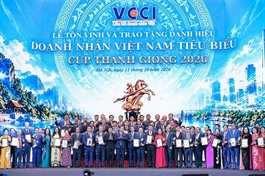
100 Vietnamese entrepreneurs have been honoured with the Outstanding Entrepreneur – Thanh Giong Cup 2026, recognising their contributions to economic growth and national development.
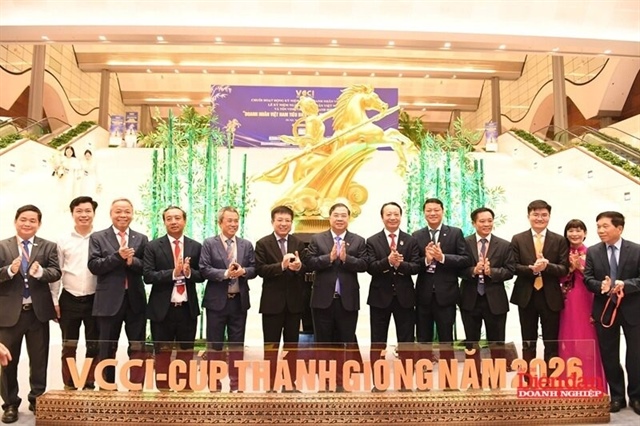
Photo: VCCI |
The Vietnam Chamber of Commerce and Industry (VCCI) held the award ceremony in Hanoi on October 11, ahead of Vietnamese Entrepreneurs' Day on October 13, celebrating the achievements, leadership, and growing responsibilities of the country's business community.
Speaking at the ceremony, VCCI chairman Ho Sy Hung said the awards, launched in 2006, had become an important platform for recognising business leaders who demonstrate strong performance, resilience, and commitment to national development. The 2026 awards marked the 10th edition, attracting more than 260 nominations submitted by ministries, local authorities, and business associations nationwide.
According to figures declared by companies in their applications to VCCI, the enterprises led by this year's award recipients generated combined revenues of approximately $51 billion in 2025, with pre-tax profits of nearly $9.4 billion. These businesses also contributed around $3.7 billion to the state budget and provided employment for approximately 273,000 workers.
"The selection process went beyond conventional financial indicators such as company size, revenue, and profitability," Hung said. "Instead, candidates were assessed on their business performance and leadership capabilities over the five-year period beginning in 2021, including their ability to maintain competitiveness, navigate challenges, and contribute to Vietnam's development,"
Addressing the ceremony, Standing Deputy Prime Minister Pham Gia Tuc acknowledged the significant contributions of Vietnamese businesses and entrepreneurs to socioeconomic development, job creation, state budget revenues, improved living standards, and the country's international standing.
He said these achievements reflected the determination, intelligence, creativity, and resilience of Vietnamese entrepreneurs, who had consistently demonstrated their willingness to overcome difficulties and pursue new opportunities. "Strong businesses make a strong economy, and thriving businesses make a prosperous nation," he said.
The Standing DPM stressed that the business community would play an increasingly decisive role in achieving Vietnam's ambition of double-digit economic growth and sustainable development in the new era.
This role, he explained, should be measured not merely by the number or scale of enterprises, but also by productivity, growth quality, innovation, competitiveness, and the economy's capacity for self-reliance.
After more than four decades of economic reform, Vietnam's private sector has expanded considerably, with nearly 1.1 million active enterprises currently contributing more than 60 per cent of GDP, approximately 55 per cent of total state budget revenues, and employment for around 17.6 million people. The sector has also played a crucial role in sustaining the country's economic momentum in 2026.
During the first nine months of the year, Vietnam's GDP expanded by 9.01 per cent, including the growth rate of 9.95 per cent in the third quarter. Industrial production increased by approximately 12.3 per cent, while total import-export turnover reached around $888 billion.
Meanwhile, nearly 224,000 enterprises were newly established or resumed operations during the period, reflecting continued business activity and entrepreneurial confidence.
DPM Tuc attributed a substantial part of these achievements to the efforts and contributions of the country's business community.
Highlighting the symbolic significance of Thanh Giong, a legendary Vietnamese hero representing patriotism, resilience, self-reliance, and national aspirations, the DPM said the awards carried meaning beyond commercial success.
He explained that the Thanh Giong Cup recognised significant business achievements as well as legitimate aspirations for prosperity, business ethics, corporate culture, and entrepreneurs' responsibilities towards society and the nation.
Despite the progress achieved, he acknowledged that Vietnam's private sector had yet to reach its full potential or meet the demands of the country's next growth phase.
The number of large-scale enterprises remains limited, while competitiveness varies considerably across businesses. Links among domestic enterprises, as well as between local and foreign-invested enterprises, remain insufficiently developed, and many Vietnamese enterprises have yet to integrate deeply into global value chains.
Access to capital, land, infrastructure, technology, and highly skilled workers also continues to present significant challenges, requiring more effective policy responses and administrative reforms.
Against this backdrop, the DPM highlighted the importance of ongoing institutional reforms and strategic policy directions, including the resolutions of the 14th National Party Congress, Conclusion No.18-KL/TW, Resolution No.19-NQ/TW, and other major development strategies. These policies are helping shape a new institutional and economic development framework aimed at supporting double-digit growth.
At the same time, advances in science and technology, innovation, digital transformation, green transition, and international integration are creating substantial opportunities for Vietnamese businesses, while intensifying competitive pressures.
"Vietnamese enterprises can no longer rely solely on low costs or labour advantages," DPM Tuc said, stressing the need to improve corporate governance, productivity, product quality, and brand development.
He also called on businesses to strengthen their technological capabilities and progressively move into higher-value segments of regional and global value chains.
Drawing on his experience working with the business community, he acknowledged the determination and sacrifices underpinning entrepreneurial success. "Behind every business success lie great determination, continuous innovation, sweat and tears, and relentless efforts driven by aspirations and confidence in the country's development," he said.
He explained that businesses needed more than markets, technology, and financial resources to grow sustainably.
"Businesses need markets, technology, and resources to develop, but they also need a stable, transparent, and predictable business environment, consistent policies, and an administrative system that genuinely listens, understands, and promptly resolves their difficulties," DPM Tuc said.
He warned that administrative obstacles could have far-reaching consequences for businesses, particularly when delays affected investment decisions and project implementation. "What may appear to regulators as merely a procedure or regulation can represent a cost or an investment opportunity for businesses, affecting the survival and development of an entire project, or even an enterprise," he said.
- 08:00 12/10/2026