Businesses struggle to retain talent in the age of AI
Businesses struggle to retain talent in the age of AI
Despite widespread employee adoption of artificial intelligence, businesses face rising turnover and struggle to translate technology investments into measurable gains and stronger workforce engagement.
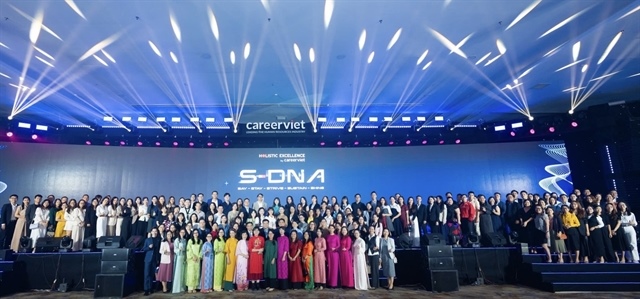
Participants at the Holistic Excellence 2026 conference in HCM City on October 8. — VNS Photo Văn Châu |
Companies are grappling with growing challenges in retaining talent as employees increasingly use artificial intelligence (AI) at work, while job satisfaction declines and staff turnover remains high, a conference in HCM City heard on October 8 afternoon.
A survey of 82,000 employees and more than 300 businesses conducted by CareerViet and Amco Vietnam found that overall employee satisfaction fell from 4.3 out of five in 2025 to 4.15.
Trần Liên Phương, research director at Amco Vietnam, said the seemingly modest decline masked growing disengagement among employees, including those who remained in their jobs while looking for new opportunities.
Average staff turnover reached 20 per cent, while 25 per cent of surveyed businesses reported turnover rates exceeding 30 per cent, she said.
Notably, high-performing employees were among those most likely to consider leaving their jobs.
Salary expectations were a major factor. While businesses increased actual wages by an average of 9-10 per cent annually, employees considering a move expected increases of more than 20 per cent. Meanwhile, 32 per cent of employees who left their jobs cited salary as their primary consideration.
The labour market also faces shortages in certain specialised positions, particularly professionals with in-depth expertise and personnel in human resources and operations. Some businesses have had to offer salaries above their usual pay scales to attract talent.
As companies compete for skilled workers, AI adoption is adding another layer of pressure, exposing gaps between employees' use of technology and their employers' ability to integrate it effectively.
Around 70 per cent of surveyed employees said they had proactively used AI in their daily work to improve productivity. However, investment in AI and automation ranked only fifth among organisations' priorities.
Lương Tuấn Thành, founder and chief executive of FAOSX AI, said a survey of more than 500 technology leaders found that although AI investment budgets continued to rise by 10–20 per cent, more than 70 per cent of large enterprises had yet to see a return on investment (ROI) from AI. Only 6-7 per cent reported tangible value, he said.
Many chief executives were eager to purchase AI tools, but IT teams could not take responsibility for employee training and adoption on their behalf.
Lê Minh, technology director at CMC Technology & Solution, said 90 per cent of businesses had adopted AI and 75 per cent of business leaders used it directly. Nevertheless, 75 per cent of leaders remained concerned about their organisations' ability to master the technology and manage the associated risks.
Practical experience suggests that user adoption and the quality of internal data are among the main barriers to successful AI implementation.
In human resources, for example, poorly controlled AI chatbots designed to answer policy questions could expose confidential salary information about senior executives. Using third-party algorithms to score employees for dismissal could also trigger serious internal disputes.
These cases highlight the risks of deploying AI without adequate safeguards, reliable data governance and clear accountability.
To address these challenges, experts recommended that businesses adopt the S-DNA strategic framework, which focuses on five areas: Sense, Shift, Scale, Sync and Shine.
The framework encourages organisations to use data to understand market conditions and workforce needs; adjust compensation policies to changing circumstances; expand employees' capabilities with AI; align leadership thinking with workforce expectations; and create workplaces where employees want to stay.
The recommendations reflect a broader challenge facing businesses: technology investment alone cannot guarantee improved performance if employees lack the skills, support or motivation to use it effectively.
As AI becomes more deeply embedded in daily operations, businesses need to combine digital transformation with appropriate remuneration, employee development and stronger engagement.
Ultimately, retaining key talent will depend not only on the tools companies provide, but also on whether employees feel heard, fairly rewarded and equipped to grow alongside the technology.
- 15:59 09/10/2026