Workforce resilience will decide Vietnam’s advantage in the age of AI
Workforce resilience will decide Vietnam’s advantage in the age of AI
AI is no longer an emerging experiment. It is reshaping how work gets done, how decisions are made and where value is created.
Globally, AI adoption is outpacing workforce readiness. Nearly three in four organisations have deployed or are piloting AI, yet only 18 per cent report that most of their workforce has joined AI reskilling or upskilling programmes. Asia-Pacific faces a similar challenge with 74 per cent of organisations deploying or piloting AI, but only 21 per cent believe they can effectively recruit and retain enough AI-skilled talent.
Vietnam reflects this broader regional trend. The country aims to rank among the world’s top 30 nations in data exploitation and AI development by 2045, yet adoption remains uneven. ITViec’s 2025 Survey found that 73 per cent of surveyed companies in Vietnam had integrated AI to some extent, while only 13.8 per cent had reached scaled or full adoption. At the same time, Amazon Web Services (AWS)’s 2025 Research found that 55 per cent of adopters cited lack of digital skills as the main barrier to expanding AI use.
These findings highlight that AI transformation is not just a technology deployment exercise. Organisations that thrive will be those that redesign work around effective human and AI collaboration, supported by the right skills, role clarity, governance and sustained change management.
AI changes tasks before it changes jobs
The key workforce question is not whether AI will replace jobs, but how it will reshape the tasks that make up those jobs, how it will be automated, augmented or kept deeply human. Most roles comprise multiple tasks, and AI will affect those tasks differently, and they will change at different speeds.
In Vietnam, the International Labour Organisation estimates that 20.8 per cent of employment, equivalent to 11.5 million jobs, is potentially exposed to generative AI. However, only 1.8 per cent of jobs fall into the highest exposure category, suggesting that AI is more likely to transform tasks within existing roles than drive widespread occupational displacement.
This distinction is important because workforce planning therefore needs to move from broad job titles to understand how individual tasks are changing and task-level analysis. In customer service, AI may support ticket routing, response drafting, knowledge retrieval and reporting, while enabling employees to focus more on complex problem-solving cases, relationships, judgment and service recovery. In software development, AI may reduce time spent on routine and repetitive coding while increasing the importance of architecture, quality assurance, validation, system integration and higher-value problem solving.
Workforce readiness is the ROI multiplier
AI value depends on how well organisations redesign the system around the tool. Too often, deployment is measured by activity: logins, prompts or tools rolled out. Yet activity alone is not impact.
The challenge is that technology evolves in months, while skills, job architecture, performance systems, learning infrastructure and culture can take years to adapt. When adoption outpaces readiness, return on investment can stall, usage can plateau and risk or resistance can increase.
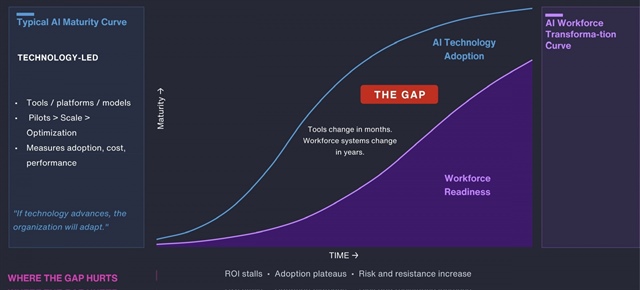
Technology evolves in months, while skills, job architecture, performance systems, learning infrastructure and culture can take years to adapt. Photo: Aon |
Leaders should therefore view AI readiness as an integrated people strategy built on four pillars: skills and learning, job design and job architecture, metrics and incentives, and governance and trust. Together, these pillars connect AI investment to business priorities, not just experimentation.
What leaders should do now
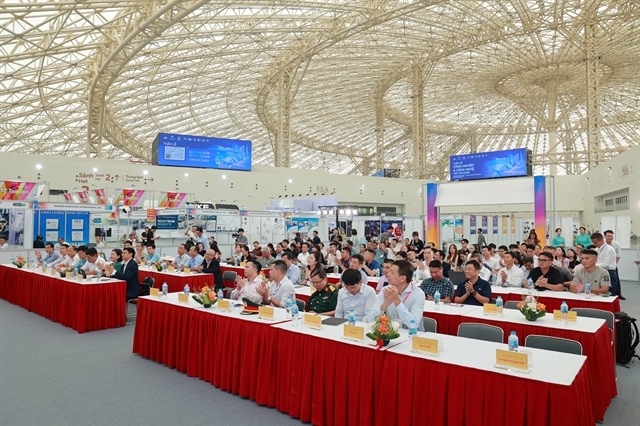
During the Aon’s Vietnam HR Insights Seminar in Hanoi on August 4 and in Ho Chi Minh City on August 8, people professionals and specialists from over 100 organisations across Hanoi and Ho Chi Minh City got together and discussed ưhat a typical AI workforce transformation journey should look like.
Identify where AI can create the highest business value. Not every workflow needs AI, and not every use case deserves equal investment. Leaders should prioritise areas where AI can improve productivity, quality, customer experience or decision speed.
Quantify the workforce impact. Organisations need to map how AI will reshape roles and tasks, identify automation risk and pinpoint new value-creating activities.
Redesign work before scaling tools. Automating old workflows can create fragmentation and anxiety. Redesigning jobs, processes and operating models clarifies what AI should do, where human judgment matters and how to avoid bottlenecks or disruption across the value chain.
Build structured reskilling pathways. Training should not be generic. It should be role-based, practical and linked to future skills, career paths and redeployment opportunities.
Align governance and incentives. If employees are expected to use AI responsibly and productively, performance systems, leadership behaviours and governance guardrails must reinforce that expectation.
Create a credible transition path for people. AI workforce transformation will succeed only if employees understand how their roles will change, what support they will receive and how they can stay relevant. Employee communication and wellbeing should be prioritised throughout the journey.

People professionals and specialists across Hanoi and Ho Chi Minh City got together at Aon’s Vietnam HR Insights Seminar 2026. Photo: Aon |
Vietnam’s AI opportunity is real, but the next phase depends on whether organisations can turn national ambition into workforce readiness and business execution.
For Vietnam’s employers, the strategic question is no longer, “How fast can we adopt AI?” It is, “How ready is our workforce to use AI to create measurable business value?” The companies that answer with discipline will move beyond pilots, reduce risk and build a more adaptable workforce for the future.
- 09:00 14/09/2026