Reform to resilience: How Vietnamese businesses build long-term strength
Reform to resilience: How Vietnamese businesses build long-term strength
As Vietnam’s business environment evolves, companies like Tan Hiep Phat show how long-term investment in technology, production and capabilities can turn reform momentum into lasting competitiveness.
Institutional reform does not create competitiveness overnight, but it can build the confidence businesses need to make long-term investments.
More than three decades of development among Vietnamese private enterprises shows that as the business environment becomes increasingly transparent, the private sector gains greater room to build its internal capabilities, invest for the long term and gradually strengthen its competitiveness.
If fair rules in sport motivate athletes to continually push beyond their limits, a healthy competitive business environment similarly gives companies the confidence to invest in technology, innovation and long-term strategies.
Through policy recommendations submitted to the government over the years, Vietnam's private business community has shown that what it needs is not preferential treatment or privileges, but a transparent, stable and consistent business environment where every player can grow on the strength of its own capabilities.
“Businesses do not need preferential treatment; they need a stable, predictable, transparent and fair environment; they need their business and property rights to be protected; they need streamlined administrative procedures and a consistent policy implementation system from the central to local levels. Reform only truly matters when it delivers tangible results,” said Nguyen Duy Hung, member of the Board of Directors at Tan Hiep Phat Beverage Group, one of the leading fast-moving consumer goods (FMCG) businesses in the country.
Established in 1994, just a few years after the Law on Enterprises expanded the space for the private sector, Tan Hiep Phat was among the businesses that came of age alongside the country's reform drive. More than three decades later, Tan Hiep Phat has become the only Vietnamese firm among the top five leading beverage companies in Vietnam.
The journey of companies such as Tan Hiep Phat, therefore, serves as a reflection of the relationship between the business environment and the process of building internal capabilities within the private sector.
Hung uses the metaphor of “where the soil is fertile, birds will come to nest”: when confidence is strengthened, “flows of knowledge, talent, technology and legitimate aspirations for prosperity will naturally find their way in.”

Nguyen Duy Hung, member of the Board of Directors at Tan Hiep Phat. Photos: Tan Hiep Phat Beverage Group |
But reform only creates the space for development. Opportunities become competitive advantages only when businesses have the determination to invest in capabilities that form a lasting foundation.
Building internal strength through manufacturing and technology
According to the Vietnam Private Economy Report and Provincial Competitiveness Index 2025, Vietnam's private economic sector currently provides jobs for approximately 26 million people, equivalent to 50.2 per cent of total employment nationwide.
Behind this scale lies the production capacity accumulated over many years by millions of businesses, with leading companies playing an important role in shaping supply chains, creating jobs and generating spillover effects across other parts of the economy.
According to Nguyen Van Viet, chairman of the Vietnam Beer – Alcohol – Beverage Association (VBA), persistent investment in modern production technologies and quality control in line with international standards not only enables businesses to provide consumers with quality products at reasonable prices, but also helps raise standards across the beverage industry and strengthen the competitiveness of domestic companies.
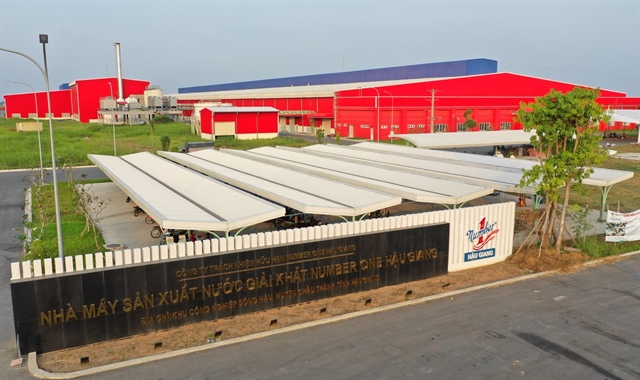
When a manufacturing company makes long-term investments, the value it creates extends beyond the company itself, spreading throughout the wider ecosystem |
Tan Hiep Phat is an example of this process of accumulation. Nearly two decades ago, when most of the market was still using conventional filling technology, the company chose to invest in an Aseptic filling system from Germany – a technology requiring substantial investment and stringent operating standards.
Aseptic technology enables the product and packaging to be sterilised separately before filling in a sterile environment, helping control product quality and safety without the use of preservatives to extend shelf life.

Aseptic filling technology requires stringent technical operation and a long payback period |
This was not simply a technology decision, but a decision to invest in long-term capabilities. The substantial investment required, stringent technical operating requirements and longer payback period made it far from an easy choice.
In return, Aseptic technology has become one of the key foundations that have enabled Tan Hiep Phat to build its manufacturing capabilities and develop its core products over the years.
More importantly, the company did not stop at adopting the technology. Through continuous operation and improvement, Tan Hiep Phat has gradually built up its capabilities, mastered the technology and worked with international partners to develop solutions better suited to Vietnam's climate, raw materials and consumer needs.
Over more than 30 years, the company has continuously reinvested in its production capabilities, gradually building a system of four manufacturing clusters in the country's key economic regions – Ninh Binh, Danang, Ho Chi Minh City and Can Tho – with 12 Aseptic filling lines and total investment exceeding $300 million.
The company has also brought its products to demanding markets such as France, the Netherlands, Australia and Canada by meeting globally-recognised standards including the Food and Drug Administration, Halal, ISO and HACCP.
These figures reflect more than the scale of investment. More importantly, they represent a decades-long process of building capabilities – a process that is still ongoing at Tan Hiep Phat.
In 2025, the company decided to invest an additional $100 million in next-generation production lines to enhance its manufacturing capacity and meet growing market demand. As the company has expanded, so have tens of thousands of partners across its supply chain matured and grown alongside it.
Seen through this lens, Tan Hiep Phat is more than simply a beverage company. Behind every bottle of Zero Degree Green Tea, Dr Thanh Herbal Tea or Number 1 Energy Drink lies an extensive economic ecosystem spanning farmers in raw-material growing regions, packaging companies, logistics providers and technology partners, through to distributors and retailers across the country.
This is also how the capabilities of individual businesses are transformed into the capabilities of an entire industry. And as more Vietnamese companies choose to invest in capabilities rather than pursue short-term growth alone, today's private-sector investments will become part of Vietnam's comprehensive productive capacity and economic competitiveness in the future.
- 09:00 12/09/2026