Việt Nam's motorcycle market shifts as electric models gain ground
Việt Nam's motorcycle market shifts as electric models gain ground
Việt Nam’s motorcycle market is shifting as electric models gain ground, while manufacturers of petrol-powered motorcycles are upgrading emissions performance and adding technology and features to retain buyers.
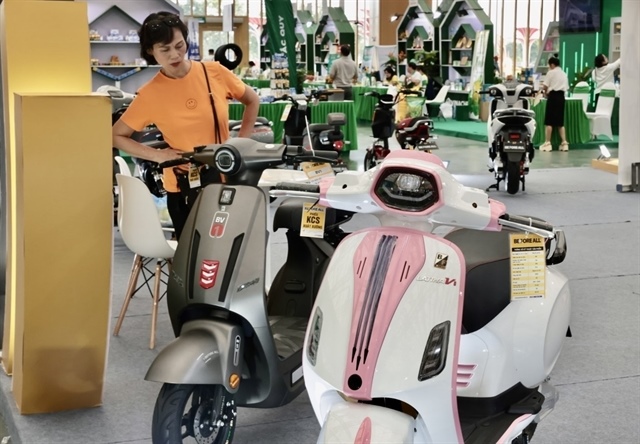
Visitors look at electric motorcycles at an exhibition booth. VNA/VNS Photo |
Electric motorcycle sales nearly doubled in the first seven months of 2026, while petrol-powered models are being upgraded to meet tighter emissions rules and changing consumer demand.
Việt Nam’s motorcycle market is shifting as electric models gain ground, while manufacturers of petrol-powered motorcycles are upgrading emissions performance and adding technology and features to retain buyers.
About 1.9 million two-wheelers were sold in Việt Nam in the first seven months of 2026, up 19.6 per cent on year, according to a MotorcyclesData report released earlier this month. Electric motorcycles accounted for 513,742 units, up 97.2 per cent and representing about 27.7 per cent of total sales.
The growth in electric motorcycles comes as internal combustion engine models still account for most of the market. The five members of the Vietnam Association of Motorcycle Manufacturers - Honda, Yamaha, Piaggio, Suzuki and SYM - sold 638,431 motorcycles in the second quarter, up 4.4 per cent on year. Their combined sales topped 1.3 million units in the first half.
On September 18, Honda Vietnam introduced the 2027 SH Mode with an engine that meets Euro 4 emissions standards. Honda said emissions from the new model were about 40 per cent lower than those of the previous version.
Sayaka Arai, general director of Honda Vietnam, said the company would continue to introduce Euro 4-compliant models while improving environmental performance, design and features.
Honda has also added the ICON e:, CUV e: and UC3 models to its electric motorcycle lineup in Việt Nam. Internal combustion models, however, still account for the bulk of the company's sales.
The push to meet tighter emissions standards comes as new regulations for motorcycles and mopeds take effect. From July 1, motorcycles produced or imported into Việt Nam must meet Level 4 emissions standards. From July 1, 2027, Hà Nội and HCM City will begin emissions testing for motorcycles and mopeds already on the road.
Honda Vietnam is committed to pursuing the goal of building a greener mobility society through a multi-pronged approach, while developing both electric vehicle and internal combustion engine technologies, Arai said.
Visitors look at electric motorcycles at an exhibition booth. VNA/VNS Photo |
Electric models drive investment in infrastructure
The growth of electric motorcycles is driving investment in batteries, battery-swapping stations and after-sales services.
VinFast said it sold 406,453 electric motorcycles in Việt Nam in 2025, up 473 per cent from the previous year. Earlier this year, the company said its infrastructure operator V-Green had completed the installation of its first 4,500 battery-swapping stations.
On September 19, VinFast launched the second phase of its For a Green Future programme, offering discounts of VNĐ1.5 million (US$58) to VNĐ6 million ($231) to buyers of electric motorcycles, depending on the model and version.
Buyers of battery-swappable models will also receive 20 free battery swaps a month through June 30, 2028, the company said.
While VinFast is expanding its battery-swapping network, Yadea is increasing production capacity and broadening its product range in Việt Nam.
Yadea’s new plant in Bắc Ninh Province covers 232,200sq.m, with a first-phase investment of $100 million and an initial annual capacity of one million vehicles.
The company is targeting several customer segments, from students to higher-end users, with models including the Osta and Omee. Yadea also said it was working with Be Group to develop products for ride-hailing drivers.
Against the backdrop of Việt Nam’s accelerating transition towards green vehicles and the electrification of urban transport, the YADEA Osta is being introduced as a strategic step in the company's product portfolio, according to Liu Jia, general director of Yadea Vietnam.
Vietnamese companies are also increasing investment in the sector.
In March, Thiên Việt Securities JSC (TVS) invested $4 million in Đạt Bike in a Series B funding round. Đạt Bike said the funds would be used to expand production, strengthen its supply chain, develop its distribution network and increase research and development capacity.
Dat Bike said its production capacity had increased fivefold over the past two years. The company is also expanding its 3S dealership network in several cities and expects to have 100 outlets this year.
Electric motorcycles need to meet people’s daily transport needs in a convenient way. A motorcycle with sufficient range, suitable charging speed and the ability to charge using household electricity are important factors for users, said Đạt Bike founder and general director Nguyễn Bá Cảnh Sơn.
Đạt Bike is also expanding its after-sales network. In August, the company opened a 1,000sq.m service centre on Ngô Gia Tự Street in Hà Nội, its largest service centre to date.
For internal combustion models, petrol stations and repair networks have been established for years. For electric motorcycles, consumers must also consider battery life, range per charge, access to charging or battery-swapping stations, charging times, warranty policies and long-term running costs.
- 08:44 25/09/2026