Rising prices and land conversions set to drive rubber profits
Rising prices and land conversions set to drive rubber profits
Vietnam's rubber industry is heading into a potentially bumper 2026-2027, with elevated natural rubber prices, stronger latex sales and substantial gains from rubber tree liquidation and plantation land conversion expected to fuel a sharp rise in corporate earnings.
Since the outset of the year, natural rubber prices in major producing markets across Southeast Asia have risen sharply, surpassing their highest levels of the past 10 years.
Accordingly, SVR10 rubber prices are forecast to remain elevated at around $2.5/kg through the first half of 2027, as processing plants stockpile more raw materials amid concerns over potential supply shortages.
Looking ahead to the rubber market, analysts at MB Securities (MBS) said the impact of El Nino could reduce tapping yields in the new 2027 crop season, potentially pushing SVR10 prices higher, with the average price expected to reach around $2.8-3/kg in the second half of 2027.
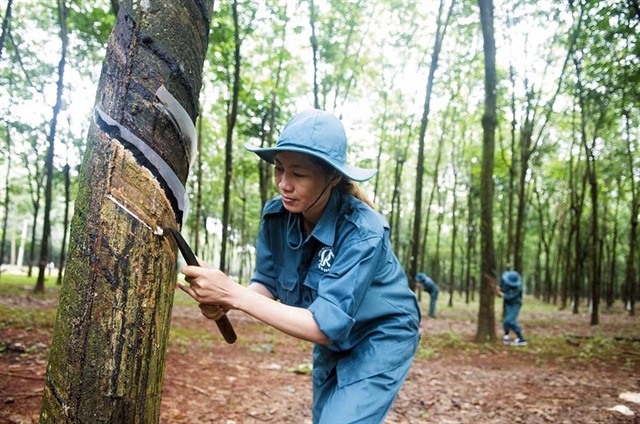
Photo: baodautu.vn |
However, downward price pressure remains as consumption demand weakens in major markets such as China and the United States.
For Vietnam's domestic rubber industry, according to the National Statistics Office of Vietnam, natural rubber output reached 308,000 tonnes in the second quarter of 2026, up 5 per cent, bringing first-half output to 440,000 tonnes, up 3 per cent. This was the highest level recorded during 2021-2026, as higher natural rubber prices since the beginning of the year encouraged growers to increase tapping.
Higher global natural rubber prices also lifted Vietnam's average rubber export price by 4 per cent on-year to $1,924 per tonne.
Rubber export volume reached 638,000 tonnes, down 8 per cent on-year. As a result, Vietnam's rubber export value in the first half of 2026 surpassed $1.2 billion.
In terms of markets, Vietnam's rubber exports declined mainly due to weak demand from China. By contrast, exports to several other markets posted relatively strong growth, with Indonesia becoming Vietnam's second-largest rubber export market.
MBS forecasts that Vietnam's rubber export value in 2026 could exceed the annual target and rise 6 per cent on-year, driven by a 15 per cent increase in the average selling price despite an 8 per cent on-year decline in export volume.
Companies in the industry also reported strong profit growth in the first half of 2026.
Specifically, Vietnam Rubber Group JSC's net profit rose 68 per cent, driven by a 44 per cent increase in latex sales revenue and more than $41.1 million in income from rubber tree liquidation.
At Phuoc Hoa Rubber JSC, net profit surged 245 per cent in the first half, as latex sales revenue increased 31 per cent on-year. Other companies also recorded positive net profit growth, with Dong Phu Rubber JSC up 58 per cent and Tay Ninh Rubber JSC up 35 per cent.
2026 is forecast to be a bumper year for the rubber industry, with revenue and gross profit from rubber latex sales expected to increase 28 per cent and 48 per cent on-year, respectively.
Gross profit margin is projected to expand by 5 percentage points, supported by expectations that rubber prices will remain elevated through the end of this year before breaking higher in the second half of 2027.
Tree liquidation and compensation from the conversion of rubber plantation land will make a significant contribution to profits. In addition to the positive outlook for rubber, land conversion activities are expected to provide significant support for earnings during 2026-2027.
Several projects involving the conversion of rubber plantation land are expected to be implemented during 2026-27, including the Eco-Smart Industrial-Urban-Service Park and Social Housing project in Binh Duong ward (Ho Chi Minh City), VSIP III Binh Duong Industrial Park (IP), Bac Tan Uyen 1 IP, Hiep Thanh IP, Thanh Duc IP, and a high-tech agriculture project in Dong Nai city in the southern region.
Against this backdrop, MBS forecasts aggregate net profit of the rubber companies within its coverage universe to increase 92 per cent on-year.
The outlook for rubber companies is strongly supported by expectations for robust earnings growth and attractive valuations compared with previous development cycles.
At the same time, Decision No.40/2026/QD-TTg has raised hopes that the state may reduce its ownership stake in GVR during 2026-2030, supporting gains in rubber stocks and improving their liquidity.
In addition, gradually increasing cash dividend policies over the years, against a backdrop of companies with healthy financial positions and low debt levels, are another factor worth noting.
Nevertheless, risks to the sector remain, MBS said. Potential risks include a decline in rubber prices due to weaker vehicle consumption in China and the US; extreme weather causing diseases in rubber trees and reducing output; and adequate supplies meeting required standards from Africa, which could put downward pressure on global prices.
- 07:26 15/09/2026