Shrimp sector under pressure over sustainability, deeper processing
Shrimp sector under pressure over sustainability, deeper processing
Competing solely on price is increasingly difficult for shrimp producers, forcing them to find ways to capture more value at the processing and retail stages.
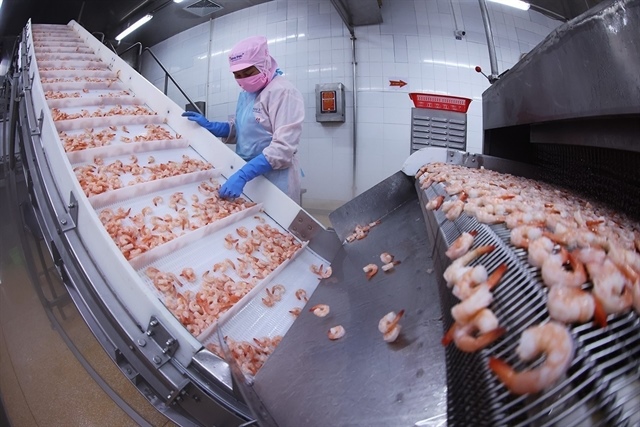
Shrimp processed for export at a plant of Minh Phú Corp in Cà Mau Province. The shrimp industry must also focus on the value farmers receive, environmental protection, biodiversity and meeting different standards and regulations in importing markets to enhance competitiveness. — VNA/VNS Photo Vũ Sinh |
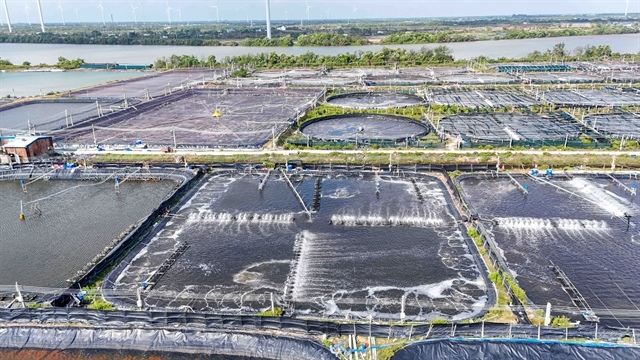
Việt Nam is seeking to promote sustainable shrimp production with higher value in the global market, but rising certification and compliance costs pose significant challenges.
Shrimp is the country’s leading seafood export product, accounting for about 46-50 per cent of the total seafood export value, said Trần Đình Luân, Director of the Department of Fisheries and Surveillance under the Ministry of Agriculture and Environment.
“Restructuring the shrimp sector is not only about expanding production,” Luân said.
“It must also focus on the value farmers receive, environmental protection, biodiversity and meeting different standards and regulations in importing markets.”
The restructuring is becoming more urgent as Vietnamese shrimp faces a significant cost disadvantage against major competitors.
Industry benchmark data showed that production costs in Việt Nam were estimated at about $4.25 per kg, compared with roughly $2.4 in Ecuador - a gap of 77 per cent.
This makes competing solely on price increasingly difficult and forces producers to reduce production risks while finding ways to capture more value at the processing and retail stages, experts say.
Việt Nam has built a significant base of certified shrimp production over more than a decade.
Barbara Janker, commercial director of the Aquaculture Stewardship Council (ASC), said Việt Nam had been an early adopter of sustainability certification.
The country is now the world's third-largest producer of ASC-certified shrimp by volume, with a total certified output of more than 50,000 tonnes. More than 500 Vietnamese shrimp farms have ASC certification, most of them small-scale operations linked into groups.
Demand for certified shrimp continued to expand in Europe, Janker said, pointing out that the number of ASC-labelled shrimp products had increased from about 7,000 in 2020 to more than 11,000 currently.
In the Benelux region and German-speaking countries, more than 80 per cent of shrimp products on supermarket shelves carry the ASC label, with a large proportion originating from Việt Nam, according to the director.
Việt Nam also has 20 feed mills participating in the ASC Feed Standard programme, of which 15 have been certified and five are undergoing initial assessments.
Antibiotics and chemicals remain among the biggest sustainability concerns for consumers. Shrimp treated with antibiotics cannot carry the ASC label, with independent auditors checking compliance through product sampling.
“However, that still happens,” Janker said, adding that eight Vietnamese farms had been suspended over antibiotic-related issues during the past two and a half years underscoring the challenges producers face in maintaining compliance.
Shrimp processed for export at a plant of Minh Phú Corp in Cà Mau Province. The shrimp industry must also focus on the value farmers receive, environmental protection, biodiversity and meeting different standards and regulations in importing markets to enhance competitiveness. — VNA/VNS Photo Vũ Sinh |
According to Trần Ngọc Thiên Kim, regional director of nutrition and aquaculture support at De Heus, producers often have to maintain several certification systems, including ASC, GlobalGAP and BAP.
"Sustainability is not free," she said, while questioning whether certification systems could eventually be better integrated to reduce duplicated paperwork, costs and potentially conflicting requirements.
Janker said the ASC had been working with other certification organisations on common assessment approaches and was looking at digitalisation to reduce administrative duplication and assessment costs.
A representative of meal-kit company HelloFresh said products such as peeled, marinated and breaded shrimp fit growing demand for convenient food and that Việt Nam was already an important supplier for such products.
Mike Turenhout, director of the Dutch Association of Seafood Importers, said younger European consumers were increasingly seeking convenient foods, an area where Việt Nam has developed a strong position. But value-added processing alone might not be enough to differentiate Việt Nam from competing with other suppliers.
Rival producers were also moving into higher-value products, said Alfons van Duijvenbode of the Netherlands’ Centre for the Promotion of Imports from Developing Countries (CBI), adding that Việt Nam may therefore need to combine value-added processing with other factors such as high-tech farming, ASC certification, responsible production and sustainability.
The European Union's Green Deal, its 2050 climate-neutrality goal and supply-chain requirements, would increasingly require European companies to account for environmental impacts across their supply chains, making early preparation essential for producers.
The challenge would not simply be to produce more sustainable shrimp, but to turn sustainability into a measurable market advantage that delivers higher returns to farmers, he said.
Joost van Uum, agricultural counsellor of the Netherlands in Việt Nam and Thailand, warned that it would be difficult to scale up sustainable production if higher standards did not translate into higher prices.
Melanie Siggs, global head of seafood at LRQA, said Việt Nam with its large processing plants should ensure that heads and shells are collected and used to produce higher-value products such as protein hydrolysates.
- 08:30 16/09/2026