Việt Nam has millions of stock accounts, but few long-term investors
Việt Nam has millions of stock accounts, but few long-term investors
Only around 6 per cent of Việt Nam's population is actually investing in the stock market, while most household financial assets remain outside the market

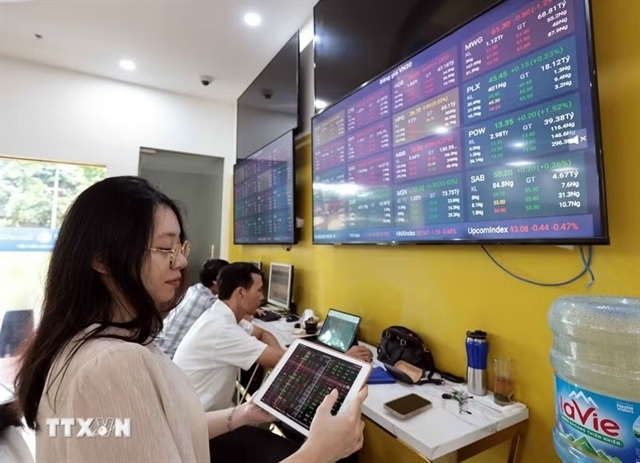
The stock market is expected to become a major channel for medium- and long-term funding to reduce the economy's reliance on banks. — VNA/VNS Photo Trần Việt |
Although Việt Nam's stock market has had nearly 13.7 million accounts with new highs in trading liquidity, only a small fraction of the population are active investors, which underscores the challenge of turning short-term speculation into long-term capital.
Data from the Vietnam Securities Depository and Clearing Corporation (VSDC) showed that by the end of July 2026, domestic investors held 13.605 million securities accounts, including 13.585 million individual accounts. Including foreign accounts, the total exceeded 13.65 million.
However, after removing duplicate accounts, only around 6 per cent of Việt Nam's population is actually investing in the stock market, while most household financial assets remain outside the market, Nguyễn Ngọc Linh, chief executive of DNSE Securities, said.
The gap highlights a persistent weakness in Việt Nam's capital markets that is attracting investors is easier than keeping them, Linh said.
Over roughly three decades of market development, individual investors have repeatedly followed a similar cycle, Linh said. Investors buy when asset prices are rising, driven by fear of missing out, then retreat after markets reverse and losses erode their confidence.
This cycle can bring money into the market quickly during rallies, but it can also inflate expectations. When actual returns fall short, investors may sell or withdraw funds instead of continuing to build their portfolios.
Nguyễn Sơn, chairman of VSDC's Members' Council, pointed that the Việt Nam's financial structure remained unbalanced with outstanding credit equivalent to about 146 per cent of GDP, compared with stock market capitalisation of just around 82 per cent of GDP.
The problem, Sơn said, was not that bank credit was too large, but that capital markets remained too small to share the burden of financing the economy.
That also helps explain why strong GDP growth does not automatically translate into higher stock prices, he added.
Việt Nam is seeking to address the imbalance by strengthening its capital markets.
The stock market development strategy through 2030 aims to diversify the investor base and improve the quality of individual investors in order to build pools of capital that can remain in the market through multiple economic and market cycles.
The need is becoming increasingly urgent as the country pursues faster economic growth. Việt Nam could require total social investment of about VNĐ38.5 quadrillion (US$1.5 trillion) between 2026 and 2030, or an average of VNĐ7.7 quadrillion a year, to achieve double-digit economic growth.
The Government aimed to lift stock market capitalisation to around 120 per cent of GDP by 2028 and strengthen the market as a major channel for medium- and long-term funding to reduce the economy's reliance on banks.
By the end of June, Việt Nam's stock market capitalisation stood at about VNĐ10.8 quadrillion, equivalent to 82.6 per cent of GDP in 2025, while the listed bond market was valued at around VNĐ2.8 quadrillion, or 22.1 per cent of GDP.
- 16:09 27/08/2026