Cheap imported pork adds pressure on domestic farmers
Cheap imported pork adds pressure on domestic farmers
Experts said pig farming must be developed through integrated supply chains linking breeding, farming, slaughtering, processing and final products to help producers control costs, improve traceability and strengthen their ability to compete with imported meat.
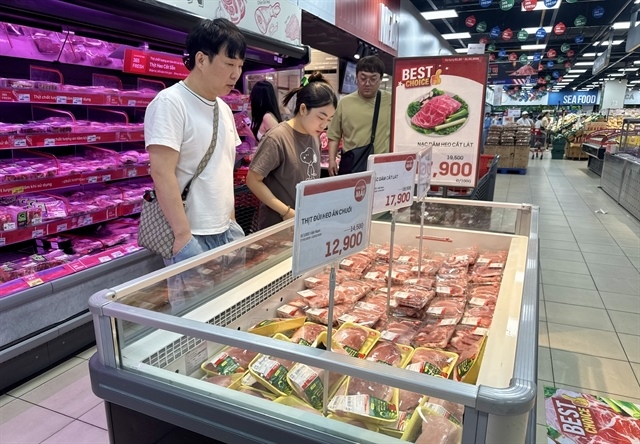
Consumers shop for meat products at a supermarket in HCM City. Việt Nam imported about 112,090 tonnes of fresh, chilled and frozen pork worth US$185.5 million from January to July. — VNA/VNS Photo Hương Giang |
Việt Nam’s pork imports rose sharply in the first seven months at competitive prices in the domestic market, adding significant pressure on local farmers already facing weak demand and higher production costs.
The country imported about 112,090 tonnes of fresh, chilled and frozen pork worth US$185.5 million from January to July, up 27 per cent in volume over the same period last year but down 21 per cent in value, according to data from the Ministry of Industry and Trade’s Import-Export Department.
Import prices averaged $1,638 per tonne, or VNĐ43,000 per kg, up to 28 per cent lower than domestic live hog prices, which are currently around VNĐ59,000 per kg.
Việt Nam imported pork from 19 markets with Brazil accounting for about 44.5 per cent of total imports, followed by Russia with 21.4 per cent and Spain with 20.5 per cent.
Brazil is expected to remain a major supplier as its pork industry expands. The Brazilian Animal Protein Association (ABPA) forecasts Brazil’s pork production at nearly 5.9 million tonnes in 2026, up about 5 per cent from 2025, while exports are expected to reach 1.6 million tonnes, up 6 per cent.
For 2027, ABPA projects production of about 6.1 million tonnes and exports of around 1.7 million tonnes, increases of 3 per cent and 6 per cent, respectively.
According to Nguyễn Kim Đoán, deputy chairman of the Dong Nai Livestock Association, live hog prices in Brazil are currently only about half those in Việt Nam.
He said rising import volumes and low import prices are putting significant pressure on domestic farmers, particularly as consumer demand remains low.
Meanwhile, domestic producers are also facing higher production costs.
Feed prices have risen several times since the beginning of the year, increasing the cost of raising pigs by about VNĐ300,000 per 100 kg of live weight, he said.
Some farmers are coming under profit pressure and may choose to sell animals earlier to limit risks, he added.
He said he expects prices to edge up after the summer, as demand from schools and traditional markets recovers.
Việt Nam exported about 10,700 tonnes of meat and meat products in the first seven months, worth $72.1 million, down 18 per cent year on year in volume but up 5 per cent in value. Hong Kong (China) was the largest destination, accounting for about 32.4 per cent of Việt Nam’s export volume.
According to industry experts from the Vietnam Livestock Association, solutions to promote the sustainable development of the pig farming sector will be needed to prevent excess supply.
The association said that supply is not yet in serious excess, but rising imports and further herd expansion can create a risk of oversupply if consumption does not increase at a similar pace.
Experts said pig farming must be developed through integrated supply chains linking breeding, farming, slaughtering, processing and final products to help producers control costs, improve traceability and strengthen their ability to compete with imported meat.
It is also important to strengthen biosecurity and disease control while reducing costs for feed, breeding stock, energy and logistics.
The association called for greater investment in high-quality genetics, centralised slaughtering, deeper processing, traceability and export brands.
The Ministry of Agriculture and Environment expects domestic live hog prices to edge higher in the coming months as demand from schools and traditional markets improves after the summer.
- 11:31 10/09/2026