$250 minimum wage demand risks factory closures, says economists
$250 minimum wage demand risks factory closures, says economists
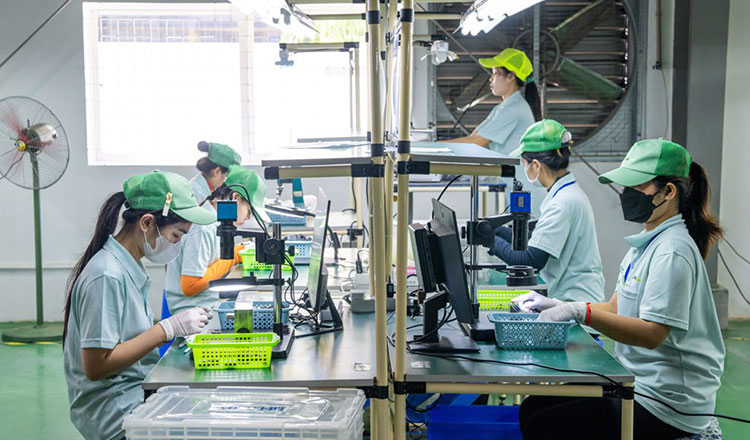
Cambodian economic experts warn that demands to raise the minimum wage to $250 could harm the country’s manufacturing sector, especially if wage increases aren’t matched by improvements in labour productivity and factory competitiveness.
Director-General of the Institute of China Studies at the Royal Academy of Cambodia Ky Sereyvath says a proposed minimum wage of $250 could be considered excessively high if wage adjustments are made without taking into account labour productivity, the capacity of factories and enterprises, and the broader investment environment.
“Regarding the proposal to raise the minimum wage to $250, I believe this is an excessively high level that could cause factories and enterprises to close because labour costs become too expensive,” he says.
He also warns that higher labour costs could increase the risk of factories relocating to other countries in the region that compete with Cambodia in garment manufacturing.
Countries such as Myanmar, Bangladesh, Sri Lanka, Pakistan and Vietnam could potentially attract manufacturers seeking lower production costs, he notes.
“If we compare Cambodia with other countries, particularly Vietnam, labour productivity there is high. Only Ho Chi Minh City has a minimum wage roughly comparable to Cambodia, while other areas have lower minimum wages,” Sereyvath explains.
Meanwhile, an economist and business researcher at the Royal Academy of Cambodia (RAC), Hong Vannak, says minimum-wage negotiations should be based on concrete evidence from both workers and employers, taking into account inflation, workers’ living costs and employers’ ability to absorb higher labour expenses.
“Setting the minimum wage should also take into account the actual conditions of factories and enterprises and production costs, including transportation, logistics, supply chains and raw materials, in order to determine an appropriate wage level,” he states.
The comments come as a small number of trade unions launch a campaign calling for a $250 basic monthly wage for 2027.
The tripartite minimum-wage negotiation mechanism, involving the government, employers and workers’ representatives, has already held five rounds of discussions on the 2027 minimum wage.
- 07:59 18/09/2026