Vietnam needs $700 billion to achieve net-zero roadmap
Vietnam needs $700 billion to achieve net-zero roadmap
Vietnam will need to mobilise around $700 billion to support its green transition and fulfil its commitment to net-zero emissions by 2050.
Speaking at the Vietnam Green Finance Conference 2026 on August 6, Assoc. Prof. Dr Nguyen Huu Huan, vice chairman of the Executive Board of Vietnam International Financial Centre - Ho Chi Minh City (VIFC-HCMC), said Vietnam needed an additional $368 billion in investment capital by 2040 to pursue a climate-resilient growth model and advance its net-zero roadmap.
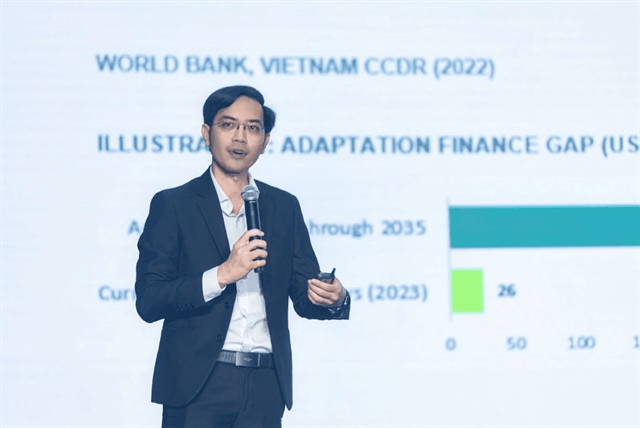
Assoc. Prof. Dr Nguyen Huu Huan, vice chairman of the Executive Board of the Vietnam International Financial Centre in Ho Chi Minh City. Photo: VIFC-HCMC |
Globally, financing needs for climate change adaptation in developing countries through 2035 are estimated to be 12–14 times the current level of international public finance flows. Meanwhile, the cost of capital for many clean energy projects in emerging markets can be at least twice as high as in developed economies and China.
“The issue is no longer whether the market has green standards, but who will help projects become investment-ready, share initial risks, measure performance, and provide liquidity after issuance,” Huan said.
He noted that the green capital mobilisation chain could still face gaps at multiple stages, from climate commitments and project preparation to risk mitigation, measurement, reporting and verification, capital mobilisation, and secondary-market trading. A lack of coordination at any one link could increase the cost of capital or prevent transactions from being completed.
Comparing Vietnam with financial centres such as London, Singapore, Hong Kong, Luxembourg and Abu Dhabi, Huan said these markets have developed relatively comprehensive systems of standards, disclosure mechanisms, and distribution channels for green financial products.
“The gap that VIFC-HCMC could focus on lies upstream, including project preparation, cash-flow structuring, and bringing projects to a stage where they can access investors,” he said.
Under the proposed roadmap, the initial phase would prioritise developing a green and transition taxonomy compatible with international standards, while selecting around 10 pilot projects across multiple sectors. Over the following six to 18 months, the market could establish a project-preparation facility, introduce guarantee mechanisms, and complete three to five landmark transactions.
The proposed targets are to mobilise around $500 million in green and transition capital in the first 12 months, $2-3 billion by the end of 2027, and more than $10 billion by 2030.
However, these are still proposed targets and will need to be adjusted based on actual resources, the availability of concessional finance, and the participation of guarantee partners.
Vo Hoang Hai, deputy CEO of Nam A Bank, said most green capital currently flowed through the banking system. When commercial banks receive funding from the IFC, ADB and other international financial institutions, they also take on requirements relating to risk management, disclosure, environmental, social, and governance impact assessment, and green classification systems.
“These requirements are then integrated into the appraisal, credit approval and capital-use monitoring processes for corporate customers, gradually creating a common language among investors, banks and businesses,” Hai said.
According to the World Bank’s Country Climate and Development Report, Vietnam will need around $368 billion in additional investment by 2040 to meet its climate adaptation and emissions reduction objectives, with the private sector expected to provide around half of the total financing requirement.
- 09:00 07/08/2026