More Dutch firms seek Vietnamese suppliers as manufacturing ties deepen
More Dutch firms seek Vietnamese suppliers as manufacturing ties deepen
Việt Nam has made significant progress in strengthening its position in global manufacturing and now has the capabilities needed to participate more deeply in international supply chains.
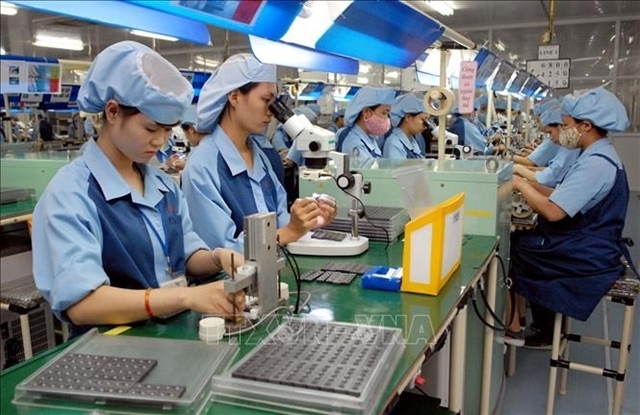
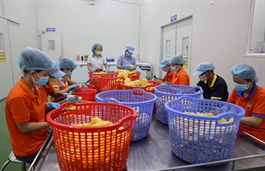
Workers producing electronic components at a plant in Hưng Yên Province. — VNA/VNS Photo |
More Dutch companies are looking to source precision engineering, semiconductors and advanced manufacturing products from Vietnamese suppliers as global companies diversify their supply chains, opening new opportunities for companies to integrate into Europe's high-tech industrial ecosystem.
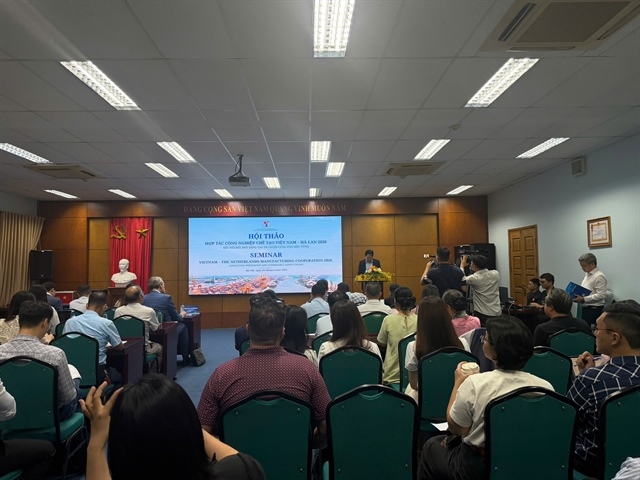
The opportunity was highlighted at the Việt Nam–Netherlands Manufacturing Cooperation Workshop held in Hà Nội on July 6.
Rick Slettenhaar, deputy ambassador of the Netherlands to Việt Nam, said Việt Nam has made significant progress in strengthening its position in global manufacturing and now has the capabilities needed to participate more deeply in international supply chains.
"Many Vietnamese companies already possess strong manufacturing capabilities," he said.
"The next step now is to connect these capabilities with international supply chains."
He noted that the Netherlands' high-tech industry, including companies specialising in precision manufacturing, mechatronics and semiconductor equipment, depends heavily on extensive international supplier networks and is continuously searching for reliable manufacturing partners.
"This is why cooperation between Dutch and Vietnamese ecosystems in the field of high-tech is growing," he said.
Slettenhaar pointed to companies such as ASML, the global leader in semiconductor lithography systems, which is strengthening supply chain connections in Việt Nam. Other Dutch firms, including VDL and Technotion, are also expanding their operations and supplier networks in the country.
"At the same time, more Dutch companies are looking to source more from Việt Nam," he added.
To facilitate those partnerships, he encouraged Vietnamese enterprises to participate in Dutch Precision Week this November, describing the event as a gateway to the Netherlands' high-tech manufacturing ecosystem.
The exhibition will allow businesses to meet original equipment manufacturers (OEMs), Tier 1 and Tier 2 suppliers, technology institutes and potential business partners while gaining a better understanding of market requirements.
"Many successful business partnerships start with a first conversation. The Dutch Precision Week is an ideal place to do so," Slettenhaar said.
The growing interest from Dutch manufacturers comes as Europe reshapes its industrial strategy around resilient supply chains, low-carbon production and advanced manufacturing.
Bùi Quang Hưng, Deputy Director General of the Trade Promotion Agency under the Ministry of Industry and Trade, said manufacturing has become increasingly important as the global economy undergoes structural changes driven by digital transformation, green development and supply chain diversification.
The European Union is promoting industrial policies that prioritise resilient supply chains, carbon reduction, smart manufacturing and innovation.
Hưng described the Netherlands as one of Europe's leading logistics, trade and high-tech manufacturing hubs, making it an ideal partner for Việt Nam.
"With strengths in precision engineering, semiconductors, automation, smart logistics and the circular economy, the Netherlands is not only an important trading partner but also a highly promising partner for investment cooperation, technology transfer and supply chain development with Việt Nam," he said.
Workers producing electronic components at a plant in Hưng Yên Province. — VNA/VNS Photo |
Although Việt Nam has become a manufacturing base for multinational corporations in electronics, precision engineering, electrical equipment and other high-tech sectors, Hưng acknowledged that domestic companies still generate relatively limited value added because many remain concentrated in assembly work and the production of simple components.
For Vietnamese enterprises hoping to become suppliers to Dutch manufacturers, Võ Thị Ngọc Diệp, trade counsellor at the Vietnam Embassy in the Netherlands, said the Netherlands offers advantages beyond its domestic market.
Goods entering through the Netherlands can circulate throughout the EU single market without additional intra-EU customs procedures, making the country an effective gateway to Europe.
Rather than relying on broad trade promotion campaigns, Diệp proposed shifting towards sector-specific supplier development programmes targeting precision engineering, electronics, semiconductors, automation and supporting industries.
She recommended combining trade missions with factory visits, technical consultations and business matching programmes before international exhibitions while incorporating Dutch Precision Week into Việt Nam's national trade promotion activities.
Diệp also urged stronger support to help manufacturers comply with EU technical requirements through training on CE marking, machinery regulations and RoHS standards, alongside programmes that improve export readiness.
For businesses themselves, she advised preparing English-language corporate profiles, comprehensive technical documentation and internationally recognised certifications while responding quickly to sample orders.
She said enterprises should gradually move away from competing primarily on price and instead differentiate themselves through quality, innovation, transparency, reliable delivery and after-sales services.
The Vietnam Trade Office in the Netherlands will continue providing market information, connecting business partners and supporting practical cooperation projects as more Dutch companies explore sourcing opportunities in Việt Nam, Diệp added.
- 11:20 07/08/2026