Việt Nam looks to develop materials industry to strengthen strategic autonomy
Việt Nam looks to develop materials industry to strengthen strategic autonomy
The materials industry forms the foundation of industrial development and is critical to strengthening strategic autonomy, national competitiveness and the ability to master core technologies.
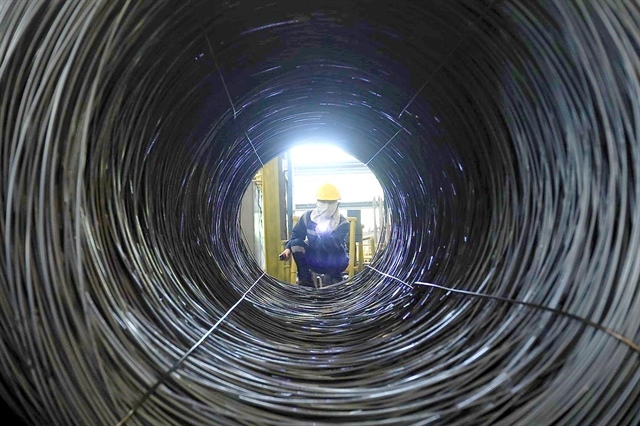
Steel products made by Hoà Phát Group. Materials are essential inputs and a prerequisite for the development of key industries and strategic technology products. — VNA/VNS Photo Tuấn Anh |
Việt Nam is looking to develop its materials industry to strengthen strategic autonomy, national competitiveness and its ability to master core technologies, as the country pushes for more self-reliant, rapid and sustainable growth.
The effort is outlined in the Politburo’s Conclusion 83-KL/TW issued on August 8, which sets out key directions and targets for the development of Việt Nam's materials industry.
In the conclusion, developing the materials industry is identified as a strategic national task. The materials industry forms the foundation of industrial development and is critical to strengthening strategic autonomy, national competitiveness and the ability to master core technologies.
Materials are essential inputs and a prerequisite for the development of key industries and strategic technology products.
Despite recent progress, the Politburo said the development of the materials industry had yet to match the country's potential and advantages.
The sector remains heavily reliant on resource extraction and energy-intensive production, while deep processing, recycling and the mastery of core and high technologies remain limited. Production is characterised by low added value and high emissions and environmental pollution, while Việt Nam remains heavily dependent on imports for high-quality, high-tech and specialised materials.
A shift from relying on natural resource advantages to mastering materials technologies is therefore needed, and from extensive growth towards deeper and higher-value development, with the goal of gradually taking control of upper levels in global value chains.
In the conclusion the Politburo called for a focused approach, concentrating resources on key and foundational segments with the potential to create spillover effects and drive the development of other industries, rather than pursuing fragmented and broad-based investment.
It said materials production should be closely aligned with market demand and the transition towards greener, recycled and circular production, with lower emissions and more efficient use of natural resources and energy.
Management of strategic minerals would be tightened across the entire value chain, from exploration and planning to mining, refining, materials production, recycling and strategic stockpiling. Exports of raw minerals should be minimised.
The conclusion also called for a comprehensive review of laws and regulations governing minerals, technology transfer, land and natural resources to create a more modern, transparent and stable environment for investment in the materials industry.
Special and preferential mechanisms should be considered to help Việt Nam master technologies for producing strategic and high-value materials, including those used in semiconductors, new energy, defence, security, dual-use applications and future industries.
Steel products made by Hoà Phát Group. Materials are essential inputs and a prerequisite for the development of key industries and strategic technology products. — VNA/VNS Photo Tuấn Anh |
Việt Nam aims to develop a national strategy for building the materials industry through 2030 by the fourth quarter of 2026.
The strategy will prioritise the development of closed industrial chains covering mining, processing, deep processing and final products, particularly in rare earths, battery, magnetic, electronics and semiconductor materials, as well as aluminium, steel, titanium, non-ferrous metals, specialised alloys and other advanced materials.
By 2027, Việt Nam aims to establish a national database for the materials industry and complete the integration of geological and mineral data. The country also aims to set up at least three to five national materials research centres by 2028.
The country hopes to master selected deep-processing technologies for rare earths, semiconductor materials and battery materials by 2030, while also raising the localisation rate of some strategic materials to 50 per cent.
In the conclusion, the industry’s development has been divided into three groups: basic materials, strategic materials and future materials.
For basic materials, the focus will be on maintaining production capacity, ensuring stable supplies and improving quality, efficiency and competitiveness. Industries including metallurgy, chemicals, polymers, technical rubber and construction materials will be restructured and modernised to reduce energy and resource use and increase the share of high-tech and high value-added products.
Việt Nam aims to raise State, private and foreign investment to gradually develop technologies and supply chains for strategic materials, including semiconductor and electronic materials, rare earths, batteries and energy storage, magnetic materials, specialised alloys and materials used in defence, renewable energy, aerospace and other high-tech industries.
The country will also prepare for the development of future materials, including next-generation nanomaterials and two-dimensional materials, quantum, biological, smart and self-healing materials, superconductors, advanced composites and next-generation materials for energy absorption, storage and conversion.
Science, technology, innovation, digital transformation and skilled workers are identified as the main drivers of the materials industry’s development in the conclusion, which called for the establishment of an ecosystem involving the State, enterprises, research institutes, universities and localities.
Incentives will be raised to upgrade materials production towards greener and more sustainable models, promote recycled and environmentally friendly materials and reduce greenhouse gas emissions.
Việt Nam also hopes to attract major high-tech projects, global technology groups and leading materials companies, linking preferential policies with requirements for technology transfer, workforce training, greater localisation and stronger links with domestic businesses.
- 09:27 17/08/2026