Việt Nam seafood exports could top $12 billion despite gathering headwinds
Việt Nam seafood exports could top $12 billion despite gathering headwinds
The industry will have to contend with four major challenges: higher tariffs, stricter traceability requirements, rising input costs, and intensifying competition in key markets.
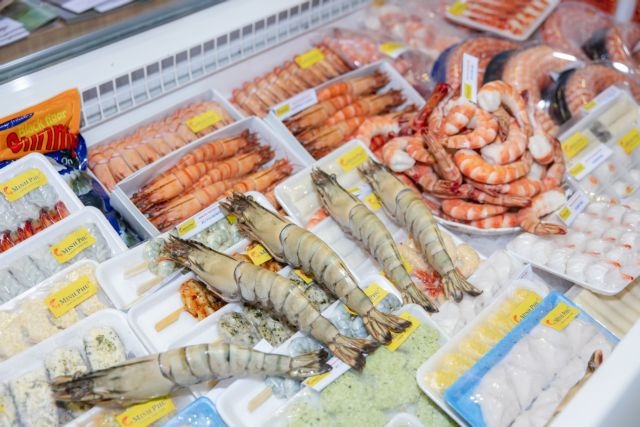
Seafood products on display at VIETFISH 2025 in HCM City. Vietnamese seafood exporters face mounting challenges from tariffs, rising input costs, and intense competition in key markets. — Photo courtesy of VASEP |
Seafood exports are expected to top US$12 billion this year, but, according to the Vietnam Association of Seafood Exporters and Producers, the industry will have to contend with four major challenges: higher tariffs, stricter traceability requirements, rising input costs, and intensifying competition in key markets.
VASEP said seafood exports in the first seven months of the year were up 11.5 per cent year-on-year at $6.78 billion.
Commenting on the prospects for the final five months, Lê Hằng, deputy general secretary of VASEP, said the outlook would increasingly depend on developments in major markets and the impact of trade policies.
She listed the challenges facing the industry.
The first is the US Government’s imposition of additional tariffs under Section 301 of the Trade Act of 1974 on 60 economies, including Việt Nam.
Vietnamese goods entering the US market have been subject to an additional tariff of 12.5 per cent since July 24 this year.
Seafood products affected include shrimp, tuna, pangasius, squid, and frozen items.
The tariff puts Vietnamese exporters at a disadvantage against some major shrimp suppliers to the US such as Ecuador, India, and Indonesia, which only pay a 10 per cent tariff.
The impact is particularly severe for shrimp exporters since some of their products are also subject to anti-dumping and countervailing duties.
When combined, the duties can push the total tariff burden on some products to 30 per cent, making it extremely difficult for Vietnamese shrimp to compete in the US market.
The second challenge is compliance with traceability and certification requirements, including those under the US Marine Mammal Protection Act and Certificate of Admissibility and the EU’s Illegal, Unreported and Unregulated fishing rules.
These requirements are particularly affecting wild-caught seafood and tuna.
The third challenge is rising aquaculture input costs, driven by higher ocean freight and global fishmeal prices amid low output in Peru, one of the world’s major producers.
The fourth is market competition.
This could be the biggest challenge because there is stiff competition for Vietnamese seafood in major markets including the US, EU, and China.
In the US, Việt Nam finds it difficult to compete with Ecuador and India in terms of tariffs, geographical location, logistics, and prices.
In China, demand is huge, but buyers demand low prices and competition with Ecuador is growing increasingly fierce.
In the EU, rising white meat fish prices create opportunities for pangasius, but certification requirements are becoming increasingly stringent.
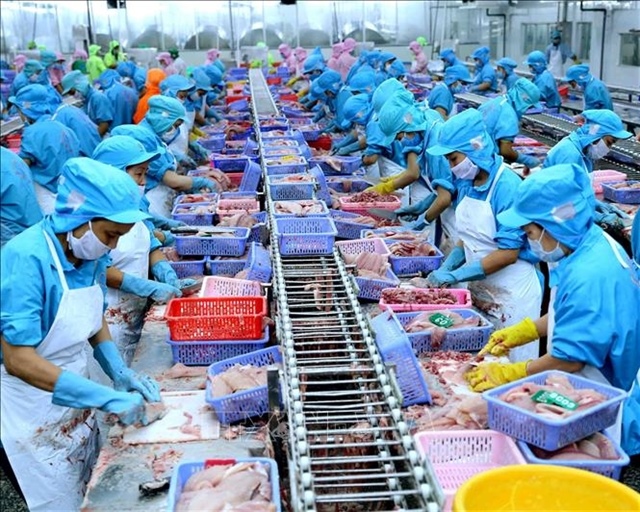
Seafood products on display at VIETFISH 2025 in HCM City. Vietnamese seafood exporters face mounting challenges from tariffs, rising input costs, and intense competition in key markets. — Photo courtesy of VASEP |
Three export scenarios
Based on export performance in the first seven months and developments in trade policies and demand in major markets, VASEP outlined some possible scenarios.
In the best case, they could exceed $12.5 billion, representing growth of more than 12 per cent, if the barriers in the US market are removed or tariff policies change favourably. But VASEP considers this unlikely in the near term.
Under the cautious scenario, exports could reach $11.8–12 billion, or around 3–5 per cent increase, if orders fall sharply, Vietnamese shrimp loses further ground to Ecuador, EU demand recovers slowly and growth in other markets loses momentum.
In the base-case scenario, which VASEP considers the most likely, seafood exports are expected to reach $12.1–12.3 billion, representing growth of 8–10 per cent.
This scenario assumes that exports to China continue to expand, shipments to Japan and other countries in the Comprehensive and Progressive Agreement for Trans-Pacific Partnership (CPTPP) remain stable, and exports to the US and EU do not decline sharply.
Hằng said: “Overall, we still expect Việt Nam’s seafood exports to reach $12–12.3 billion in 2026. This means achieving double-digit growth will be difficult, with exports more likely to increase by 8.5–9 per cent.
“Shrimp will remain the industry’s largest product category and the main driver of growth, but it will also face the greatest competitive pressure.
“Pangasius is expected to have a more stable outlook, while tuna will certainly face greater difficulties. Crab, sentinel crab, and lobster are likely to be key growth drivers, particularly in the Chinese market.”
Meanwhile, the US, EU and Japan would remain important traditional markets for Việt Nam, but export growth would likely slow in the final months of the year, she said.
Nguyễn Hoài Nam, general secretary of VASEP, said the business community was making efforts to maintain production, and VASEP would regularly report to the Government, suggesting measures to address difficulties faced by businesses.
- 07:23 17/08/2026