The ‘infrastructure’ connecting VBSP with borrowers
The ‘infrastructure’ connecting VBSP with borrowers
Vietnam’s policy credit system relies on a grassroots network that connects VBSP with borrowers, channels capital to communities, monitors its use and strengthens financial discipline.
A total of 165,303 Savings and Credit Groups (SCGs) of Vietnam Bank for Social Policies (VBSP) are currently present in villages, hamlets, residential areas and neighbourhoods across the country.
This is the network closest to borrowers, where financing needs are identified, loans are monitored after disbursement, and difficulties faced by borrowing households are reported back to the bank.
With policy credit, SCGs are not merely places where borrowers come together, but part of the infrastructure that delivers policy to the grassroots level.
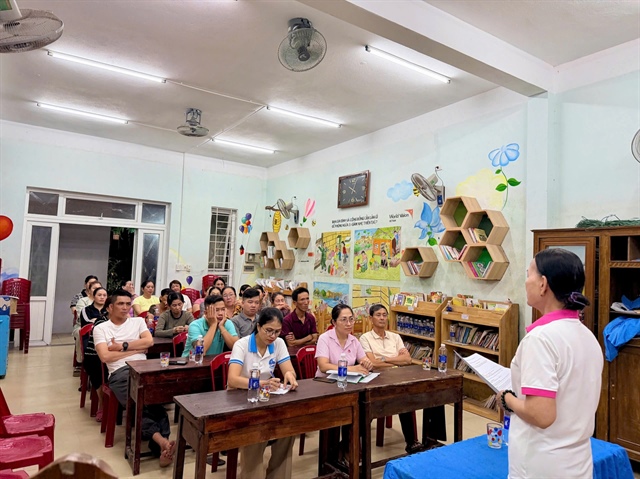
Savings and Credit Groups serve as an effective link between the bank and residents. Photo: VBSP |
A meeting of an SCG in residential groups in Son Tra ward, Danang, takes place much like a neighbourhood meeting. Residents hear about policy information, exchange views on their businesses, remind one another about savings deposits and debt repayment schedules.
Behind that meeting is an entire process. SCGs take part in reviewing and selecting borrowers, guiding them through paperwork, coordinating with local socio-political organisations and grassroots authorities, and informing borrowers of disbursement schedules.
Once the capital reaches residents, the groups continue to monitor how the funds are used, remind borrowers to repay principal, collect interest and monthly savings deposits, and disseminate new VBSP policies.
The distinctive feature of this network lies in the very short distance between those managing the capital and the borrowers.
Le Thi Chau, head of an SCG under the Women’s Union of Son Tra Ward, often visits households that remain hesitant about taking out loans.
Some people do not yet understand the borrowing conditions, while others have not identified a suitable production plan. For Chau, if people are to feel confident about borrowing, they first need to understand what the loan will be used for and what source of income will enable them to repay it.
After disbursement, Chau continues to keep track of each household's situation. Her visits help identify early difficulties in production and business activities and in the use of the funding.
In other case, Le Thi Kim Son has served as an SCG head for more than 20 years and currently oversees 50 members with total outstanding loans of more than $120,000, with no overdue principal or outstanding interest for many years.
Son believes that effective capital management starts with understanding the circumstances of each household, from its borrowing needs to its ability to use and repay the capital.
These tasks add another layer of information at the local level. Whether a plan is suitable, whether production activities are progressing smoothly or encountering difficulties, and whether borrowers are fulfilling their commitments – all these issues can be identified earlier when someone within the community is monitoring them.
SCGs are therefore not simply places where people who borrow money come together, but a connecting layer between the bank and residents, where credit policies are translated into practical guidance suited to individual circumstances.
The ‘touchpoint’ of policy credit
Viewed across the system as a whole, the role of SCG network is becoming increasingly apparent. As of June 30, VBSP maintained 9,964 transaction points and 165,303 SCGs in all communes, wards and special administrative zones across the country.
Total capital stood at approximately $19 billion, while total outstanding policy credit was about $18.12 billion, with nearly 6.7 million households still carrying outstanding loans.
Overdue loans accounted for just 0.20 per cent of total outstanding loans. At this scale, SCGs are no longer merely a supplementary support network.
They constitute a distinctive credit-delivery infrastructure, helping VBSP maintain a presence close to residents at the grassroots level. This model is based on the participation of the bank, grassroots authorities, local socio-political organisations and the management boards of SCGs.
A VBSP study on policy credit in ethnic minority and mountainous areas found that 98.8 per cent of respondents rated the effectiveness of lending through SCGs and local socio-political organisations positively.
The network also operates in two directions. If one side is the flow of capital from the bank to residents, the other is the flow of savings deposits, information about loans and repayment discipline from residents back into the system.
In An Hai ward (Danang), Hoang Xuan Nhi manages 59 members with outstanding loans of more than $212,000. All members participate in savings, with their deposits reaching $11,400.
For Nhi, encouraging members to save money is not only about increasing their accumulated savings but also about helping borrowers develop financial habits and become more proactive when repayment dates arrive.
On a larger scale, as of the end of May 2026, the network of SCG jointly managed by the Vietnam Women's Union had nearly 2.47 million borrowing households, with members' savings deposits reaching $307 million.
Thus, SCGs do not merely help capital flow from VBSP down to residents. The network also creates a reverse flow of information, savings and financial discipline.
Behind a policy loan, therefore, there is not merely the bank and the borrower. There is an entire intermediary system that understands borrowers, monitors the use of capital and helps establish financial discipline.
For VBSP, this is not a network operating outside credit activities, but an integral part of the policy-credit model.
- 15:28 26/08/2026