Tax administration for large enterprises requires different approach
Tax administration for large enterprises requires different approach
Compliance risks for large enterprises go beyond tax registration, filing and payment, with greater challenges arising from tax liability determination, related-party transactions and transfer pricing. Improving tax administration for large taxpayers is an urgent priority that requires a tailored approach.
The Department of Taxation held a working session with a delegation of International Monetary Fund (IMF) experts on August 17 to exchange experience, assess the current state of tax administration and explore ways to reform the tax administration model for large enterprises, with a focus on strengthening compliance risk management and aligning with international practices.
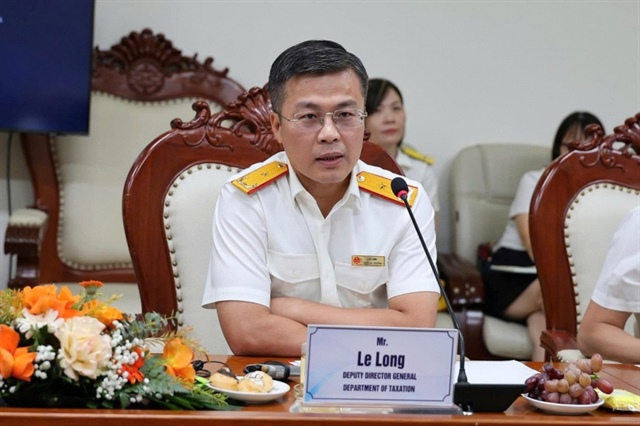
Le Long, deputy director general of the Department of Taxation. Photo: Phuong Thao |
Speaking at the meeting, deputy director general of the Department of Taxation Le Long said the IMF’s recommendations on assessing tax administration performance, managing compliance risks and modernising taxpayer administration were valuable both technically and practically for Vietnam’s tax authorities.
The Department of Taxation is studying and incorporating a number of these recommendations into ongoing efforts to improve the legal framework, restructure its organisational system, reform business processes and modernise tax administration methods, he said.
Vietnam’s tax sector is entering a period of far-reaching reform, with significant changes to the legal and administrative framework. The Law on Tax Administration, No.108/2025/QH15, and its implementing regulations took effect on July 1, 2026, providing a new legal framework for tax administration.
"Alongside the transition to a new organisational structure, the tax sector is accelerating digital transformation, making greater use of electronic invoice data and interconnected databases, strengthening risk analysis and compliance management, and expanding digital tax services," he said.
"These changes create opportunities to improve the efficiency of tax administration while placing greater demands on governance capacity, data quality, business processes, technology and the skills of tax officials," he added.
Regarding tax administration for large enterprises, Long said its Large Enterprise Tax Branch currently directly manages 393 enterprises, including major corporations, state-owned groups, large foreign-invested companies and businesses operating in specialised sectors. Tax revenue from this group accounts for approximately 25 per cent of total domestic tax revenue.
Large taxpayers typically have significant scale and broad operations, complex ownership and organisational structures, and extensive related-party and cross-border transactions. They also engage in specialised financial activities and new forms of business arising from the digital economy.
"Compliance risks for these enterprises extend beyond registration, tax filing and payment. They increasingly involve the determination of tax liabilities, related-party transactions and transfer pricing, the allocation of costs and capital, the valuation and use of intangible assets, income from specialised business activities, the application of tax treaties and the treatment of emerging business models," Long said.
As a result, tax administration for large enterprises cannot rely solely on individual inspections or risk mitigation after problems have emerged. Tax authorities need to identify risks at an earlier stage, allocate resources strategically, tailor management measures to taxpayers’ levels of compliance and provide stronger support to help businesses meet their tax obligations, he added.
The Department of Taxation outlined five key expectations for the cooperation programme. These include an independent and objective assessment of the functions, responsibilities, organisational structure, staffing and core business processes of the Large Enterprise Tax Branch; an assessment of its current maturity in applying compliance risk management and the gaps compared with international practices; recommendations on tools that can be implemented immediately; a feasible future operating model with performance indicators; and an action plan for reform that can serve as the basis for translating the recommendations into specific tasks.

Patrick De Mets, an IMF expert. Photo: Phuong Thao |
Speaking at the session, Patrick De Mets, an IMF expert, welcomed the Department of Taxation’s proactive approach to reforming tax administration, particularly its shift from traditional administration towards a model based on taxpayers’ risks and levels of compliance.
As business activities become increasingly complex, developing a specialised administration model for large enterprises is essential, Mets said. Such a model would enable tax authorities to focus resources on high-risk sectors, businesses and transactions while improving support for taxpayers with strong compliance records.
“Managing large enterprises requires a different approach. Tax authorities need to understand taxpayers’ business activities, identify risks at an early stage and develop appropriate strategies to improve compliance across different taxpayer groups. International practices should be adapted to Vietnam’s circumstances, with feasibility and administrative effectiveness as key priorities,” Mets said.
The working programme between the Department of Taxation and the IMF delegation provided a stronger practical basis for further reforming the administration of large enterprises, improving compliance risk management, making more effective use of resources and gradually aligning Vietnam’s tax administration with international best practices.
The cooperation is also expected to support the tax sector’s broader efforts to modernise its administration system in line with the requirements of the new reform phase.
- 09:00 18/08/2026