FX pressures to persist but remain manageable in H2: HSBC
FX pressures to persist but remain manageable in H2: HSBC
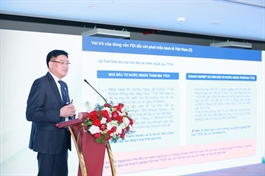
Ngo Dang Khoa, country head of Markets and Securities Services at HSBC Vietnam, spoke with VIR’s Hong Dung about the outlook for Vietnam’s FX market, the USD/VND exchange rate, and key risks shaping market expectations in the second half.

Ngo Dang Khoa, country head of Markets and Securities Services at HSBC Vietnam |
As demand rises for imported machinery, raw materials and cross-border payments, how do you expect this to impact FX supply and demand and the USD/VND exchange rate in the second half?
H1 saw a clear pick-up in Vietnam’s trade activities, with both exports and imports rising strongly. From a growth perspective, this is positive as it suggests businesses are scaling up production, preparing for orders and increasing investment for the next phase. Especially, the sharp rise in imports of machinery, equipment, components and input materials indicates that import demand is largely driven by production and investment rather than consumption.
However, from an FX market perspective, this also means onshore demand for foreign currency (FCY) has increased meaningfully. As companies import more, demand for USD to settle cross-border payments rises accordingly. Meanwhile, although exports remain solid, import growth is running faster, leading to the goods trade balance and the current accounts are less ample than last year.
As a result, the economy’s FX buffer is relatively thinner, and the exchange rate may become more sensitive to both domestic and external volatility.
In the second half, these pressures may become more visible due to seasonality. The third quarter (Q3) is typically when businesses ramp up input imports for the year-end production cycle.
It is also a time when FDI companies carry out profit repatriation, intercompany settlements, or cash-flow rebalancing. As a result, foreign currency supply-demand is likely to remain tighter than in the same period of some previous years.
Even so, my base-case view is that USD/VND will see a moderately upward move. Vietnam still benefits from key supportive factors, including strong GDP growth, healthy FDI disbursement, a robust tourism recovery and a broadly positive export outlook.
In addition, the State Bank of Vietnam has demonstrated proactive management through open market operations, FX forwards sales and system liquidity management.
USD/VND may continue to climb in line with the broader global strength of the US dollar and domestic FCY demand, but moves are likely to remain within the authorities’ active management range.
In this cycle, how is the relationship between the exchange rate and interest rate different from previous years?
The key difference in this cycle is that the relationship between the exchange rate and interest rate has become more flexible and more dynamic. In some earlier periods, market tended to assume a more straightforward linkage: if FX pressure rose, interest rate would need to increase to defend the local currency. Today, the policy trade-offs are far more complex.
This is because Vietnam is in a stronger growth cycle with higher credit demand. At the same time, FX pressure is driven by external factors such as a stronger USD, but also by structural domestic FCY demand linked to trade, investment and payments.
This means interest rates are no longer used solely to support the exchange rate; they also need to balance multiple objectives at once, including supporting growth, managing inflation, maintaining system liquidity and anchoring market expectations.
Another notable point is that in the first half of the year, even though policy rates were unchanged, deposit rates and interbank rates elevated and stayed at higher levels. This highlights a more flexible operating framework: policy rates do not necessarily need to change, while expectations can still be managed through liquidity conditions and open market operations.
How do you see domestic and international investor expectations towards the VND evolving?
From a financial market perspective, expectations towards the VND have become more realistic and more selective. Previously, when external balances were favourable and FCY supply was abundant, the VND was often viewed as one of the more stable currencies in the region.
Today, investors still have confidence in the VND’s fundamentals, but they are monitoring near-term drivers more closely such as onshore FCY demand, trade dynamics, FDI flows, and the global rate environment.
There are signs showing market sentiment has become more cautious. For example, the exchange rate has been more responsive to domestic FCY demand, and short-term VND rates have been maintained at levels that help support market stability and expectations. However, I see this as a re-pricing for better rather than a loss of confidence.
On the positive side, the key supports for the VND remain resilient growth, strong FDI disbursement, strong tourism recovery and continued progress on the equity market upgrade, all of which support investor sentiment. Therefore, the market is not necessarily more negative on the VND; rather, it is assessing the currency in a more data-driven, balanced and realistic way.
Which risks do markets still seem optimistic about, but could quickly change expectations for interest rates and exchange rates in the final months of the year?
One risk that the market may still be relatively optimistic about is the possibility of multiple pressures converging at the same time. Each factor on its own may still look manageable: oil prices have cooled from peak stress levels, inflation eased in June, the Fed has not delivered a fresh shock, and the exchange rate has been moving within a managed range.
However, if the second half witnesses three factors occurring simultaneously, for example energy prices rising once again, the Fed staying higher for longer than expected, and a seasonal spike in onshore FCY demand, market expectations could shift rapidly.
I would highlight external risks, especially the trajectory of the global USD. HSBC’s current view is that the USD could strengthen gradually, supported by growth and rate differentials.
If that trend persists, pressure on Asian currencies, including the VND, may come less from a single shock and more from a steady shift in market expectations.
Another risk is that the market may be somewhat optimistic about how quickly the trade balance improves in the second half. While imports are largely driven by production needs, if export growth does not accelerate enough to absorb the imported inputs, pressure on the external balance could last longer than expected.
- 08:00 02/08/2026