FDI listing hurdles lie beyond securities law
FDI listing hurdles lie beyond securities law
With the current position of Vietnam's stock market, the State Securities Commission expect foreign-invested enterprises to become one of the key providers of high-quality listings for the market, reflecting its integral role in the economy.
Speaking at the seminar "From Private to Public: The Listing Roadmap for FDI Enterprises in Vietnam," jointly organised by SSI and Daiwa Securities Group in Hanoi on July 28, Hoang Van Thu, vice chairman of the State Securities Commission (SSC), said the presence of foreign-invested enterprises (FIEs) on Vietnam's stock market remained disproportionately small compared to the sector's scale and contribution to the economy.
"Since Vietnam's stock market was established, only 11 FIEs have completed listing or registered for trading. Today, just 10 remain among nearly 1,600 listed and registered public companies across the market," Thu said. "By the end of 2025, these companies had a combined charter capital of approximately $505.2 million and total assets of around $1.79 billion, accounting for only 0.15 per cent and 0.48 per cent of the market, respectively."
According to Thu, since 2017, four additional FIEs have completed the procedures required to become public companies, but none has subsequently proceeded to list or register for trading.
"These figures highlight the significant gap between FIEs' contribution to Vietnam's economy and its representation in the capital market," he said.
Thu noted that Vietnam issued Decree 38 as early as 2003, allowing FIEs to convert into joint-stock companies and list on the stock market. However, successive amendments to the Law on Enterprises and the Law on Investment later created inconsistencies across the legal framework, making it difficult for many FIEs to pursue listing.
Between 2014 and 2020, the MoF repeatedly submitted proposals to the government aimed at facilitating the participation of FIEs in the stock market, although a comprehensive legal framework had yet to be established. The government has now endorsed the policy of encouraging foreign-invested enterprises to access the capital market.
"The prime minister has approved the MoF's proposal to facilitate the participation of FIEs in the stock market," Thu said. "FDI is an indispensable component of Vietnam's economy and should be an integral part of the country's capital market development."
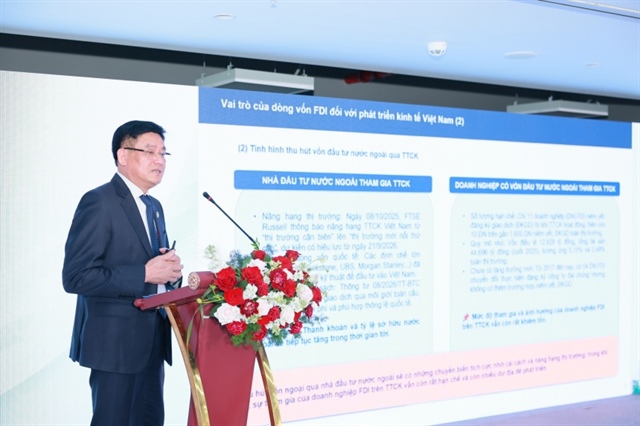
Hoang Van Thu, vice chairman of the State Securities Commission. Photo: SSI |
According to the SSC vice chairman, Vietnam's securities regulations fundamentally make no distinction between domestic enterprises and FIEs.
"FIEs with strong financial capacity and transparent corporate governance are encouraged to list and issue shares on Vietnam's stock market to diversify funding sources, enhance transparency, and expand the market," said Thu. "Attracting more listed FIEs will improve the quality of listed companies and provide both domestic and international investors with greater access to businesses operating under internationally recognised governance standards, thereby enhancing the attractiveness of Vietnam's capital market."
However, he emphasised that equal treatment under the Securities Law does not mean every FIE can immediately proceed with a listing.
"For many enterprises, the main obstacles lie not in securities regulations but in their investment certificates, project structures, contractual arrangements, and commitments made during the investment approval process in Vietnam," he added.
Following a comprehensive review, the SSC has identified five major categories of legal impediments that need to be addressed before FIEs can access the stock market.
The first group comprises enterprises that remain subject to commitments linked to investment licences, tax incentives, or obligations agreed with local authorities.
According to Thu, many companies benefiting from investment incentives are simultaneously required to fulfil specific obligations or commitments, which must first be resolved or completed before a listing can take place.
The second category covers enterprises implementing projects under public-private partnership arrangements, which are subject to separate investment mechanisms and contractual obligations throughout the project lifecycle.
The third group includes enterprises operating in sectors governed by Vietnam's international treaty commitments. Depending on the industry, these companies must satisfy sector-specific regulatory conditions before participating in the securities market.
The fourth category involves enterprises undertaking projects that require assets to be transferred to the Vietnamese government without compensation upon project completion. Thu said these projects involved unique legal considerations regarding assets and ownership that need to be addressed before listing.
The final group consists of enterprises awarded projects through investor bidding processes. Such projects typically involve specific contractual commitments, most notably restrictions on capital transfers.
"The most notable restrictions relate to limitations on transferring ownership stakes to other investors," Thu said, advising both FIEs and their financial advisers to carefully assess these five categories of legal issues when preparing for a listing.
The SSC assessment suggests that the principal barriers preventing FIEs from entering Vietnam's stock market do not stem from the Securities Law itself, nor from any discrimination between domestic suppiliers and FIEs. Instead, they arise primarily from investment conditions, contractual obligations, and commitments established when foreign-invested projects were originally licensed.
"Going forward, regulators will continue studying measures to attract more FIEs to the stock market so they can raise capital and expand their business operations in Vietnam," Thu said. "One of the key priorities will be encouraging initial public offerings in conjunction with exchange listings, while also reviewing regulations governing corporate restructuring and share transfers."
"Over the medium and long term, policy will focus on strengthening the legal framework, improving the investment and business environment, and gradually expanding foreign investors' access to Vietnam's capital market. This process must remain transparent, consistent, and non-discriminatory towards all investors," he said.
According to Thu, the government and the MoF will continue refining the regulatory framework, enhancing transparency, strengthening market governance, and safeguarding investor interests.
"Together with Vietnam's market upgrade and broader participation from FIEs, the stock market is expected to further establish itself as an efficient capital-raising platform while supporting sustainable corporate growth and enhancing enterprises' brand value in Vietnam," he said.
- 16:56 28/07/2026