Dong Thap eyes success as Mekong transshipment hub
Dong Thap eyes success as Mekong transshipment hub
As a fertile agricultural hub in the Mekong delta, Dong Thap is poised for a breakthrough that could see it emerge as a new transshipment centre for the Mekong subregion.
With its distinctive advantages, long-term development planning, and a series of strategic infrastructure projects in the pipeline, Dong Thap province is steadily turning its ambition of becoming a cross-border logistics hub into reality, connecting the Mekong Delta with Ho Chi Minh City, the southeast region, and other countries in the Mekong subregion.
The focus of this strategy extends beyond logistics services to the development of a multimodal cargo transshipment network linking production areas, border gates and industrial and service centres with port systems and major domestic and international markets.
As the northern gateway to the Mekong Delta, Dong Thap covers nearly 6,000 square kilometres and has a population of more than 4.2 million. The province’s development space stretches from the border area adjoining Cambodia to the coastal area in the east, creating distinct advantages for trade connectivity.
This geo-economic position makes Dong Thap a point of convergence for diverse road and inland waterway transport routes, as well as international trade corridors along the Mekong River. From here, goods can be efficiently connected with Ho Chi Minh City, the southeast region, other localities in the Mekong Delta region and the Cambodian market.
This distinct advantage is opening up a new room for development in Dong Thap in logistics, trade, processing industries, services and tourism.
More importantly, the advantage provides the foundation for Dong Thap to become an important link in the flow of goods from Cambodia and the Mekong Delta to Ho Chi Minh City, the southeast region and major seaports, while also enabling goods to move comfortably from consumption centres and seaports back to production areas.
This is also the basis for the decision from Dong Thap People’s Committee to approve adjustments to the provincial planning for the decade, with a vision to 2050. It sets out the goal of developing Dong Thap into a modern agricultural centre of the entire region, while positioning it as a logistics hub, a processing industry centre and a strategic connector between the Mekong Delta and Ho Chi Minh City, the southeast region and the Mekong subregion.
The new planning is built on principles that aim to restructure the province’s development space, establish new growth areas and economic corridors, and lay the foundation for long-term growth.
Dong Thap eyes success as Mekong transshipment hub |
Cross-border logistics
Dong Thap’s ambition to become a transshipment centre for the Mekong subregion is being pursued first through a strategy to develop a modern logistics system and an integrated transport infrastructure network.
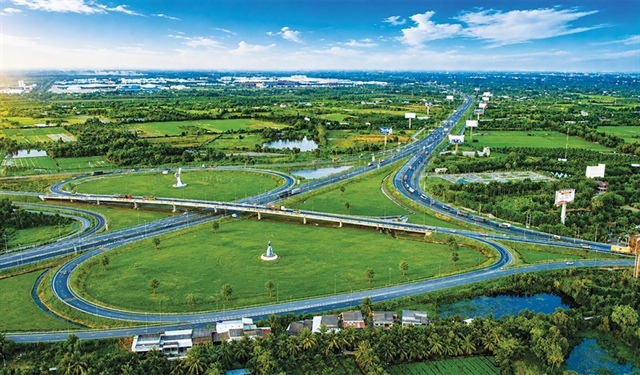
Accordingly, before 2030, the province will prioritise investment in expressways, national highways, inland waterway ports and logistics centres to strengthen inter-regional connectivity, reduce transportation costs and enhance the competitiveness of businesses.
Under the planning scheme, Dong Thap will establish five key economic corridors: the central economic corridor, the eastern coastal economic corridor, the Tien River corridor, the corridor connecting the Dong Thap Muoi area, and the Hau River corridor. These will form an important connectivity network linking border gates and raw material production areas with seaports and major consumption centres.
They should be viewed as components of an integrated economic and logistics network, with each corridor playing a distinct role in connecting raw material areas, production zones, logistics centres, border gates, ports and consumer markets.
In particular, the border economic zone is envisioned as an international trade hub connecting the Mekong Delta with Cambodia, while the area from southern Tien River to northern Hau River is planned as a logistics centre linked to processing industries and trade services.
Together, these two development poles will form a cross-border logistics chain, strengthening Dong Thap’s position in regional supply chains.
To realise the plan, Dong Thap has identified five strategic breakthroughs, with transport and logistics infrastructure being set as the top priority. Infrastructure development needs to be directly aligned with the goals of reducing logistics costs and transit times, expanding market access, enhancing the province’s appeal to investors, and stimulating local processing industries, trade and exports.
The province is focusing on building a modern transport system that is climate-resilient, while developing multimodal and cross-border logistics to maximise its geo-economic advantages. Simultaneously, it is boosting ecological and high-tech agriculture linked to processing industries and export value chains.
Alongside infrastructure, Dong Thap is prioritising the development of modern industries, the marine economy and port services, while attracting projects that use advanced, environmentally friendly technologies.
Moreover, developing suitable personnel, encouraging innovation and accelerating digital transformation have also been identified as new drivers to foster the province’s competitiveness.
Partnering with investors
Beyond infrastructure, turning Dong Thap into a fully-fledged transshipment centre will also require the simultaneous development of logistics businesses, warehousing and distribution networks, human resources, digital transformation and trade support services. This will help convert the province’s connectivity advantages into service delivery strengths and higher added value.
By 2030, Dong Thap aims to achieve average annual regional GDP growth of 9.5-10 per cent, total development investment capital of approximately $30-32 billion, export value reaching $14.8 billion and an urbanisation rate of around 50 per cent.
Alongside infrastructure investment and completion, Dong Thap will continue improving local investment environment and the quality of services provided to businesses and investors, creating new advantages for project implementation across the province.
At a conference announcing adjustments to the provincial planning in late May, numerous corporations, businesses, and investors spoke high of Dong Thap’s potential, advantages and development orientation.
Going forward, Dong Thap will continue to entice investment in sectors aligned with its development strategy, including logistics, processing industries, high-tech agriculture, renewable energy, industrial park infrastructure, and trade and services, striving to best avail of investment resources and propel socioeconomic development.
A number of strategic transport projects are being accelerated, including the Cao Lanh-An Huu expressway, My An-Cao Lanh expressway, the expansion of Ho Chi Minh City-Trung Luong-My Thuan expressway, the road network linked to Dong Thap Muoi area, the upgrading of Cho Gao Canal, and the port system along the Tien and Hau rivers, together with the Go Cong general seaport.
Once completed, these projects will help complete the interregional logistics network and provide fresh momentum to spur local economic development.
Chairman of Dong Thap People’s Committee Pham Thanh Ngai stated that the adjustment of the provincial planning is a strong commitment to building a transparent, favourable and effective investment environment.
“The province will continue to stand alongside businesses and mobilise all available resources to effectively implement the planning, gradually realising the goal of making Dong Thap a place worth living and a new growth pole for the Mekong Delta,” said Chairman Ngai.
- 09:05 25/08/2026