Đắk Lắk seeks to turn intellectual property into market value
Đắk Lắk seeks to turn intellectual property into market value
By the end of 2025, 59 community-based IP assets in the province had been granted protection, including three geographical indications, 15 certification marks and 41 collective marks.
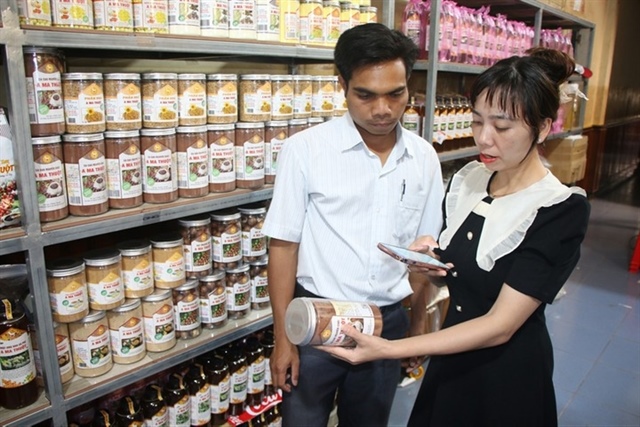
Many OCOP products from Đắk Lắk carry QR codes for traceability. — VNA/VNS Photo |
The Central Highlands province of Đắk Lắk is shifting its focus from registering intellectual property (IP) rights to managing, exploiting and commercialising IP assets to boost product value and foster innovation.
By the end of 2025, 59 community-based IP assets in the province had been granted protection, including three geographical indications, 15 certification marks and 41 collective marks. The province had also secured 33 exclusive protection certificates for patents and utility solutions.
These assets have provided an important foundation for protecting the legitimate rights and interests of organisations, businesses, cooperatives and producer communities.
However, as the number of protected intellectual property assets grows, the focus is shifting beyond granting protection to managing and commercialising these assets to generate tangible market value.
According to the provincial Department of Science and Technology, some protected assets have yet to realise their full potential in production, business and commercial activities.
The department is therefore stepping up support for organisations, businesses, cooperatives and producer communities to better link IP protection with production, market demand, technology and innovation.
Trần Văn Sơn, deputy director of the department, said IP support activities in 2026 are focused on the management, commercialisation and valuation of IP assets, as well as workforce training and support in dealing with infringements.
Under this approach, intellectual property is viewed not merely as the result of registration and protection, but as an asset that can contribute to production, business and market development.
For the cooperative sector, this approach is particularly important as more local products are being developed around quality improvement, branding, standards compliance and QR-based traceability.
Once a product has established a market reputation, its name, brand, distinctive identifiers, packaging and quality-related production processes can become valuable assets that need to be identified, protected and commercially exploited.
Cooperative products are also increasingly reaching consumers through e-commerce, social media and online sales platforms. While digital transformation expands market access, it also creates new IP risks, including unauthorised copying of images, names and packaging and confusion over product origins.
In this context, IP protection needs to be closely linked with traceability and digital transformation. While traceability provides information about a product's origins, production process and value chain, IP protection provides a legal basis for safeguarding its name, identifying marks and creative elements.
For Đắk Lắk's signature products, combining these tools can strengthen market recognition and consumer confidence. Protected brands, transparent product information and controlled production processes can add value beyond the physical product through reputation, quality and the identity of the producer community.
Therefore, Đắk Lắk's IP development strategy should focus not only on increasing the number of registered trademarks and protection certificates, but also on building the capacity to manage and commercialise IP after protection.
This would help cooperatives and businesses turn brands, quality, production processes and reputation into assets that can be protected, exploited and further developed as products enter new markets.
The shift from IP registration to market value creation marks an important change in Đắk Lắk's approach, with IP protection increasingly linked to technology, data, traceability and commercialisation as part of efforts to improve product value, competitiveness and local economic development.
- 09:50 26/08/2026