Cà Mau seeks new drivers to achieve double-digit economic growth
Cà Mau seeks new drivers to achieve double-digit economic growth
With coordinated policies, stronger investment and a growing focus on renewable energy, logistics and value-added industries, Cà Mau is laying the foundations for more sustainable economic expansion.
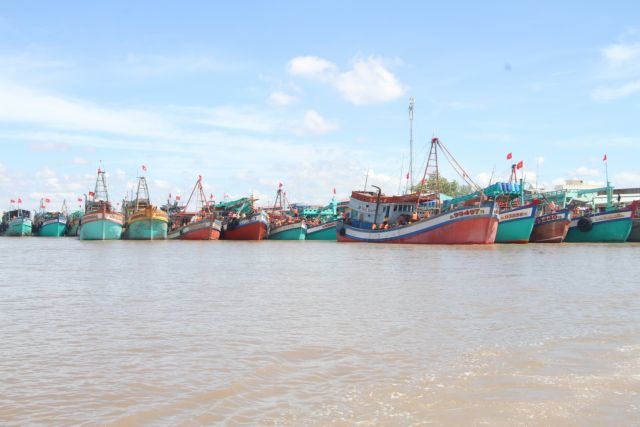
Cà Mau Province's shrimp production rose by almost 13 per cent to 278,200 tonnes in the first half of 2026. Shrimp exports remain one of Cà Mau's key economic pillars. — VNA/VNS Photo |
Cà Mau Province is banking on public spending, renewable energy, seafood production and transport infrastructure to accelerate economic growth in the second half of 2026, as it strives to achieve its target of more than 10 per cent growth.
The southernmost locality posted stronger economic performance in the second quarter than in the first, but growth in the first six months fell short of expectations.
Provincial authorities estimate the economy expanded by 6.4–6.6 per cent year-on-year in the first half, below the 8 per cent target.
Growth is estimated to have jumped from 5.64 per cent in the first quarter to 7.2–7.4 per cent in the second.
The Chairman of the provincial People's Committee, Lữ Quang Ngời, said agriculture, forestry and fisheries continued to serve as the backbone of the economy and outperformed expectations.
The sector grew by between 5 and 5.2 per cent in the first half, exceeding the projected 4.6 per cent.
Seafood output reached nearly 610,000 tonnes, up more than 6.1 per cent from a year earlier, with shrimp production rising by almost 13 per cent to 278,200 tonnes.
The province has continued to expand internationally certified farming areas while maintaining stable production under ecological shrimp, shrimp-forest and shrimp-rice farming models, helping improve the competitiveness and value of its key shrimp, crab and rice industries.
But manufacturing and construction recorded mixed results.
Although the output of electricity and liquefied petroleum gas declined due to external factors, including fluctuations in global fuel prices, seafood processing and fertiliser production maintained healthy growth.
Investment activities remained robust.
Total social investmentexceeded VNĐ36.8 trillion (US$1.4 billion), up 27.4 per cent, while disbursement of public investment accelerated.
The province recorded an estimated 1,000 newly established businesses in the first six months, up 28 per cent, reflecting improving business confidence.
Growth pillars
Trade, services and tourism were among the strongest contributors to economic growth.
Exports topped $1.3 billion, up 14.2 per cent from a year earlier, while retail sales of goods and services rose by 18.5 per cent to more than VNĐ81.3 trillion.
Tourism maintained strong momentum, attracting more than 5.34 million visitors and generating revenues of nearly VNĐ5.4 trillion, up 10.4 per cent from a year earlier.
Despite these encouraging figures, provincial leaders acknowledged that traditional growth drivers alone would not be sufficient to achieve the province's long-term ambitions.
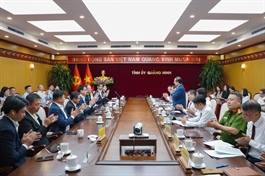
Speaking at a recent meeting to review progress towards the double-digit growth target, the province's Communist Party Secretary, Nguyễn Hồ Hải, said Cà Mau must address structural constraints and identify new sources of economic expansion rather than rely solely on conventional development models.
He said industries capable of generating higher added value, together with new investment projects, innovation and economic diversification, would be essential to sustaining stronger growth in the years ahead.
For the remainder of 2026, provincial authorities have identified seafood, renewable energy, infrastructure development and public investment as the four key pillars underpinning economic expansion.
|
Cà Mau Province's shrimp production rose by almost 13 per cent to 278,200 tonnes in the first half of 2026. Shrimp exports remain one of Cà Mau's key economic pillars. — VNA/VNS Photo |
Maintaining sustainable growth in fisheries remains a top priority.
Alongside expanding aquaculture and offshore farming, Cà Mau will take measures to combat illegal, unreported and unregulated (IUU) fishing by digitising fishing records and operating electronic catch documentation and logbook systems in line with recommendations from the European Commission.
It is also pressing ahead with its sustainable fisheries restructuring programme, encouraging fleet modernisation, supporting occupational transition and promoting marine aquaculture as part of its development strategy through 2030.
Future drivers
Public investment has also been identified as a major catalyst for growth.
Authorities have called for accelerating public investment disbursement from the 23 per cent of the full-year target achieved in the first half, although this already exceeds the national average.
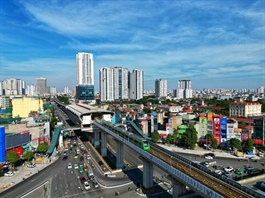
Priority will be given to nationally significant infrastructure projects, including the expressway linking central Cà Mau with Đất Mũi Commune, the dual-use Hòn Khoai Port, and the transport route connecting the mainland with Hòn Khoai Island.
Renewable energy is expected to become one of the province's most important long-term growth drivers.
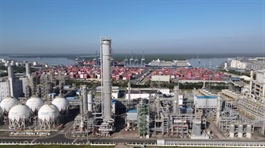
Cà Mau plans to optimise the operation of its existing 14 wind power projects which have a combined capacity of 694.2 MW, and support investors seeking to build another 14 wind farms with a capacity of 1,046 MW and a 3,200 MW LNG-to-power project.
The province is moving forward with a renewable electricity export scheme included in the revised National Power Development Plan VIII targeting exports of 2,000-5,000 MW.
It is also studying a green hydrogen project in a coastal area with an estimated capacity of around 86,000 tonnes per year.
Agriculture will continue to be upgraded through higher-value production.
Cà Mau plans to expand participation in the national one-million-hectare programme for high-quality, low-emission rice, seeking to add more than 5,000ha this year.
Support measures are also being implemented to help farmers recover from weather-related losses while improving the value chain for salt production and other key agricultural products.
With coordinated policies, stronger investment and a growing focus on renewable energy, logistics and value-added industries, the provincial authorities believe Cà Mau is laying the foundations for more sustainable economic expansion.
The province hopes that a combination of new growth drivers, improved infrastructure and continued reforms will help strengthen its position as an emerging growth pole in the Mekong Delta.
- 09:10 08/08/2026