Sustainable Development Dialogue explores green and digital transition
Sustainable Development Dialogue explores green and digital transition
Green and digital transformation are becoming central to Vietnam's new growth model as businesses seek to strengthen competitiveness, resilience, and innovation.
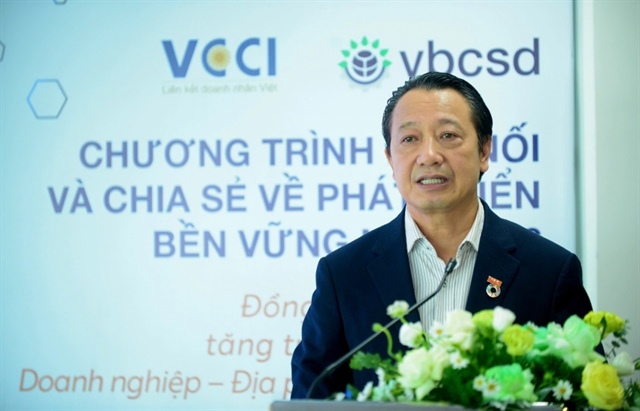
Nguyen Quang Vinh, vice chairman of VCCI. Photo: Quoc Tuan |
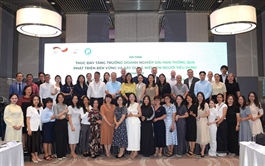
The 2026 Sustainable Development Dialogue took place on August 6 at Nestlé Vietnam's Bong Sen Factory in Hung Yen province, discussing how stronger collaboration between enterprises, local governments, and the state can accelerate Vietnam's transition towards a greener, more resilient economy.
Nguyen Quang Vinh, vice chairman of the Vietnam Chamber of Commerce and Industry, said 2026 marks a turning point in the country's development journey.
"In the past, discussions on sustainable development often began with environmental protection, social responsibility, or corporate governance. Today, the more important question is how sustainable development can become an integral part of competitiveness and a new engine of growth," he said.
"Sustainability is no longer solely the responsibility of ESG or sustainability departments. It has become a shared agenda for business leaders, investors, employees, supply chains, local governments and the entire economy," he added.
He noted that global uncertainties have made resilience an essential business capability. Companies today must manage costs and markets alongside their ability to withstand disruptions. Meanwhile, the green transition has evolved beyond an environmental programme into a competition for technology, capital, energy, markets, and production capabilities.
Vinh said Vietnam is entering a new development phase with increasingly coherent policy directions. Recent major policy resolutions collectively promote growth driven by science, technology and innovation, improve the quality of investment attraction, and encourage a greener, smarter and more resilient growth model.
He called on businesses to lead innovation, digital and green transformation, responsible investment and workforce development. Local governments, he said, should create transparent, efficient and predictable investment environments while strengthening infrastructure, talent and innovation ecosystems. At the national level, continued institutional reforms, fair competition and more effective resource allocation will be critical to enhancing Vietnam's competitiveness.
"If these four forces move in the same direction, I believe rapid growth and sustainable development will not conflict with each other. They can become two complementary pillars of Vietnam's new development model," he said.
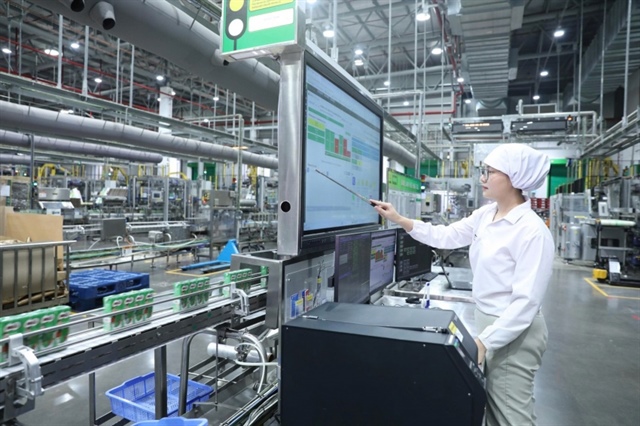
Photo: Quoc Tuan |
Nguyen Hoa Cuong, vice president of the Institute of Policy and Strategy Studies, cited the UOB Business Outlook 2025 survey, which found that 90 per cent of Vietnamese businesses recognise the importance of sustainable development, while 75 per cent have already begun implementing sustainability initiatives.
He said integrating sustainability into product development, supply chain management and customer engagement can create long-term strategic advantages. "Sustainability reporting is no longer just a communications document – it is a management tool. Environmental, social, and governance standards are not the final destination but the starting point of a data-driven governance model," Cuong said.
To maximise the value of sustainability reporting, he recommended that businesses integrate reporting into their governance systems rather than treating it as a standalone exercise, build reliable datasets, particularly emissions data, and use those data to support strategic decision-making instead of simply meeting disclosure requirements.
|
Photo: Nestlé |
Nestlé Vietnam's Bong Sen Factory manager Dau Van Hoan shared how the company is combining digital transformation with sustainability, shifting from smart factory operations to broader local development.
According to Hoan, the factory is pursuing Nestlé's vision of becoming a globally connected company with strong local roots through three strategic pillars: digital transformation and consumer-focused operations, sustainable development, and innovation centred on people.
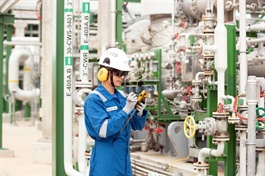
The factory has adopted advanced technologies including AI-powered quality inspection systems, real-time data monitoring and automated process controls to improve efficiency and minimise waste. Between 2018 and 2025, these initiatives reduced paper consumption by 80 per cent, increased labour productivity per hour by 52 per cent, saved 11,800 gigajoules of energy and conserved 38,700 cubic metres of water.
Automation has also expanded through the deployment of robots for spare-parts delivery and cleaning, smart ventilation systems, automated sampling, 3D printing, CNC machining, automated warehouses and robotic palletising systems.
As a result, the factory has generated 3,000 hours for continuous improvement activities, achieved annual savings of VND22 billion ($850,000), added 6,000 pallet storage positions and shortened spare-parts procurement time from seven days to just eight hours, while improving employee engagement.
Hoan stressed that sustainable growth begins with investing in people. "Technology does not replace people; it empowers people, many factory operators have developed into multi-skilled specialists, technical experts and managers within Nestlé's global network."
The company has also partnered with Hung Yen University of Technology and Education to develop a workforce equipped for digital transformation.
Drawing from the factory's experience, Nestlé identified four key lessons: digital transformation is the foundation rather than the destination; digitalisation accelerates the green transition; people must lead technology adoption; and sustainable value is created by extending innovation to local communities.
"Technology can be acquired, but an empowered digital mindset with human-centric creates lasting value," Hoan said.
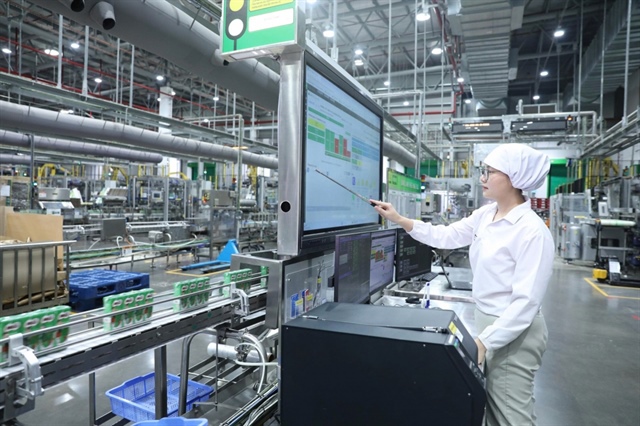
Photo: Nestlé |
Binu Jacob, CEO of Nestlé Vietnam and co-chair of the Vietnam Business Council for Sustainable Development, said Bong Sen Factory demonstrates how digital and green transformation can be implemented simultaneously with people at the centre.
"Bong Sen is more than a factory. It is one of Nestlé's most modern, technology-driven sites, a place where digital and green transformation come to life every single day. When we talk about 'human-centric dual transformation', this is where those words become machines, processes, and most importantly - people," he said.
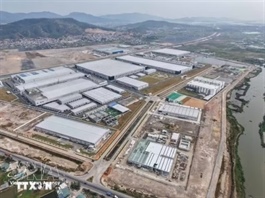
Jacob believes Nestlé deliberately chose Hung Yen for its investment because of the province's remarkable improvements in the business environment. Between 2020 and 2024, Hung Yen's Provincial Competitiveness Index ranking rose from 53rd place to the country's top 10, reflecting strong cooperation between local authorities and businesses.
"Nestlé's investment in Hung Yen demonstrates the value that can be created when businesses and local governments build trust and grow together," he added.
- 12:00 07/08/2026