Vietnam International Financial Centre institutions come first, capital follows: experts
Vietnam International Financial Centre institutions come first, capital follows: experts
A seminar on building the financial centre and shaping next-generation capital flows was held in Đà Nẵng on Tuesday.
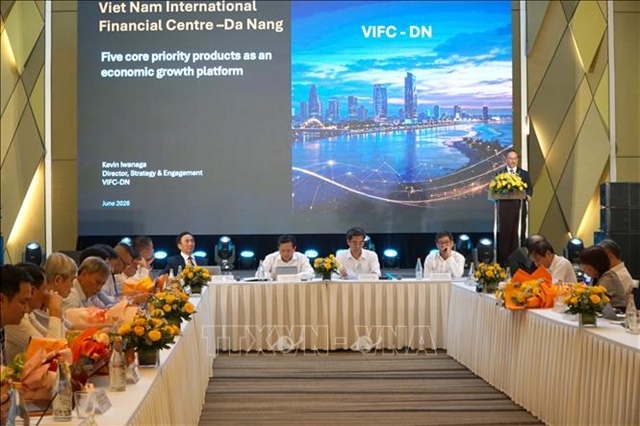
A view of the seminar on the international financial centre. — VNA/VNS Photo |
As Việt Nam moves forward with plans to establish the Vietnam International Financial Centre in Đà Nẵng (VIFC-DN), the project is expected to become a new financial growth hub linking global capital with Việt Nam and the broader Asia-Pacific region.
A seminar on building the financial centre and shaping next-generation capital flows was held in Đà Nẵng on Tuesday.
However, experts said several challenges remained, including gaps in the legal framework and a lack of strategic financial products and mechanisms to attract international capital.
They have called for institutional reforms and the development of specialised products to unlock the centre's full potential.
Successful financial centres, such as Singapore, Dubai and Abu Dhabi, focus on developing a limited number of priority sectors rather than trying to cover every financial service, said Trần Mạnh Huy, deputy chairman of the National Assembly's Committee for Science, Technology and Environment.
Drawing on these experiences, he suggested that VIFC-DN's regulatory sandbox should prioritise three areas.
The first is Real World Asset tokenisation, particularly for infrastructure projects, commercial real estate and other assets capable of generating stable cash flows.
Another is the development of carbon credit trading platforms and green finance, to capitalise on the global transition towards low-carbon economies.
The last priority is creating new fundraising mechanisms involving investment funds, financial companies and international non-bank financial institutions to finance strategic infrastructure projects and support small and medium-sized enterprises.
Economist Trần Đình Thiên agreed, saying the Đà Nẵng financial centre should develop a distinctive "product core" based on the city's comparative advantages.
He proposed focusing on digital finance sandboxes, regulated digital assets and tokenisation, green finance and carbon markets and trade and supply-chain finance linked to the city's planned free trade zone, as well as maritime, aviation, logistics and legal financial services.
Thiên stressed that while the planned international financial centre in HCM City would serve as a comprehensive capital market hub similar to Singapore and Hong Kong on a global scale, the Đà Nẵng centre should specialise in serving next-generation capital flows.
This division of roles should be clearly defined in law to avoid overlap and internal competition, he added.
Meanwhile, Đặng Tùng Lâm, deputy head of Strategy and General Affairs at the VIFC-DN Executive Agency, said Đà Nẵng is well positioned to benefit from three major trends: Việt Nam's deeper integration into international capital markets, the global shift towards green finance and supply chain restructuring, and rapid technological innovation transforming the issuance, trading and supervision of financial assets.
He said the city's greatest advantage is being a late entrant, enabling it to build a financial centre that is digital-first, greener, more flexible and more modern than traditional financial hubs from the outset.
- 11:09 01/07/2026