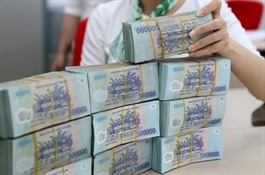
New policy in foreign exchange reserve management proposed
New policy in foreign exchange reserve management proposed
The State Bank of Vietnam (SBV) has proposed more flexible market intervention tools in a draft decree amending the management of the country's foreign exchange reserves.

According to the SBV, after more than 10 years of implementation, Decree 50/2014/NĐ-CP on the management of State foreign exchange reserves has created an important legal framework for the management of foreign exchange reserves, helping to improve the capacity for monetary policy management and ensuring macro-economic stability.
However, the strong fluctuations in the global economy and financial market in recent times have necessitated the improvement of the current foreign exchange reserve management mechanism in a more flexible and practical direction.
The SBV said that in recent years, the nation's foreign exchange reserves have played a crucial role as a buffer to stabilise the foreign exchange market, support exchange rate management, control inflation and strengthen investor confidence.
Việt Nam’s foreign exchange reserves increased from US$34.3 billion at the end of 2014 to a record high of over $111.8 billion in January 2022.
However, under the impact of the US Federal Reserve's sharp interest rate hike cycle, geopolitical tensions, energy price fluctuations and global economic uncertainties, the foreign exchange reserves decreased to $86.7 billion at the end of 2022.
The reserves stood at nearly $87.6 billion as of June 18, 2026.
Under the draft decree, the SBV amends many provisions related to the sources of foreign exchange reserves, investment principles, coordination mechanisms between the Ministry of Finance and the SBV, as well as market intervention tools.
The SBV proposes the inclusion of Special Drawing Rights (SDRs) from the International Monetary Fund (IMF) in the sources of State foreign exchange reserves. SDRs are international reserve assets allocated by the IMF to member countries to supplement reserve resources and support global liquidity. Under the draft, the SBV will record the portion of SDRs allocated by the IMF into the State foreign exchange reserve fund.
According to the SBV, the addition of this regulation aims to clarify the management and accounting mechanism for SDRs, in line with the characteristics of this special reserve asset and Việt Nam's management experience.
In addition, the SBV has proposed improving the coordination mechanism with the Ministry of Finance in managing the State budget's foreign currency resources.
The Ministry of Finance will continue to deposit the State Treasury's foreign currency at the SBV, except in some specific cases, and will ask for Prime Minister's approval of the maximum amount of the foreign currency to be retained to meet budget expenditure needs. The remaining amount will be used to supplement the State's foreign exchange reserves as prescribed.
Under the draft, regulations will also be added on handling cases of State budget's foreign currency shortages, thus clarifying the mechanism for coordinating and balancing foreign currency among relevant agencies.
The draft decree also amends the profit-generating principle for investment activities in gold held in the country's foreign exchange reserves.
According to the SBV, gold does not generate recurring income like bonds or other financial instruments. The value of gold is only reflected through revaluation or sale.
International experience shows that central banks hold gold primarily to diversify their reserve portfolios, hedge against risks, ensure liquidity, support the domestic currency and strengthen the nation's financial position, rather than pursuing profit targets.
The central bank therefore believes that applying the principle of profitability to gold investment activities is inappropriate and unfeasible.
Instead, the SBV proposes amending the regulations so that the assessment of profitability of official foreign exchange reserves will not include income and expenses related to gold investment activities.
The draft also proposes adding foreign currency and gold options to the forms of domestic market intervention, alongside the buying, selling and swapping operations that are currently applied.
According to the SBV, the options will help diversify intervention measures, increase flexibility in operations and improve the effectiveness of monetary policy implementation. This is also a tool used by many central banks around the world to respond to unusual fluctuations in financial markets.
Under the proposal, the intervention mechanism would also be amended to give the SBV’s Governor more autonomy.
Instead of requiring the establishment of intervention mechanisms on a periodic basis, as is the case currently, the draft stipulates that the Governor will decide on intervention options when necessary.
This would be based on monetary policy objectives, developments in the foreign exchange market, the domestic gold market and the liquidity situation of the Vietnamese đồng. The adjustment will help improve the policy's ability to respond to rapid market fluctuations.
According to the SBV, the draft amended decree aims to further improve the legal framework for managing State foreign exchange reserves, enhance the efficiency of reserve resource use and increase the proactiveness and flexibility of the SBV amid the complex and unpredictable developments in the international financial market.
- 08:44 29/06/2026