Việt Nam's wood exporters race to stay on growth path
Việt Nam's wood exporters race to stay on growth path
Despite headwinds from Middle East tensions that have pushed up freight and logistics costs, exports of wood and wood products were estimated at $1.53 billion in June, lifting first-half export turnover to $8.54 billion, up 4.4 per cent from a year earlier, according to the Ministry of Agriculture and Environment (MAE).
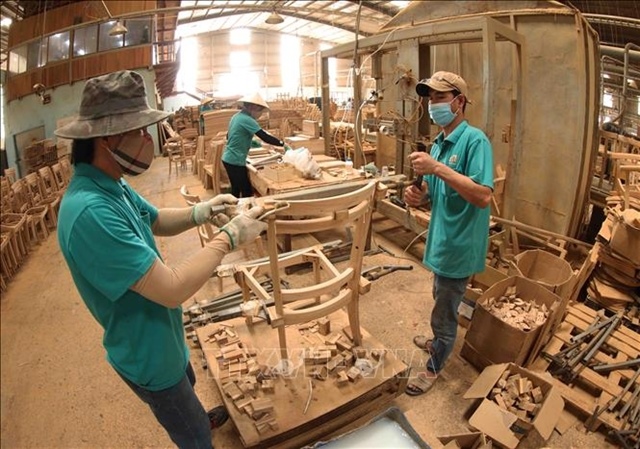
Việt Nam ranks among the world's top five furniture exporters and ships products to almost 170 countries and territories. — VNA/VNS Photo |
Việt Nam's wood industry is seeking to maintain export momentum and reach its US$19 billion target this year by diversifying markets and building more transparent, legal and sustainable supply chains.
Despite headwinds from Middle East tensions that have pushed up freight and logistics costs, exports of wood and wood products were estimated at $1.53 billion in June, lifting first-half export turnover to $8.54 billion, up 4.4 per cent from a year earlier, according to the Ministry of Agriculture and Environment (MAE).
The US remained the dominant destination, accounting for nearly half of Việt Nam's wood-export revenue, while China represented 15 per cent and Japan 12.9 per cent. Export performance, however, showed a mixed picture: shipments to the US fell 8 per cent in the first five months of the year, whereas exports to China jumped 49 per cent and those to Japan rose 5.1 per cent. The Netherlands posted the fastest growth among major markets, while the Republic of Korea recorded the sharpest decline.
Việt Nam ranks among the world's top five furniture exporters and ships products to almost 170 countries and territories. Even so, the country holds only about 7 per cent of global furniture import demand, leaving significant room for expansion.
Industry officials say the sector's greatest risk lies in its dependence on the US market, which absorbs roughly half of total export turnover, exposing businesses to shifts in trade policy, tariffs and trade-remedy measures. Expanding sales to the EU, Japan, China, India and the Middle East has therefore become increasingly urgent.
Exporters say order books remain relatively healthy, with many contracts extending through the second quarter and some into the third as global consumption gradually recovers. The bigger challenge now is meeting stricter requirements on legal timber sourcing, anti-deforestation compliance, traceability and carbon-emission reduction.
Nguyễn Văn Diện, Deputy Director General of the MAE's Forestry and Forest Protection Department, said Việt Nam has strengthened its position in international markets by developing legal raw-material sources, expanding sustainably certified forests and gradually forming a legal timber supply chain. However, he acknowledged that the current system is only an initial step toward satisfying increasingly demanding market requirements.
The pilot programme for production forest area codes currently covers about 25,500 hectares in five northern provinces, a small fraction of the country's nearly 4.9 million hectares of planted forests. Around 868,000 hectares have received sustainable forest-management certification, but the area remains insufficient to meet export demand.
Dien said the industry must expand certified forests, ensure the legality of timber supplies, accelerate digital traceability and proactively comply with regulations such as the EU Deforestation Regulation (EUDR), the US Lacey Act and emerging carbon standards. Doing so, he added, is not only essential for market access but also an opportunity to improve the industry's competitiveness.
Phùng Quốc Mẫn, Chairman of the Handicraft and Wood Industry Association of HCM City (HAWA), said ASEAN's wood sector can develop sustainably only through regional cooperation in building transparent, responsible supply chains that meet international standards.
To support businesses, the MAE is working with the Ministry of Finance to resolve value-added tax refund issues for semi-processed wood products under Government Decree No 181/2025/NĐ-CP and is finalising guidance on implementing the EUDR for wood and agro-forestry products. Authorities also plan to launch the National Plan on Production Forest Area Codes for 2026–30, expand pilot programmes to 15–20 key provinces and integrate the system into the national forest database to satisfy traceability requirements in importing markets.
As global trade moves increasingly toward green and sustainable standards, industry leaders say that market diversification, legal timber supply chains and compliance with international rules will be crucial for Việt Nam to maintain export growth and increase its share of the global furniture import market, estimated at around $230 billion a year.
- 11:42 10/07/2026