SBV faces tough monetary management amid high capital demands
SBV faces tough monetary management amid high capital demands
The disparity between credit growth and deposit growth is creating a fierce underlying deposit raising race among commercial banks.
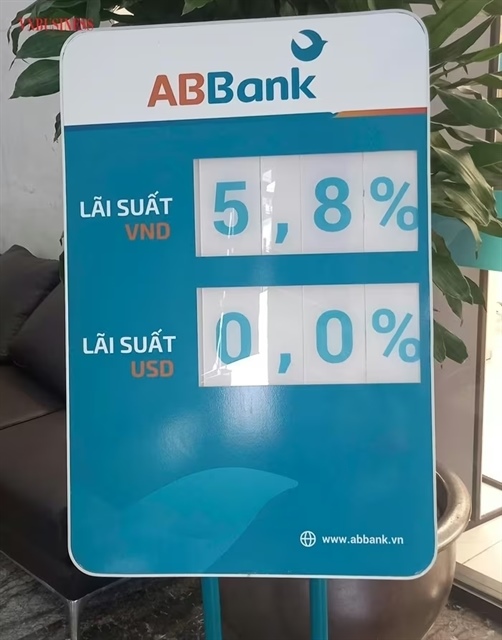
An interest rate board listed at an ABBank branch in early July. While the listed interest rate on banks’ websites for a six-month term is only around 6 per cent per year, depositors can actually receive 9-10 per cent per year with special conditions. — Photo courtesy of the company |
While the capital market is underdeveloped, the banking system is burdened with the responsibility of supplying capital beyond its actual capacity, causing a fierce deposit raising competition and putting heavy pressure on the State Bank of Vietnam (SBV)’s monetary policy management.
Việt Nam’s economic development strategy for the 2026-2030 period sets an ambitious GDP growth target of 10 per cent or more per year.
According to detailed calculations from BIDV Research, to achieve this goal, the required average investment capital will be around US$250-260 billion per year. Looking further ahead to 2045, the economy's capital needs could reach $500 billion per year.
However, the Vietnamese economy still relies heavily on bank credit, with this channel consistently accounting for 50-60 per cent of the total capital supply.
Meanwhile, long-term capital channels such as the corporate bond market only account for a modest 3-6 per cent, and the stock market contributes about 10-18 per cent.
Phạm Xuân Hòe, former deputy director of the Institute of Banking Strategy, said that banks are simultaneously burdened with three heavy responsibilities: acting as payment intermediaries, providing short-term capital and financing medium- and long-term capital.
The consequence of this situation is that the balance sheets of the banking system are constantly overloaded, he noted.
Currently, about 80 per cent of deposits in Việt Nam have maturities of less than 12 months, while medium- and long-term loans once accounted for up to 47 per cent of total outstanding loans.
According to SBV data, as of June 15, credit growth reached 6.35 per cent, but deposit growth only reached 4.3 per cent. This 2 per cent gap forces banks to attract deposits in a variety of ways.
The disparity between credit and deposit growth is creating a fierce race to raise deposits among commercial banks. Meanwhile, depositors are easily misled by the varying interest rates offered.
While the listed interest rate on banks’ websites for a six-month term is only around 6 per cent per year, customers can actually receive 9-10 per cent per year through special conditions related to balances or certificates of deposit.
At one private bank, customers depositing VNĐ200 million or more are offered an interest rate of 8.5 per cent per year. Some even offered 9 per cent for deposits of VNĐ1 billion or more.
Chairman of Vietcombank’s board of directors Nguyễn Thanh Tùng pointed out the obstacles related to the imbalance of capital sources. According to Vietcombank's calculations, to achieve 10 per cent GDP growth, the investment rate needs to reach 40 per cent of GDP, but the average domestic savings rate is currently only 36.5 per cent.
If the growth of unofficial sectors is excluded, the accumulated domestic capital deficit is even more severe.
Tùng confirmed that his bank always adheres to directives on interest rate levels, so raised capital is currently insufficient to meet growth needs.
Although Vietcombank's loan-to-deposit ratio is below 70 per cent, a safe level compared to the SBV's 80 per cent ceiling, the bank still warned that there will not be enough capital for large projects in the future.

An interest rate board listed at an ABBank branch in early July. While the listed interest rate on banks’ websites for a six-month term is only around 6 per cent per year, depositors can actually receive 9-10 per cent per year with special conditions. — Photo courtesy of the company |
Tùng proposed raising capital from external sources by allowing the Ministry of Finance to issue international bonds to leverage national prestige and obtain the best possible interest rates.
He also expressed a desire for the capital market, especially the corporate bond market, to develop more rapidly.
The current size of Việt Nam's corporate bond market is only equivalent to about 10 per cent of GDP, significantly lower than other countries in the region such as Thailand and Malaysia.
SBV Governor Phạm Đức Ấn admitted that pressure to raise capital is making the central bank’s interest rate management difficult.
When capital demand is high but raised capital is limited, rising deposit interest rates will cause higher lending interest rates, directly impacting enterprises. To alleviate this pressure, the SBV is working to prevent commercial banks from engaging in extreme competition for capital mobilisation.
As for long-term solutions, the governor said the SBV is studying expanding the scope of eligible foreign currency loans serving investment purposes, especially for import businesses.
In addition, the amended Law on Credit Institutions allows commercial banks to manage collateral assets for businesses issuing bonds. This is expected to be a breakthrough, because many investors are currently hesitant about the collateral assets of corporate bonds, such as real estate, or assets formed from borrowed capital.
Only when banks participate in this asset management process can the bond market develop enough to alleviate the burden of medium- and long-term capital requirements in the banking system.
- 07:59 30/07/2026