Party maps out new growth drivers, maritime strategy for Việt Nam
Party maps out new growth drivers, maritime strategy for Việt Nam
Việt Nam is seeking to unlock new growth drivers, expand its development space and strengthen the marine economy under a new set of long-term Party resolutions.
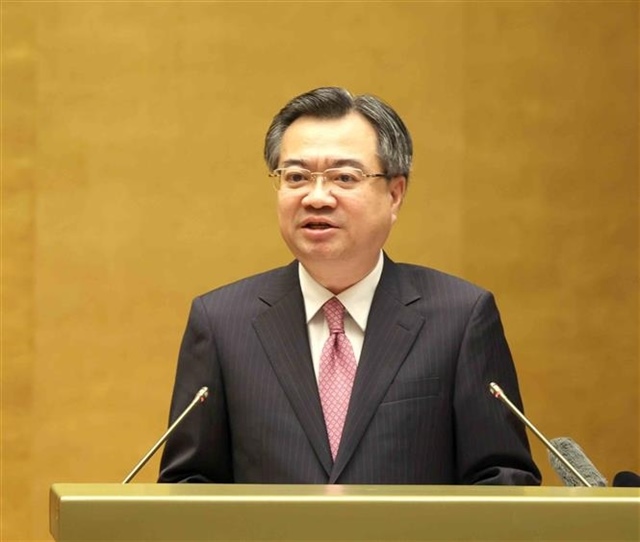
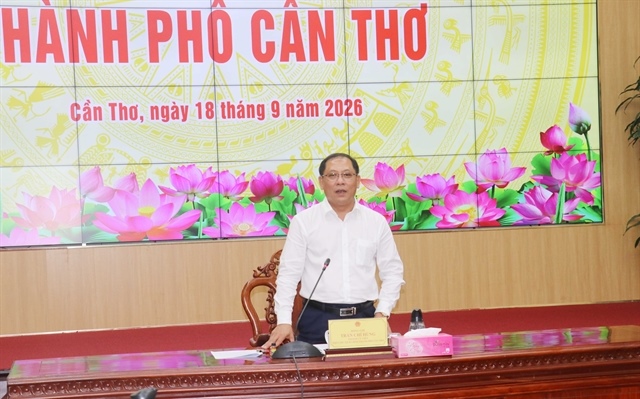
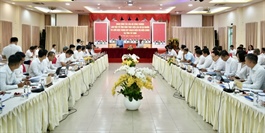
Politburo member and head of the Party Central Committee's Commission for Policies and Strategies Nguyễn Thanh Nghị speaks at the national conference on Wednesday. — VNA/VNS Photo |
Việt Nam will overhaul its development model to place innovation, science and technology, productivity and modern governance at the centre of future growth under a Party resolution presented at a national conference on Wednesday to implement outcomes of the 14th Party Central Committee's third plenum.
Presenting the resolution on renewing the country's development model, Politburo member and head of the Party Central Committee's Commission for Policies and Strategies Nguyễn Thanh Nghị described the shift as "a strategic task of historic significance" aimed at supporting the country's long-term development goals.
The resolution sets out a roadmap to transform Việt Nam into a self-reliant, innovative, humane, sustainable and internationally integrated economy, with people positioned as "the centre, the objective, the driving force and the main actor of development".
"Renewing the country's development model is a strategic task of historic significance," Nghị said.
Rather than relying primarily on traditional growth drivers, the new model identifies science, technology, innovation, digital transformation, green transition and skilled workers as the main engines of future economic expansion. It also calls for higher labour productivity and more efficient allocation of national resources to become key measures of development.
The resolution proposes reforms extending beyond the economy to the way the country is governed. It envisions a modern national governance system operating through closer coordination between the Party, the State, the market and society, with policymaking increasingly guided by data, measurable outcomes and public service quality.
"Science, technology and innovation will serve as the primary drivers of the new development model," Nghị said.
The roadmap outlines several milestones.
By 2030, Việt Nam aims to establish the foundations of the new development model, including breakthroughs in institutions, governance, strategic infrastructure, innovation capacity and leading enterprises.
The country expects to complete most of the transition to the new model by 2035, while by 2045 it aims to become a high-income developed nation with a knowledge-based, innovation-driven economy.
To support the transition, the resolution groups its policy agenda into seven areas: institutions and governance, the economy, society, culture and people, the environment, national defence and security, and foreign affairs.
The resolution's economic agenda centres on creating new growth engines alongside traditional ones.
It also calls for reorganising national development through a more integrated, multi-layered approach, developing Việt Nam into a strong maritime nation and expanding into emerging sectors such as the low-altitude, space and underground economies.
Other priorities include reforming the financial system, improving the allocation of national resources, accelerating next-generation industrialisation, developing strategic infrastructure and strengthening links between research, innovation and commercialisation.
The resolution also calls for stronger efforts to attract and retain highly skilled professionals, including overseas Vietnamese experts and international talent, while promoting research commercialisation and deeper links between universities, research institutes and businesses.
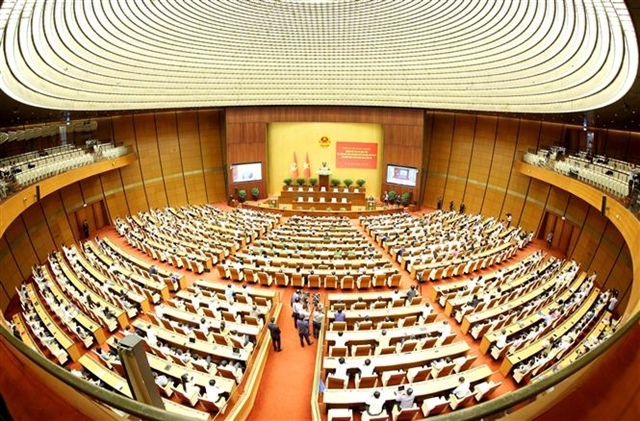
Politburo member and head of the Party Central Committee's Commission for Policies and Strategies Nguyễn Thanh Nghị speaks at the national conference on Wednesday. — VNA/VNS Photo |
Building a strong maritime nation
At the same conference, Nghị also presented a separate Party resolution outlining a long-term strategy to develop Việt Nam into a strong maritime nation, saying it reflects "new and breakthrough thinking" on the role of the sea in national development.
He said the new resolution builds on eight years of implementing the Party's strategy on the sustainable development of the marine economy. During that period, awareness of the sea's strategic importance increased, while marine governance, legal and policy frameworks, and resource management continued to improve.
The marine economy strengthened its role as an important driver of growth, living standards in coastal and island communities improved and international cooperation on maritime affairs expanded.
However, Nghị acknowledged that major challenges remain. Marine industries have yet to realise their full potential, while governance and institutional frameworks require further reform.
Climate change, sea level rise and coastal erosion continue to pose growing risks, and investment in marine science, technology, innovation and workers has yet to meet development needs.
He noted that Việt Nam's sea area exceeds one million square kilometres, around three times the country's land area, making it a strategic space for economic development, national competitiveness and security. Against this backdrop, the new resolution seeks to modernise marine governance, expand the country's development space and strengthen the role of the marine economy in supporting sustainable growth and national resilience.
"The resolution on building and developing Việt Nam into a strong maritime nation reflects a strategic vision founded on new and breakthrough thinking about the sea," Nghị said.
The strategy aims to strengthen marine industries while ensuring sustainable use of marine resources and safeguarding national sovereignty. It calls for the development of globally competitive maritime sectors, including shipping, logistics, offshore energy, fisheries, marine tourism and the shipbuilding industry, alongside emerging sectors linked to new marine technologies.
It also seeks to expand development space through modern seaports, coastal infrastructure and marine economic centres capable of serving both national and regional markets.
A major pillar of the strategy is modern marine governance. The resolution calls for integrated management of sea space based on digital data and national marine spatial planning, covering coastal areas, islands, seabed resources and offshore zones.
It also emphasises stronger environmental protection, conservation of marine ecosystems and greater resilience to climate change and rising sea levels.
The resolution sets targets through 2030 with a vision to 2045, covering the marine economy, marine spatial planning and infrastructure, science and technology, environmental protection, social development and national defence and foreign affairs.
- 08:00 30/07/2026