Innovative airports crucial for country's economic development
Innovative airports crucial for country's economic development
The imperative for Việt Nam is not only about expanding terminals or runways, but also about building airports that are innovative, adaptable, and capable of supporting the country's economic aspirations for decades to come, experts said.
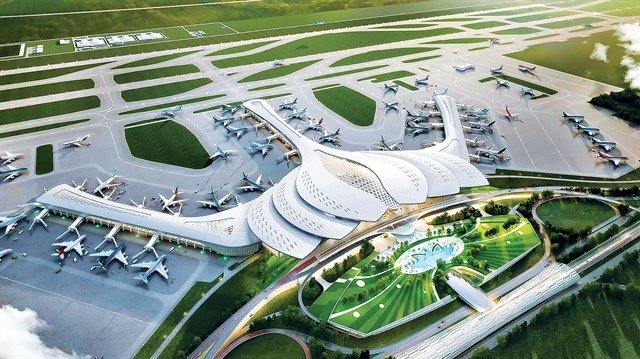
A rendering of Long Thành International airport. The Ministry of Transport has proposed the construction of six new airports by 2030 and the addition of three more by 2050. — Photo courtesy of baochinhphu.vn |
The nation is at a crucial juncture in its economic development, boasting one of the fastest-growing economies in Asia. Việt Nam is witnessing record levels of foreign direct investment, expanding manufacturing capabilities, and a steady influx of international visitors annually. Last year, the country attracted US$38.4 billion in foreign investment, with figures reaching $34.7 billion in the first half of this year, marking a 61 per cent increase.
Foreign visitor arrivals have also seen continuous growth, with 21.2 million visitors travelling to Việt Nam last year, a figure expected to rise further this year. The General Statistics Office reported an increase in foreign visitors to 1.7 million in the first six months, a 14.9 per cent surge year-on-year. The country aims to welcome 25 million visitors throughout the year.
Situated in the heart of Southeast Asia, Việt Nam holds a strategic position as a gateway connecting some of the world's fastest-growing markets. As regional trade, tourism, and cross-border investment gain momentum, modern airport infrastructure plays an increasingly pivotal role in enhancing connectivity with neighbouring countries such as China, Cambodia, Laos, Thailand, and the broader Asia-Pacific region.
Recognising this vital opportunity, the Vietnamese Government has initiated major aviation infrastructure projects.
The Ministry of Transport has proposed the construction of six new airports by 2030 and the addition of three more by 2050. The ultimate goal is to ensure that by 2050, around 95 per cent of the population can access an airport within a 100 km radius.
Key among these projects is the Long Thành International Airport, the nation's largest infrastructure endeavour to date, designed to serve over 100 million passengers and handle five million tonnes of cargo annually. Alongside Long Thành, expansion initiatives at Đà Nẵng International Airport are bolstering capacity in one of Việt Nam's crucial tourism and business hubs.
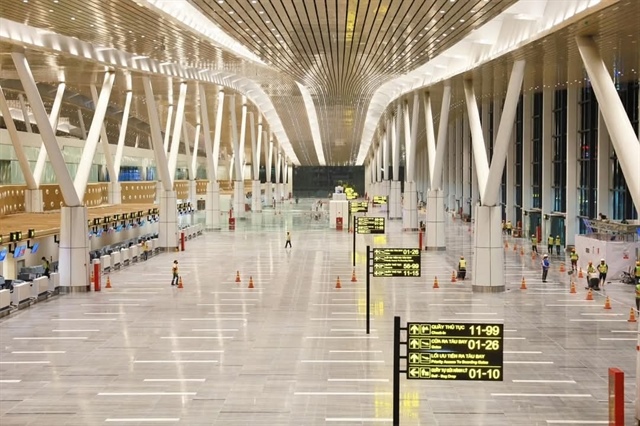
A rendering of Long Thành International airport. The Ministry of Transport has proposed the construction of six new airports by 2030 and the addition of three more by 2050. — Photo courtesy of baochinhphu.vn |
While new airport construction is pivotal, the focus should also be on enhancing existing airport infrastructure.
For multinational companies considering Việt Nam as an investment destination, aviation connectivity is a critical factor, according to Gordon Heap, principal, DXC Technology.
“A modern, reliable airport system supports executive mobility, enables the movement of high-value goods, facilitates tourism, and enhances the country's overall competitiveness. In many respects, the performance of an airport system reflects a nation's readiness to attract investment and participate more deeply in the global economy,” he said, affirming that around the world, airports are rethinking how they prepare for long-term growth.
Heap took an example of Perth Airport in Western Australia, which is undergoing a multi-billion-dollar transformation to consolidate airline operations into a single integrated precinct. The project goes beyond expanding physical infrastructure; it aims to create a smarter airport capable of meeting future demand while delivering a better experience for passengers and stakeholders alike.
“The project highlights an important lesson that extends well beyond Australia: investing in physical infrastructure alone is no longer sufficient. Long-term value is created when airport stakeholders, operational processes and technology are brought together within a unified ecosystem that is flexible enough to adapt to rising passenger expectations, changing operational needs and evolving technologies."
This is particularly relevant for Việt Nam as it accelerates investment in its aviation infrastructure. The challenge is not simply to build more airports, but to build airports that are intelligent, connected and resilient enough to support economic growth over the coming decades.
“Smart airports are no longer just an aviation investment—they are an investment in national competitiveness. By integrating infrastructure, technology and operations into a cohesive system, Việt Nam can strengthen its position as a regional hub for trade, tourism and investment while laying the foundation for sustainable long-term growth,” said Heap.
Today's airports have evolved far beyond their traditional role as transportation hubs. They have become complex economic ecosystems where dozens of interconnected systems work together to keep the movement of people, goods and commerce flowing efficiently.
Every passenger journey depends on the seamless integration of airport operations, baggage handling, immigration, security screening, retail services and ground transportation. Delivering a smooth travel experience requires all of these systems to operate in harmony and in real time.
- 07:42 29/07/2026