National conference highlights green finance and ESG for sustainable growth
National conference highlights green finance and ESG for sustainable growth
Researchers and policymakers gathered in Khánh Hòa Province on Thursday to discuss green finance, ESG and sustainable development amid global uncertainties.

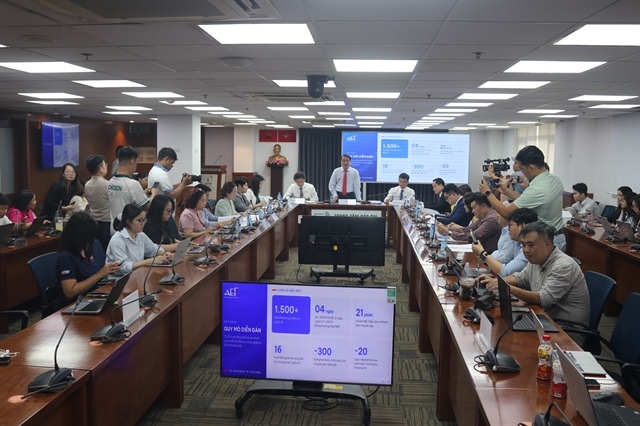
Delegates attend the national scientific conference on green finance, ESG and sustainable development held in Khánh Hòa Province on July 3. — VNA/VNS Photo |
Researchers and policymakers gathered in Khánh Hòa Province on Thursday to discuss green finance, ESG and sustainable development amid global uncertainties.
The conference explored policy recommendations to support Việt Nam's green transition.
The conference, held in Khánh Hòa Province, was jointly organised by the School of Economics and Business under Nha Trang University, the School of Economics, Law and State Management under the University of Economics Hồ Chí Minh City, and the University of Finance and Marketing.
The event brought together researchers and policymakers to discuss theoretical and empirical studies on green finance and ESG standards, as well as the impacts of interest rate fluctuations, exchange rate volatility, geopolitical risks and global supply chain disruptions on financial systems and sustainable development strategies.
Participants also assessed the current state and future prospects of Việt Nam's green finance market while proposing policy recommendations to strengthen financial resilience and promote sustainable economic growth.
Global uncertainties
Professor Dr Phạm Quốc Hùng, vice rector of Nha Trang University, said the global economy is undergoing profound changes driven by intertwined challenges, including macroeconomic instability, persistent inflation, high interest rates, geopolitical tensions, supply chain restructuring and increasingly severe climate change.
According to Hùng, these developments have created an urgent need to reform growth models, improve risk governance and accelerate the transition towards sustainable development.
He noted that green finance and ESG principles have evolved beyond academic research to become strategic priorities for governments, financial institutions and businesses worldwide.
Developing green financial instruments, improving ESG transparency, encouraging responsible investment and strengthening sustainable corporate governance are becoming increasingly important in directing capital flows, enhancing competitiveness and helping economies adapt to a rapidly changing business environment, he said.
As Việt Nam works towards its commitment of achieving net-zero emissions by 2050, the country faces both opportunities and challenges in improving its institutional framework, expanding green finance and green credit, strengthening environmental and social governance, and supporting businesses in their green transition.
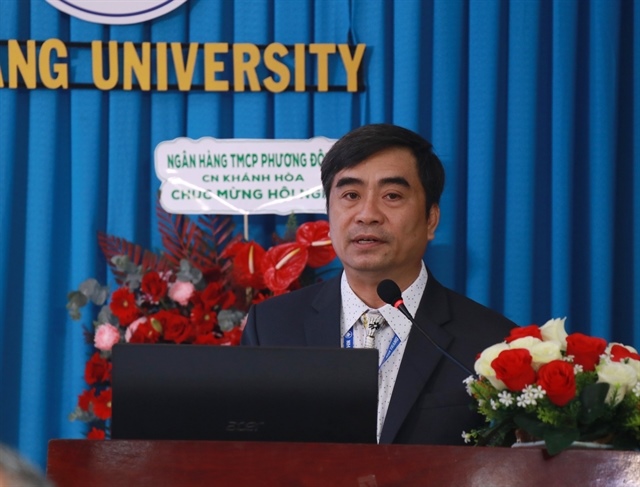
Delegates attend the national scientific conference on green finance, ESG and sustainable development held in Khánh Hòa Province on July 3. — VNA/VNS Photo |
Building fiscal resilience
Associate Professor Dr Nguyễn Hồng Thắng from the School of Economics, Law and State Management stressed that fiscal resilience should not be measured solely by foreign exchange reserves or low public debt.
Instead, he argued, a country's resilience also depends on its ability to maintain public spending that protects vulnerable groups during periods of macroeconomic shocks.
He proposed several policy solutions to strengthen fiscal resilience, including establishing a counter-cyclical social security reserve fund, shifting towards results-based budgeting, adopting adaptive fiscal rules, digitalising social welfare systems and promoting public-private-social partnerships.
Green transition
Presenting a paper entitled Green Transition: Perspectives from Finance and Public Governance, Dr Đoàn Vũ Nguyên said research on the topic had expanded rapidly over the past five years because green transition extends far beyond environmental protection.
"It is fundamentally about fiscal capacity, public investment and the quality of public governance," he said.
Nguyên described Việt Nam as a country that has acted in a timely, determined and prudent manner in implementing its green transition strategy.
He identified green finance and public governance as the two pillars underpinning the country's transition to a green economy.
On the financial side, he highlighted the importance of effectively applying fiscal instruments such as carbon taxes and environmental taxes while mobilising funding from international environmental agreements and climate finance mechanisms to support green investment.
Regarding public governance, he emphasised the need to build coherent and practical institutions and policy frameworks capable of supporting long-term green development.
He also noted that green transition policies should not follow a one-size-fits-all approach. Instead, the Government should consider allocating resources and fiscal support according to the socio-economic characteristics of each locality.
"Green transition is a long-term journey that requires persistence and gradual progress through clearly defined milestones," he said.
In addition to presentations delivered at the conference, 109 peer-reviewed research papers were published in the conference proceedings, providing further scientific evidence to support policymaking, corporate governance and sustainable economic development in Việt Nam.
- 17:08 03/07/2026