Expanding credit and livelihoods
Expanding credit and livelihoods
As the labour market continues to recover, policy credit is helping poor and vulnerable workers improve their livelihoods while supporting small businesses to expand and create jobs.
The labour market is gradually recovering in tandem with economic growth, yet millions of people remain underemployed or unable to fully utilise their working capacity.
In this context, expanding credit for job creation not only provides an additional source of capital for workers and production and business units, but also opens up opportunities for small livelihoods to grow into more stable production activities.
In the first six months of 2026, the labour market continued to show positive signs. The labour force aged 15 and above reached 53.7 million, up 690,700 from the same period last year.
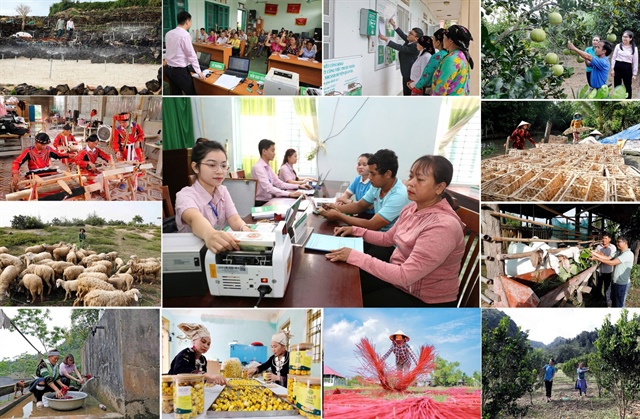
Photo: VBSP |
The number of employed people reached 52.6 million, up 672,500. Average monthly income stood at $360, an increase of $28.68 from the same period last year. The unemployment rate among the working-age population remained at 2.22 per cent.
Behind these positive figures, however, remains a significant gap in employment and livelihoods. Nearly 2.2 million people were classified as underutilised labour during the period.
More than four million people were engaged in work producing goods and services primarily for their own consumption, 89.6 per cent of them in rural areas. Informal employment continued to account for 61.9 per cent of total employment, rising to as high as 71.1 per cent in rural areas.
These figures indicate that the employment challenge is not simply a matter of the unemployment rate. For many households, particularly in rural areas, a lack of capital to expand their activities remains a barrier.
The income gap also points to this reality. In the first six months of the year, average monthly income among urban workers was $424, while that of rural workers was $316.
As a result, job creation is increasingly linked to another question: how can people who are able to work be given better conditions to create jobs for themselves, expand their livelihoods or join production establishments capable of generating additional employment?
This is a gap that policy credit can help address, particularly through lending policies that support job creation, job retention and expansion, targeting both workers with production and business plans and production and business units in need of capital for development.
Expanding capital flows for job creation
Under Government's Decree No.338/2025/ND-CP dated December 25, 2025, the lending programme supporting job creation, job retention and expansion has two main groups of borrowers: workers and production and business establishments, including small and medium-sized enterprises, cooperatives, cooperative unions, cooperative groups and household businesses.
Loan limits have also been raised. Workers may borrow up to $8,000, while production and business units may borrow up to $400,000, with a limit of no more than $8,000 for each worker whose employment is supported, retained or expanded. The maximum loan term is 10 years.
What notable is the way the funding is tied to employment objectives. To obtain loans from the Vietnam Bank for Social Policies system, the labourers must have a plan for using the funds to create, retain or expand employment.
For production and business establishments, the capital-use plan must also be feasible and meet regulatory requirements. Ultimately, the effectiveness of the policy is measured by its ability to generate income and employment.
The current interest rate under the programme is 7.92 per cent, per year. Some groups are eligible for a similar interest rate applied to poor households, currently 6.24 per cent, per year.
These include workers from ethnic minority groups belonging to poor households, poor households in areas facing extremely difficult socioeconomic conditions, people with disabilities, and people who directly care for people with particularly severe disabilities.
Preferential treatment is also available to production and business establishments where at least 30 per cent of their total workforce belongs to certain groups, including people with disabilities, ethnic minority people, people who have completed their prison sentences, and those who have completed decisions placing them in compulsory education or compulsory drug rehabilitation establishments.
This is a noteworthy approach: capital is prioritised for people seeking to create employment for themselves and establishments capable of creating jobs for others, while better conditions are provided to groups that face greater difficulties in entering the labour market.
In a growing economy, employment would be generated across a range of sectors: enterprises, cooperatives, household businesses and individual family livelihood models.
Many jobs are created from small loans just large enough to purchase additional machinery, procure more raw materials, expand production or keep a business activity running.
The value of job-creation credit therefore lies in its ability to direct capital to the right places - where there is demand for funding and the capacity to turn capital into economic activity.
As the labour market gains more jobs but the number of workers whose potential remains underutilised is still significant, expanding the capital flow would take on an additional meaning: creating conditions for more people not merely to have a job, but to have an opportunity to build a better livelihood from the work they do.
- 09:48 20/08/2026