Resolution 10 sets new course for high-quality FDI
Resolution 10 sets new course for high-quality FDI
Việt Nam is shifting its focus from attracting more FDI to securing higher-quality investment that drives innovation, technology transfer and sustainable growth.
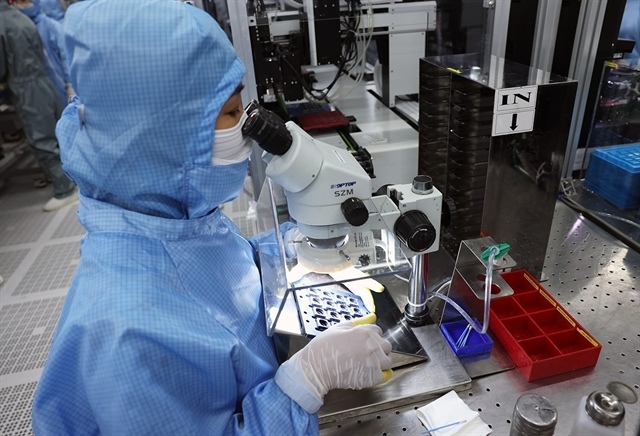
A worker at MCNEX VINA Co., Ltd., a South Korean-invested manufacturer, inspects electronic components at Phuc Son Industrial Park in Ninh Binh Province. — VNA/VNS Photo |
After nearly four decades of opening its economy to foreign investment, Việt Nam is entering a new phase in its FDI strategy, placing greater emphasis on quality over quantity by prioritising investment that brings advanced technology, innovation and stronger connections with domestic enterprises.
Policymakers and international investors spoke about the strategy when they gathered on June 30 at a conference to discuss the implementation of Resolution 10 issued on June 8 by the Communist Party of Việt Nam on economic development with FDI.
The new resolution marks a significant shift in development thinking. Rather than competing primarily through tax incentives or low labour costs, Việt Nam aims to attract projects that generate greater added value, strengthen technological capabilities and contribute to sustainable long-term growth.
This approach was a central theme at the national conference on studying, disseminating and implementing Resolution 10, where government leaders, international investors and representatives of major foreign-invested enterprises shared their views on how the policy could reshape Việt Nam's investment landscape.
A new direction
Addressing the conference, Party General Secretary and State President Tô Lâm said Việt Nam had entered "a new stage of development", where the country should no longer ask simply how to attract more foreign capital, but how to use international investment more effectively to strengthen domestic capabilities, technological competitiveness and economic resilience.
He stressed that Việt Nam would not compete for investment by lowering standards or sacrificing the environment, natural resources, social welfare or economic security. Instead, the country's competitiveness would increasingly depend on institutional quality, modern infrastructure, skilled workers, efficient public services and a transparent, predictable business environment.
The top leader also reaffirmed the foreign-invested sector role as an integral part of the national economy, and that investors with advanced technology, strong governance and long-term commitments would continue to receive favourable conditions to expand their operations in Việt Nam.
This message comes as the foreign-invested sector continues to play a vital role in the country's economy, after it was opened to international investment nearly four decades ago.
According to the Ministry of Finance, the FDI sector currently contributes around 20 per cent of GDP, accounts for more than 70 per cent of export turnover and generates approximately half of Việt Nam's industrial production, while creating millions of jobs.
The latest figures also underline the sector's resilience despite continuing global economic uncertainty.
During the first five months of this year, newly registered, adjusted and capital contribution transactions reached US$24.81 billion, up 34.9 per cent compared with the same period last year. Meanwhile, disbursed FDI climbed 9.6 per cent to $9.75 billion, the highest level recorded during the first five months of any year over the past five years.
Manufacturing remained the largest recipient of foreign investment, attracting $14.52 billion, or more than 70 per cent of total newly registered and adjusted capital, reaffirming Việt Nam's position as an increasingly important manufacturing and supply chain hub.
For policymakers, however, the significance of these figures extends beyond their size.
Strong disbursement, despite persistent global headwinds, reflects growing confidence among international investors in Việt Nam's economic outlook and its ability to deliver investment commitments.
Raising the bar
Resolution 10 seeks to build on that confidence by raising expectations for future investment.
Rather than prioritising labour-intensive projects, the resolution identifies high technology, semiconductors, artificial intelligence, research and development, international financial services, clean energy and other innovation-driven industries as priority sectors capable of generating stronger technology spillovers and closer collaboration with domestic enterprises.
Phan Hữu Thắng, former director of the Foreign Investment Agency, described the resolution as marking a transition from a mindset of attracting as much investment as possible to improving the quality of investment inflows.
As the global minimum tax reduces the effectiveness of traditional tax incentives, he said, Việt Nam's future competitiveness would increasingly depend on institutional reform, administrative efficiency and the economy's capacity to absorb advanced technologies.
One of the conference's most notable features was the participation of foreign investors, underscoring the Government's intention to strengthen dialogue with the international business community while translating the resolution into concrete policies.
Takuya Sahashi, vice president of Mitsubishi Corporation in Việt Nam, welcomed the resolution's clear policy orientation towards attracting high-quality investment while promoting stronger links between foreign-invested enterprises and domestic businesses.
He said Japanese companies had contributed to Việt Nam's industrialisation for more than three decades through investment in transport equipment, electronics and industrial machinery, while supporting technology transfer, workforce development and supplier localisation.
Sahashi said the country's future growth should not rely solely on attracting foreign capital, but also on enabling Vietnamese enterprises to participate more deeply in global value chains.
Through that process, advanced technologies, modern management methods and international production standards would gradually spread throughout the domestic business sector, strengthening the country's industrial foundation.
He nevertheless identified several challenges that need to be addressed, including improving the capabilities of domestic suppliers, developing upstream industries such as materials and key components, simplifying support policies for small- and medium-sized enterprises and strengthening vocational education.
Building partnerships
Rather than providing broad support, policies should focus on identifying Vietnamese companies with strong growth potential and helping them become internationally competitive suppliers, he said.
Stronger cooperation between FDI enterprises and local companies would increase productivity, create greater domestic added value and build a more resilient industrial structure, while enhancing the global competitiveness of businesses operating in Việt Nam.
"We remain committed to supporting Việt Nam through investment, technology transfer and workforce development," Sahashi said, adding that Japanese companies looked forward to working closely with the Government to realise the vision outlined in Resolution 10.
Representatives of international investment funds also argued that maintaining Việt Nam's attractiveness would increasingly depend on institutional reforms rather than financial incentives.
Dominic Scriven, chairman of Dragon Capital, described the resolution as an important milestone for the international investment community, because it clearly recognises the foreign-invested sector as an inseparable component of the national economy and reaffirms the principle of equal treatment among economic sectors.
He also welcomed the resolution's emphasis on attracting investment that delivers advanced technology, international governance standards and sustainable development, instead of focusing solely on capital volume.
To strengthen Việt Nam's capital markets, Scriven proposed measures to lower financing costs for businesses, encourage foreign companies to retain more earnings in Việt Nam, accelerate the country's stock market upgrade to emerging market status, improve foreign exchange mechanisms and review foreign ownership limits in sectors that do not affect national security.
A worker at MCNEX VINA Co., Ltd., a South Korean-invested manufacturer, inspects electronic components at Phuc Son Industrial Park in Ninh Binh Province. — VNA/VNS Photo |
He also called for further development of international financial centres in HCM City and Đà Nẵng and for greater support for institutional investors to deepen domestic capital markets.
From capital to capability
VinaCapital chief economist Michael Kokalari echoed these views, saying Việt Nam remained one of Asia's most attractive investment destinations but needed to continue improving infrastructure, administrative procedures and the business environment to maintain its long-term competitiveness.
He said large-scale infrastructure projects would provide the foundation for sustained growth, while creating opportunities to mobilise long-term international capital.
Drawing on VinaCapital's relationships with global investors in financial centres including London, New York and Singapore, Kokalari said international funds were closely monitoring Việt Nam's reforms.
He recommended accelerating efforts to achieve emerging market status under MSCI after recent progress with FTSE Russell, obtaining investment-grade sovereign credit ratings, expanding equitisation and initial public offerings, establishing central counterparty clearing mechanisms and improving transparency and corporate governance.
According to Kokalari, many international investment funds managing hundreds of billions of dollars stand ready to increase allocations once these reforms are completed.
The recommendations from investors closely mirror the broader direction of Resolution 10, which sees FDI not as a standalone source of capital, but as part of a modern financial and investment ecosystem that includes capital markets, international financial centres and stronger domestic enterprises.
The resolution also sets ambitious long-term goals. By 2030, Việt Nam aims to develop 10,000 domestic companies capable of joining supply chains led by foreign-invested enterprises, while by 2045 the FDI sector is expected to contribute around 30 per cent of GDP through closer integration with State-owned and private businesses.
Those targets reflect a broader transformation in Việt Nam's development model.
Rather than competing primarily through incentives or low production costs, the country is positioning itself as a destination for strategic, innovation-driven investment capable of strengthening domestic capabilities and creating sustainable long-term growth.
Ultimately, the success of Resolution 10 will be measured not simply by the volume of foreign capital attracted, but by how effectively that investment strengthens Vietnamese enterprises, accelerates technological innovation and builds a more resilient economy for the decades ahead.
- 07:28 04/07/2026