Identifying advantages to realise FDI attraction targets: experts
Identifying advantages to realise FDI attraction targets: experts
The positive FDI performance in the first half of 2026 provides a favourable foundation for Việt Nam to realise Resolution No. 10-NQ/TW’s goals. However, to maintain advantages and improve the quality of capital inflows, Vietnam needs not only to improve the investment environment but also develop infrastructure, strengthen domestic enterprises, expand capital markets and promote substantive links between the FDI and domestic sectors.
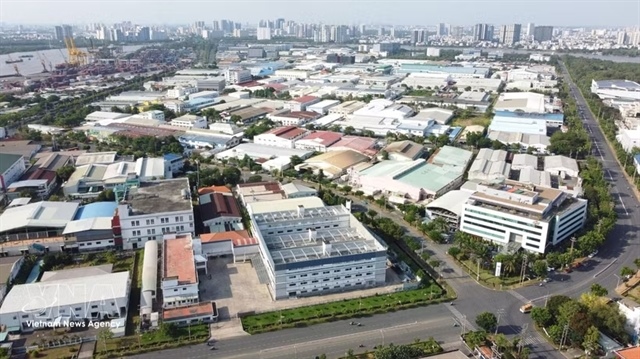
A view of Tân Thuận Export Processing Zone in HCM City. VNA/VNS Photo |
Despite Việt Nam’s favourable conditions in attracting foreign direct investment (FDI), experts held that achieving long-term goals in the field requires identifying advantages, removing bottlenecks and improving links between the FDI sector and domestic enterprises.
The Politburo’s Resolution No 10-NQ/TW on the development of the foreign-invested economic sector aims for Việt Nam to attract around US$200-300 billion in FDI during 2026-2030, equivalent to $40-50 billion annually, with realised FDI reaching $150-200 billion, or $30-40 billion per year.
According to the Foreign Investment Agency under the Ministry of Finance, Việt Nam has so far attracted around $550 billion in FDI from 46,000 projects. The FDI sector continues to contribute significantly to economic growth, industrialisation, modernisation, exports, job creation, improved governance capacity and Việt Nam’s global economic position.
In the first six months of 2026, total registered foreign investment, including newly registered capital, adjusted capital and foreign investors’ capital contributions or share purchases, reached $34.65 billion, up 61 per cent year-on-year. Realised FDI was estimated at $13.03 billion, rising 11.2 per cent year-on-year, marking the highest first-half figure in five years.
The results suggest that Việt Nam’s 2026 FDI attraction target is achievable if the current momentum continues. The country remains an attractive destination thanks to its favourable location, abundant labour force and improving investment and business environment.
However, greater challenges lie ahead as competition for international investment intensifies amid uncertainties affecting global growth, inflation and capital flows.
Under the resolution, 75 per cent of foreign investment is expected to come from developed economies with strong technology, capital and modern management capabilities. The number of multinational corporations on the Fortune 500 list investing in Việt Nam is also projected to rise by 30 per cent.
The resolution also aims to attract multinational corporations to establish research, design and innovation centres, data centres, regional headquarters, operating centres, treasury centres, shopping centres and shared service centres in Việt Nam, including at least three leading global technology groups setting up headquarters, offices or R&D centres.
Việt Nam also seeks to attract foreign enterprises, including small and medium-sized firms, with core and specialised technologies, capable of deeper participation in global value chains.
Another important target is to raise average localisation rates in key industries to 45-50 per cent and have around 10,000 domestic enterprises joining the value chains and supply chains of FDI firms, including 500-1,000 tier-1 suppliers.
By 2045, the foreign-invested economic sector is expected to develop effectively and sustainably, closely connected with the state and private sectors, helping Việt Nam become a competitive Asian hub for production, services, innovation and regional operations, with deeper involvement in global value chains.
To achieve these goals, Takuya Sahashi, Vice President of Mitsubishi Corporation Việt Nam Co., Ltd, said Việt Nam needs to address challenges including improving the technical capacity and quality of domestic suppliers. He pointed out that upstream industries such as key materials and components remain underdeveloped, resulting in continued import dependence.
Although support policies for small and medium-sized enterprises have been introduced, many firms still find it hard to access them due to complicated procedures or mismatches with practical needs. Sahashi stressed the need for targeted support for high-potential domestic enterprises rather than focusing only on quantity.
Việt Nam should identify capable local firms and provide suitable support, while strengthening business connections, improving information access and developing mechanisms to identify and promote domestic suppliers.
Expanding supplier databases, organising exhibitions and developing business-matching platforms through cooperation between the Government and business organisations would help strengthen links between FDI and domestic firms. Vocational training, closer cooperation between schools and enterprises, and improved practical skills are also necessary to enhance technology transfer and absorption capacity.
From the perspective of capital markets, Dominic Scriven, Chairman of Dragon Capital, said Resolution No 10 focuses not only on attracting investment by capital scale but also on improving capital quality. The resolution emphasises that FDI attraction must not compromise Việt Nam’s environment, natural resources or social security.
Scriven said that besides capital volume, another challenge for rapid growth is businesses’ cost of capital. He suggested that the Government consider mechanisms encouraging FDI enterprises to retain profits in Việt Nam instead of transferring them abroad.
A possible solution is to develop suitable interest rate mechanisms for USD deposits held by foreign-invested enterprises at Việt Namese banks, helping provide a stable foreign currency source for the economy.
Michael Kokalari, Chief Economist at VinaCapital, said Việt Nam has become an attractive destination for international investors. However, maintaining effective FDI attraction requires continued investment in large-scale infrastructure, a key foundation for long-term growth.
He also called for stronger efforts to accelerate State-owned enterprise equitisation, initial public offerings and other capital mobilisation channels to expand and improve the quality of the capital market, thereby attracting more international investors.
The positive FDI performance in the first half of 2026 provides a favourable foundation for Việt Nam to realise Resolution No 10-NQ/TW’s goals. However, to maintain advantages and improve the quality of capital inflows, Việt Nam needs not only to improve the investment environment but also develop infrastructure, strengthen domestic enterprises, expand capital markets and promote substantive links between the FDI and domestic sectors.
- 06:00 20/07/2026