Green solutions create room for sustainable growth in paper industry
Green solutions create room for sustainable growth in paper industry
The paper and pulp industry in Việt Nam has enjoyed strong growth over the past decade, with annual expansion remaining in double digits.
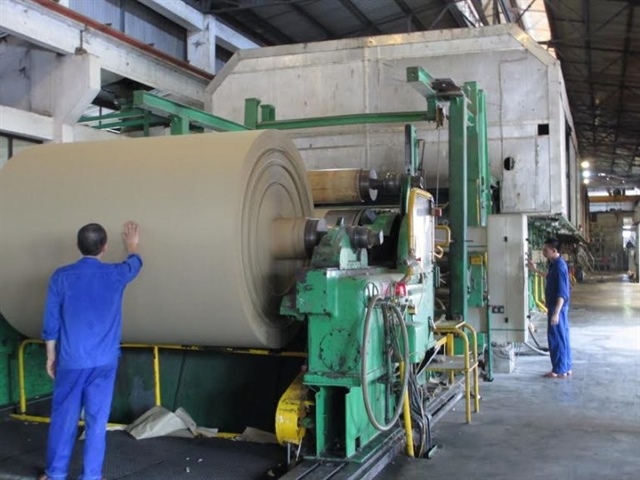
A paper mill. — Photo vppa.vn |
The circular economy is emerging as an inevitable pathway for the paper industry, helping improve resource efficiency, reduce environmental pressures and create new momentum for sustainable growth.
The paper and pulp industry plays an indispensable role in the global economy, serving demand for packaging, printing and a wide range of everyday consumer products.
The industry in Việt Nam has enjoyed strong growth over the past decade, with annual expansion remaining in the double digits. Total paper output is estimated to reach 6.34 million tonnes last year.
Việt Nam's paper and paperboard production capacity is projected to increase to around 10.9 million tonnes by 2030.
The paper packaging segment is also forecast to reach a market value of US$3.5 billion by this year, driven by the shift away from plastic packaging and the rapid expansion of e-commerce.
Transitioning towards greener production
However, amid growing demands for sustainable development and environmental protection, the industry faces mounting challenges related to raw material use, energy consumption and emissions control.
Manufacturers are under growing pressure to reduce their reliance on virgin pulp and adopt more resource-efficient production practices. At the same time, they are expected to minimise the use of hazardous chemicals, lower carbon emissions and optimise costs to improve operational efficiency.
Against this backdrop, green growth and circular economy practices are becoming essential for the industry.
As one of the sectors that consumes large volumes of raw materials, water and energy, the paper industry has considerable potential to adopt circular economy models through expanded paper collection and recycling, greater utilisation of by-products and more efficient resource management.
The transition not only helps ease pressure on forest resources, reduce waste generation and lower greenhouse gas emissions, but also enables businesses to cut production costs, improve material efficiency and strengthen competitiveness.
With export markets increasingly imposing stricter sustainability and carbon-reduction requirements, the promotion of circular economy practices is viewed as a critical solution for the paper industry to pursue greener development and integrate more deeply into global supply chains.
Speaking to Công Thương (Industry and Trade) newspaper, Cao Văn Sơn, director of the Research Institute of Pulp and Paper Industry (RIPPI) under the Ministry of Industry and Trade, said circular economy development played a vital role in the paper industry by reducing the exploitation of natural resources, protecting the environment and improving production efficiency.
Through paper recycling, the industry could save wood, water and energy while reducing solid waste and pollutant emissions. He noted that the circular economy also encouraged businesses to adopt cleaner technologies, extend product lifecycles and optimise material use, thereby lowering production costs and improving competitiveness.
The model would help balance economic growth with environmental protection while responding to growing consumer demand for green products and greater environmental responsibility from manufacturers, said Sơn.
"Circular economy development is an inevitable solution for the paper industry to achieve green and sustainable growth goals," he said.
Technology innovation drives transition
Industry experts say that achieving sustainable development goals will require paper manufacturers to prioritise investment in modern technologies, digitalise production processes and adopt ESG management standards.
These foundations can help businesses improve operational efficiency while meeting the growing global demand for sustainability and supply-chain transparency.
The adoption of advanced technologies not only reduces consumption of water, electricity and chemicals but also optimises wastewater and solid waste treatment processes, significantly lowering long-term operating and environmental management costs.
Lê Văn Hiệp, general director of Miza Nghi Sơn LLC, told the newspaper that companies across the paper industry, including Miza, were working to green their production processes to minimise environmental impacts and improve sustainable production efficiency.
The use of recycled materials not only reduced pressure on forest resources but also lowered waste generation and supported the creation of a more sustainable circular production model.
Modern technologies had helped the company reduce electricity consumption by around 10 per cent compared with conventional production methods, said Hiệp.
The technologies also allowed greater flexibility in sourcing raw materials, he said.
At Miza's facilities, highly automated production systems are designed to minimise waste. Up to 95 per cent of solid waste generated during paper recycling is reused, while approximately 50 per cent of treated wastewater is recycled back into production.
Demand for technological innovation remained substantial as technology was the key to producing high-quality products, improving competitiveness, enhancing operational efficiency and securing a stronger position in global value chains, said Hiệp.
However, investing in and deploying advanced technologies required significant capital and supporting infrastructure, creating challenges for many businesses, particularly small- and medium-sized enterprises, he said.
Industry stakeholders therefore hoped that support policies and incentive mechanisms would be implemented more effectively to facilitate technology upgrades, he added.
- 10:10 16/07/2026