Chinese investment wave opens new doors
Chinese investment wave opens new doors
As Chinese companies move beyond factory relocation to ecosystem-driven investment, Vietnam has a rare opportunity to evolve from a low-cost production base into a strategic node in regional value chains.
When global companies first diversified supply chains, the focus was largely on relocating manufacturing capacity. That shift was highlighted during discussions at the China International Supply Chain Expo in Beijing at the end of June, drawing on findings from ACCA China’s CFO Leadership in Globalisation report, released the previous month.
The survey found that 57 per cent of Chinese chief financial officers (CFOs) identify Southeast Asia as the region offering the greatest growth opportunities over the next three years, ahead of Africa with 36 per cent and the Middle East with 30 per cent.
“Although traditional export models still dominate, accounting for 46 per cent of respondents, there is a clear strategic shift towards higher-commitment models such as mergers and acquisitions now represent 27 per cent, and greenfield investment accounts for 22 per cent. This signifies that Chinese enterprises are moving beyond simple trade to establish deeper operational footprints,” stated in the report.
Sunny Shao, director of ACCA China, described international expansion as a defining strategic priority.
“Going global is the most critical strategic initiative for Chinese enterprises over the next 5-10 years. As a globally international professional organisation, the ACCA boasts an extensive worldwide network,” stated Shao. “It can serve as a super connector, facilitating effective communication, dialogue, and alignment between Chinese enterprises and overseas businesses, particularly those in Southeast Asia.”
|
According to the report, Chinese companies are no longer expanding overseas primarily in search of lower labour costs.
“Instead, investment is increasingly centred on building integrated regional value chains that combine production, technology, financing and market access. As a result, the next phase of outbound investment will be defined less by the number of factories established overseas than by the strength of the ecosystems built around them,” stated the ACCA in its report.
For Vietnam, rather than competing solely as a low-cost production destination, it has an opportunity to position itself as a platform where international investors can integrate technology, local suppliers, distribution channels and professional services.
Sam Chen, policy and insight lead at ACCA China, asserted that Vietnam is likely a key beneficiary of the inflection point, where enterprises are shifting from a cost centre to a value centre.
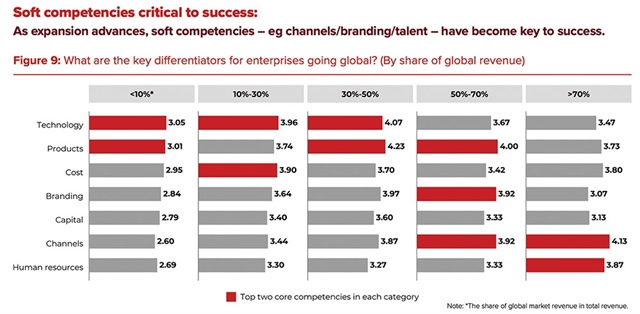
“Initially, Chinese enterprises prioritise technology and products, which they often bring themselves. However, the report clearly states that in the mid-to-long-term, success depends on soft power, specifically channels, branding, and human resources. This is precisely where Vietnamese partners can add the most value,” Chen told VIR.
“By providing deep local market knowledge, distribution networks, and a skilled workforce, Vietnamese entities become indispensable collaborators rather than just subcontractors. Furthermore, Vietnam can assist with the non-financial risk identification by providing crucial support in local compliance, regulatory interpretation, and legal navigation,” Chen added.
To capture this opportunity, Chen said Vietnam must address three key challenges. “As regulatory compliance ranks as top concern for CFOs expanding overseas, Vietnam must ensure a transparent and stable legal framework to reduce the perceived high-risk environment,” he said. “The second priority is talent development. Vietnam needs to focus on developing a workforce capable of handling not just manufacturing, but also financial compliance, data analytics, and cross-cultural communication.”
Chen noted that manufacturing may remain the initial entry point, but sustaining growth will require much broader capabilities.
“In the next 5-10 years, as Chinese investors bring not just factories but also technology and research and development activities as part of the chain-based investment, Vietnam will likely experience a learning curve,” said Chen. “Vietnam will inevitably need to develop soft infrastructure, including local innovation, branding, and complex service provision. By moving up this value chain, Vietnam can expect to capture a larger share of the profit pool.”
- 11:01 21/07/2026