Carbon credit push gathers pace among Vietnamese firms
Carbon credit push gathers pace among Vietnamese firms
Vietnamese businesses are accelerating efforts to develop carbon credits for international trading as the country's regulatory framework for cross-border transactions continues to take shape.
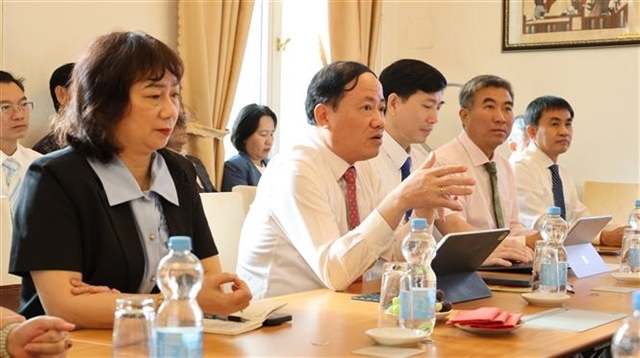
At a workshop on promoting international carbon credit exchange in Hanoi on July 23, businesses said they were ready to develop carbon credit projects targeting international markets. The event was organised by the Department of Climate Change, the Southeast Asia Energy Transition Partnership, the United Nations Office for Project Services, and the Vietnam Association of Economic Sciences.
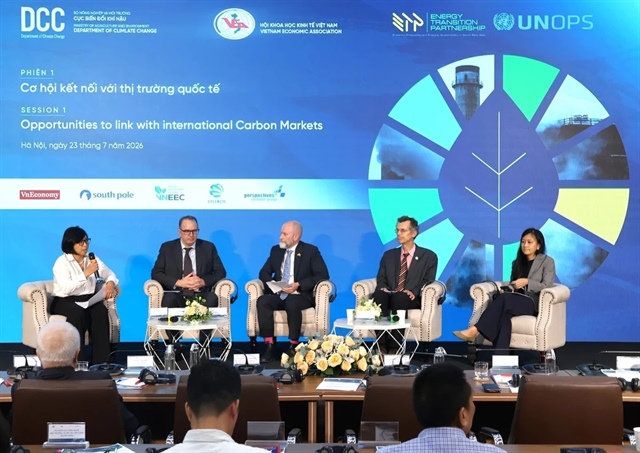
Photo: Trung Nguyen |
Tran Ky Anh, Carbon Credit Trading manager at Vingroup, said the conglomerate had established its data infrastructure from the earliest stages of project development to support its participation in the carbon market.
“Vingroup has already built the measurement platform required for 4.5 million carbon credits from electric vehicles and charging stations, while Green Carbon Japan is awaiting approval to export carbon credits to Japan and Singapore,” he said.
Each V-Green charging station is equipped with a smart electricity meter connected to a centralised management platform, allowing charging data to be collected, stored and updated in real time. The data can be traced and verified, providing the basis for calculating emissions reductions and supporting the measurement, reporting and verification process under international carbon credit standards.
Vingroup’s electric mobility ecosystem provides the company with significant scale advantages. At its core is VinFast, supported by V-Green charging stations, Green SM ride-hailing services, and VinBus electric buses. The group has also expanded into renewable energy and high-speed rail infrastructure.
“These sectors provide a strong foundation for Vingroup to participate effectively in both domestic and international carbon markets,” Ky Anh said.
The group is currently developing two carbon credit projects. One is expected to generate one million carbon credits from the conversion of petrol-powered motorcycles to electric vehicles during 2025–2029. Meanwhile, its charging station network could generate emissions reductions equivalent to approximately 3.5 million tonnes of CO2 annually. Both projects are being developed under internationally recognised standards, including Verra and Gold Standard.
Alongside projects developed in-house, other Vietnamese companies are partnering with international organisations to generate carbon credits.
Phan Tien Thanh, business development manager at Green Carbon Japan Vietnam Co., Ltd., said the company is implementing a low-emission rice cultivation project using alternate wetting and drying techniques across around 80,000 hectares in 15 provinces, with an estimated 500,000 carbon credits expected to be generated this year.
“These carbon credits are awaiting approval from the relevant authorities before being exported to markets such as Japan, Singapore and South Korea, with Switzerland expected to follow. We expect prices to range between $15 and $30 per credit, depending on the market,” Thanh said.
Under Decree No.112/2025/ND-CP, businesses are permitted to transfer carbon credits overseas through three mechanisms: bilateral agreements between governments, mechanisms established under the United Nations Framework Convention on Climate Change, or independent standards such as Verra and Gold Standard.
The decree also sets limits on the proportion of carbon credits that may be transferred abroad to ensure a balance between domestic emissions' reduction targets and international trading opportunities. Projects involving electric vehicles, charging stations and low-emission rice cultivation are permitted to transfer up to 90 per cent of the credits generated, while forestry projects are subject to a 50 per cent cap.
Nguyen Tien Hai, technical director at Vietnam Energy and Environment Consultancy, said the transfer cap had disappointed some forestry project developers, although the remaining credits could still be traded on Vietnam’s domestic carbon exchange once it becomes operational.
According to Hai, allowing regulated emitters to use carbon credits to offset up to 30 per cent of their emissions quotas will create substantial domestic demand and provide a strong incentive for businesses to invest in carbon credit projects.
“This will be a major driver for project developers, as they will have opportunities to sell carbon credits in both domestic and international markets,” he said.
According to Nguyen Tuan Quang, deputy director general of the Department of Climate Change under the Ministry of Agriculture and Environment, an increasing number of Vietnamese companies in export-oriented industries, energy, agriculture and forestry have begun developing carbon credit projects, while many localities are also exploring opportunities to monetise their emissions' reduction potential.
“Participating in the carbon market will help Vietnam fulfil its emissions' reduction commitments and create new revenue streams and strengthen the competitiveness of businesses as the economy transitions towards low-carbon development,” Quang said.
- 13:20 24/07/2026